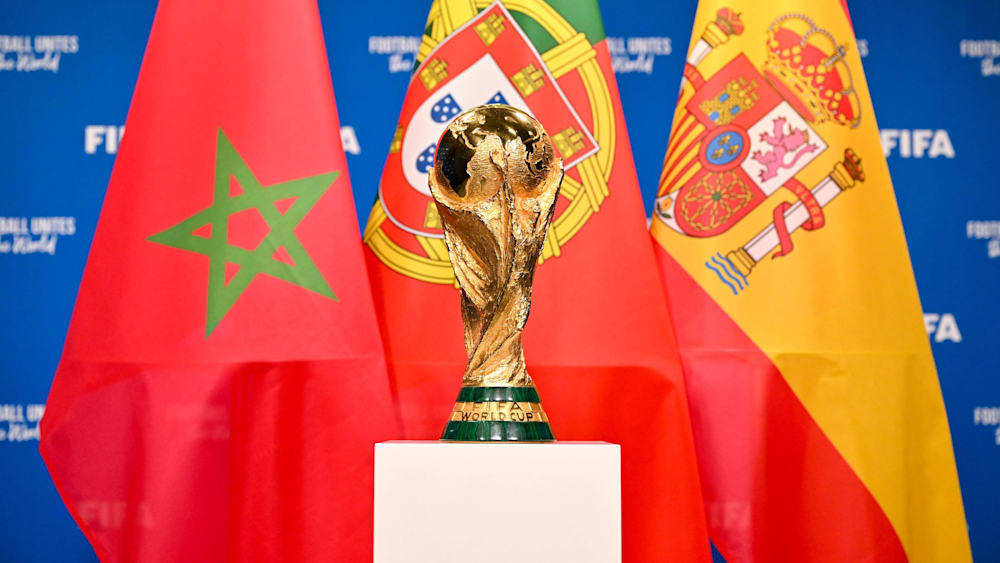
The biggest World Cup in history is over—but the next one won’t be any smaller. What’s new? Where and when will the games be played? The most important information about the 2030 World Cup.
Even before the opening match, Gianni Infantino called the 2026 World Cup the “biggest and best ever.” If only he hadn’t been mistaken! In four years, FIFA’s most important tournament will be even more extensive—if only in terms of duration. So, what do we already know about the 2030 World Cup? Here’s an overview.
HOST COUNTRIES: Three official—and three additional
The 2030 World Cup will be the first to be held on three different continents. While the three hosts—Spain, Portugal, and Morocco—are “only” spread across two continents, FIFA is having three of the 104 World Cup matches played in South America to mark the 100th anniversary of the first World Cup, which took place in Uruguay in 1930.
Specifically, Uruguay, Argentina, and Paraguay will each host one match. FIFA is highlighting Argentina as a 1930 World Cup finalist and Paraguay as the home of the South American soccer confederation CONMEBOL. In effect, six countries will host the next World Cup tournament.
This also had the advantage for FIFA that, in accordance with the host rotation, only countries from the Asian and Oceanian confederations were eligible to host the 2034 World Cup—which is what allowed Saudi Arabia to enter the race in the first place and ultimately be selected.
SCHEDULE: Three matches well before the opening match
The novelty of a World Cup spanning three continents has far-reaching consequences. The plan: Before the official opening match takes place on June 13 or 14, 2030, in Spain, Portugal, or Morocco, the first three World Cup matches will already be played in South America on June 8 and 9. The action kicks off at the 1930 World Cup final stadium, the Centenario in Uruguay’s capital, Montevideo, with a grand celebration marking 100 years of the World Cup and Uruguay’s first World Cup match.
To ensure that Uruguay, Argentina, and Paraguay—as well as their opening opponents—have sufficient time to travel to Europe or North Africa, the six teams will not play their second group stage match until nearly two weeks later. In total, FIFA plans to allow the six nations “about eleven to twelve days” for travel and rest.
The World Cup final will take place on Sunday, July 21, 2030. This means the tournament will span about six weeks—one week longer than in 2026.
2030 World Cup: An overview of the most important dates already known:
June 8–9, 2030: Opening matches for Uruguay, Argentina, and Paraguay
June 13–14, 2030: World Cup opening ceremony and World Cup opening match(es)
June 15–16, 2030: First matches for the group opponents of Uruguay, Argentina, and Paraguay
June 21–22, 2030: Second group matches for Uruguay, Argentina, and Paraguay
July 21, 2030: World Cup Final
VENUES: Spain clearly dominates
As things stand, the World Cup matches taking place in Spain, Portugal, and Morocco in 2030 will be spread across 20 stadiums: eleven in Spain, six in Morocco, and three in Portugal. In addition, there are three stadiums in Uruguay, Argentina, and Paraguay. FIFA has not yet officially confirmed the host venues.
Spain: Camp Nou (Barcelona), RCDE Stadium (Barcelona), San Mamés (Bilbao), Estadio de Gran Canaria (Las Palmas), Bernabéu (Madrid), Estadio Metropolitano (Madrid), Estadio Anoeta (San Sebastián), Nueva Romareda (Zaragoza), Estadio de La Cartuja (Seville), Nou Mestalla (Valencia), Estadio Balaídos (Vigo)
Morocco: Stade Adrar (Morocco), Stade Hassan II (Casablanca), Complexe Sportif de Fes (Fes), Stade de Marrakech (Marrakech), Stade Prince Moulay Abdallah (Rabat), Grand Stade de Tanger (Tangier)
Portugal: Estadio da Luz (Lisbon), Estadio José Alvalade XXI (Lisbon), Estadio do Dragão (Porto)
Uruguay: Estadio Centenario (Montevideo)
Argentina: Estadio Monumental (Buenos Aires)
Paraguay: Estadio Manuel Ferreira (Asunción)
PARTICIPANTS: Six Teams Already Qualified for the 2030 World Cup
FIFA has already confirmed six World Cup participants—in addition to the official hosts Spain, Portugal, and Morocco, Uruguay, Argentina, and Paraguay also won’t have to go through World Cup qualifying. The remaining 42 teams will be determined in the coming years. Or will there be even more? President Infantino continues to toy with the idea of expanding the World Cup. The debate could gain further momentum in the coming months.
FORMAT: Will anything change for the third-place teams in the groups?
If the World Cup remains at 48 teams, changes to the format are likely to be limited. Currently, the format is once again expected to consist of twelve groups of four and a knockout stage that begins with the round of 32. In 2026, the rules regarding third-place finishers were particularly controversial. Will FIFA reconsider this issue before the next World Cup?
WORLD CUP QUALIFYING: UEFA is breaking new ground
To finally experience another successful World Cup around 2030, the German national team must break new ground beforehand. UEFA has fundamentally restructured World Cup and European Championship qualifying starting in 2028. Under the new system, there will be two leagues. League 1 will consist of three groups of twelve teams each, which—similar to the current Champions League format—will play six matches against six different opponents.
Only the three group winners will qualify directly; the remaining spots will be decided through playoffs. This will also give teams from League 2—which consists of three groups of six teams each—a chance to qualify. For the 2026 World Cup, UEFA selected 16 teams. In 2030, therefore, excluding the hosts Spain and Portugal—which are to be part of the qualifying groups even without a sporting incentive—there would be 14 spots up for grabs.
The composition of the qualifying leagues is based on league affiliation in the Nations League. This virtually rules out matchups between top nations and teams like San Marino or Luxembourg.