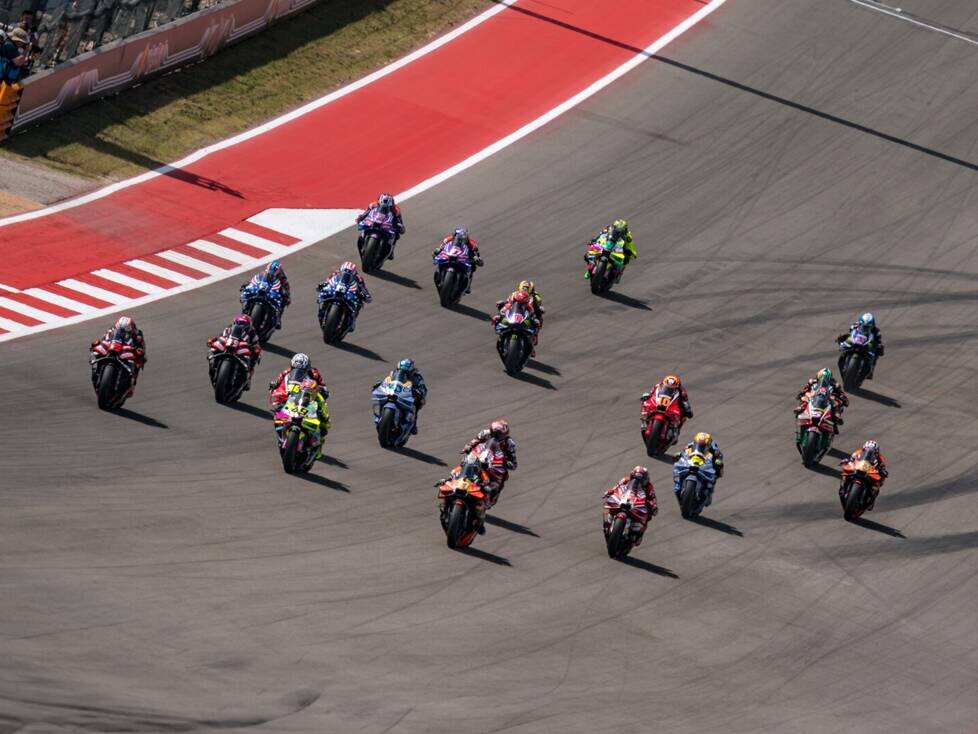
MotoGP bikes are among the fastest racing machines in the world with over 360 km/h on the straights – how fast they really are and which records apply
MotoGP is undisputedly the fastest motorcycle series in the world. The machines in the top category of the motorcycle world championship not only reach impressive top speeds, but also impress with their dynamics, precision in corners and spectacular overtaking maneuvers.
In this article, we take a look at the top speed records of the premier class, their average speeds in races and how they compare to other racing series.
Record speeds in the MotoGP
The top speed of a MotoGP bike is an incredible 366.1 km/h. This record was first set by Brad Binder in the 2023 sprint at Mugello and later repeated by Pol Espargaro in practice in 2024.
Mugello is predestined for record attempts due to its long start-finish straight and flowing track layout. Numerous other records have been set here:
– 364.8 km/h – Enea Bastianini (2023), Pedro Acosta (2024), Alex Marquez (2024) and Marco Bezzecchi (2024) and Brad Binder (2024)
– 363.6 km/h – Jorge Martin (2022), Maverick Vinales (2023), Fabio Di Giannantonio (2023), Pol Espargaro (2024), Joan Mir (2024) and Jack Miller (2024)
Other tracks with impressive top speed records are Lusail (2021 with Johann Zarco: 362.4 km/h), Austin (2023 with Maverick Vinales: 356.4 km/h), Phillip Island (2022 with Enea Bastiaini: 356.4 km/h) and Barcelona (2024 with Franco Morbidelli: 356.4 km/h). The top speeds vary greatly depending on the track layout, particularly depending on the length of the straights and the combinations of corners.
Average speeds in the race
In addition to the top speed, the average race speeds are also impressive. At the 2024 Italian Grand Prix, winner Francesco Bagnaia achieved an average speed of 177.1 km/h over 23 laps. He was similarly fast at the 2024 Qatar Grand Prix with 177.2 km/h.
At Phillip Island in 2024, Marc Marquez even achieved an average speed of 181 km/h over the entire race distance of 27 laps. In contrast, the average value on tighter tracks such as Jerez is around 161.9 km/h, which illustrates the importance of layout, number of corners and track character.
Factors that influence speed
The speed of MotoGP bikes has increased significantly since the 1960s. While it was still around 240 km/h in 1960 and around 305 km/h in 1990, it climbed to around 352 km/h in 2011 and to over 365 km/h last year.
This development is the result of technical innovations: More powerful 1000 cc engines, improved aerodynamics, anti-wheelie and traction control ensure higher top speeds. The driving technique of the drivers also has an influence, for example through optimized line selection, posture and responsiveness.
The continuous further development of tires by the official supplier Michelin as well as improved track surfaces and safety measures also contribute to this.
The comparison with other types of motorsport
A direct comparison with other series shows the dominance of MotoGP on two wheels. While IndyCar (380 km/h) and Formula 1 (378 km/h) reach slightly higher top speeds, MotoGP (366.1 km/h) is still well ahead of WSBK (339.5 km/h). NASCAR (321 km/h) and WRC (~200 km/h) rank behind them.
Safety at extreme speeds
The enormous speeds require the highest safety standards. MotoG riders wear state-of-the-art protective clothing, including airbags, helmets and special boots. The motorcycles themselves are equipped with advanced safety and sensor technologies. Race tracks must meet strict safety guidelines, from track quality and run-off areas to on-site medical care.