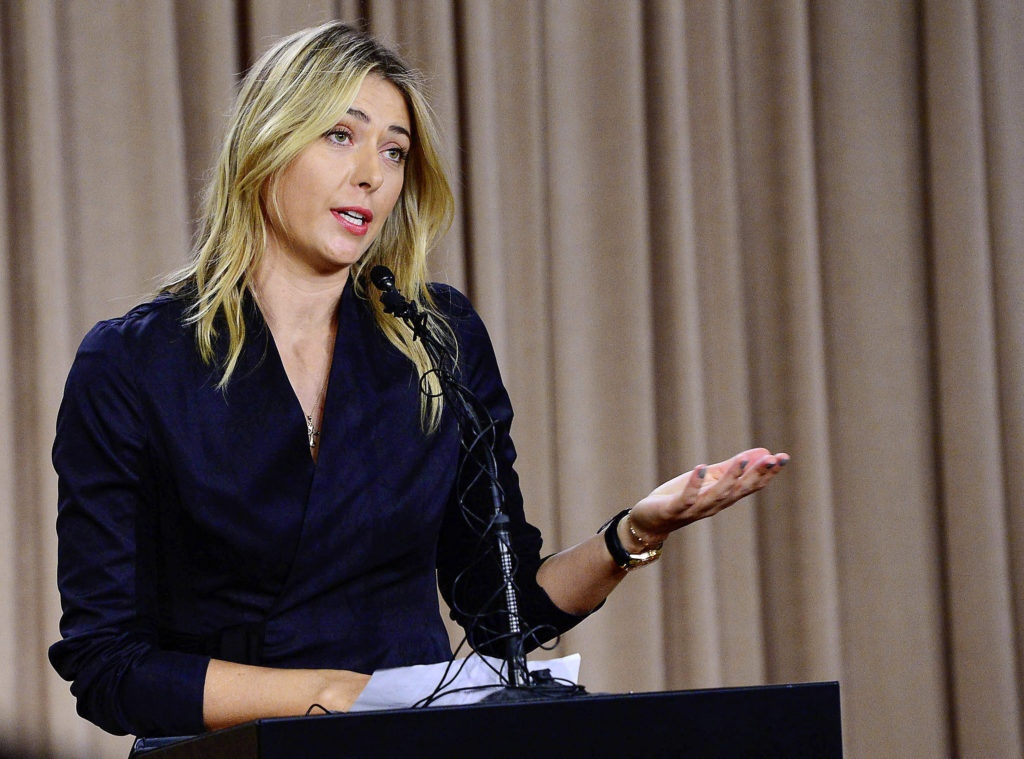
Ten years ago, tennis superstar Maria Sharapova shocked the tennis world with her doping confession, which was not without consequences.
“I know many of you thought I would retire, but if I ever announce my retirement, it probably won’t be in a hotel in downtown Los Angeles with this rather ugly carpet.”
It was March 7, 2016, when tennis superstar Maria Sharapova uttered these very words in front of countless sports reporters. The carpet on which the Russian was standing at the time was indeed anything but pretty to look at—unless you like large red ornaments on a yellow background. Just one day earlier, the athlete’s team had called a press conference and promised a “major announcement.” Reporters and tennis fans immediately began speculating whether the five-time Grand Slam winner would announce her retirement. But things turned out differently.
Doping confession shocks the tennis world
And what ultimately came out shocked the tennis world. Sharapova, one of the most successful players of her time, announced that she had failed a doping test. “I received a letter from the ITF stating that I had failed a doping test at the Australian Open. I take full responsibility for this,” Sharapova said in her statement.
At the first Grand Slam tournament of the year in January 2016, the Russian tested positive for meldonium, a drug that was only added to the World Anti-Doping Agency’s list of banned substances on January 1 of that year.
Sharapova took the drug for a long time
“Over the past ten years, my family doctor has prescribed me a drug called Mildronate. A few days ago, after receiving the letter from the ITF, I found out that it also has another name that I was not aware of, namely Meldonium.”
She continued: “It is very important that you understand that this drug was not on the WADA Prohibited List for ten years and I have been taking the drug legally for the past ten years. But on January 1, the rules changed and Meldonium became a prohibited substance, which I did not know.”
Meldonium, a blood flow-promoting drug that increases oxygen uptake and thus endurance, was prescribed to the then 28-year-old in 2006 due to “various health problems” and a history of diabetes in her family, according to her own statements.
Several athletes tested positive
Two Ukrainian biathletes, a Russian cyclist, a Russian figure skater—Sharapova was certainly not the only one to test positive for the drug at the time.
However, Sharapova was by far the most successful, wealthiest, and most professional among them.
Her explanation that she had not noticed the change to the WADA Prohibited List because she forgot to click on the link in an email appeared rather amateurish.
Sharapova was banned for 15 months
“Throughout my long career, I have been very open and honest about many things, and I take great responsibility and professionalism in my job every day, and I made a big mistake,” she said in her statement. “I have let my fans down. I have let down the sport that I have been playing since I was four years old and that I love so much.”
The Russian subsequently declared that she would accept the consequences of her offense. However, she did not want to end her career in this way. “I really hope that I will get another chance to play this game.”
The former world number one was subsequently banned for two years, but after an appeal, the ban was eventually reduced to 15 months.
Sponsors jumped ship
The doping scandal was accompanied by her sponsors jumping ship. Nike, Porsche, the Swiss watch brand Tag Heuer—no one wanted anything to do with the once-coveted Russian with model measurements—Sharapova is 6’2″ tall. In April 2017, the Russian’s suspension finally ended, but she was unable to build on her former successes in the years that followed.
In February 2020, the 38-year-old, who has been the mother of a son since July 2022, finally announced the end of her career. Not on an ugly carpet in Los Angeles, but in a column for Vanity Fair magazine.