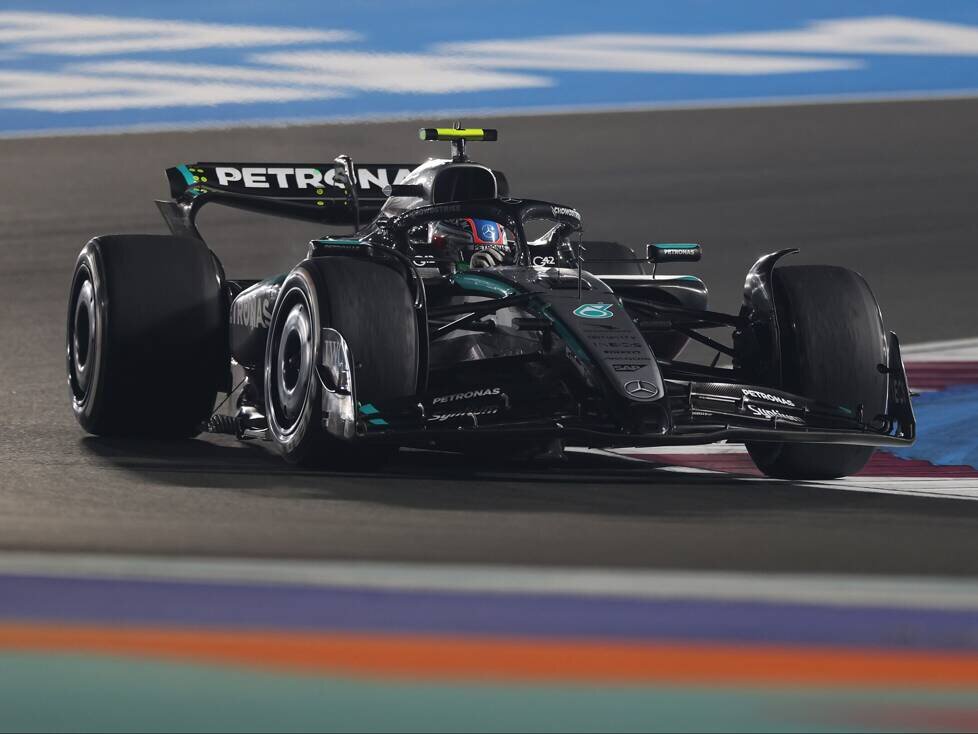
In qualifying and the sprint race, Mercedes showed that they could keep up with the leaders in Qatar – but in the race itself, there was “no chance to overtake.”
The Mercedes was actually really fast. This was evident throughout the weekend at the 2025 Qatar Grand Prix. On Friday, for example, George Russell put his Silver Arrow in second place in the sprint qualifying, just three hundredths of a second behind Oscar Piastri.
In the sprint, the Briton confidently maintained his position, finishing second again on Saturday afternoon. Despite recurring steering wheel problems, Russell was also able to keep up with the leaders in qualifying, finishing fourth, just 11 hundredths of a second behind the eventual race winner, Max Verstappen, who took third place. Kimi Antonelli also confirmed his rapidly improving form with fifth place on the grid for the race. But even after qualifying, Toto Wolff was not particularly confident. Starting on the wrong side of the grid was “not ideal” for Russell. In addition, with his experience from the sprint, he probably already had an idea of what would happen in the race.
Mercedes loses positions in pit lane traffic jam
After the sprint, the drivers were critical of the Lusail International Circuit: They said the track was hard on tires, had DRS zones that were too short, had a layout that was unfavorable for overtaking, and that the cars, with their aerodynamic characteristics, were the final negative piece of the puzzle when it came to making overtaking difficult. Lewis Hamilton even described the event as “probably the worst race” and said it must have been “pretty awful” for the spectators.
And so it came to pass at the start, just as Wolff had predicted: Russell not only lost a position to his teammate Antonelli, but also had to let Carlos Sainz and Fernando Alonso, who would later finish third, pass him in the following corners. When Nico Hülkenberg and Pierre Gasly then triggered the only safety car of the race with their collision, the entire field drove into the pits together—except for the two McLarens.
In the dense traffic in the pit lane, Mercedes then had “the misfortune” that “we had to hold the cars because of the traffic in the pit lane. You can’t prevent that, so we lost a position each,” said Wolff. The double pit stop cost Russell additional time.
Russell “one second faster” in the final stages of the race
In the traffic in Qatar, there was hardly anything possible after that, as the Mercedes boss went on to explain: “The moment you’re driving behind one or two cars, it gets worse and worse. And then there’s just no chance of overtaking.”
Later in the race, the potential of the Mercedes flashed again. Russell drove deep 1:23 times and was “a second faster” than in traffic. “But that’s normal, that’s how it is at the moment,” says Wolff, referring to the peculiarities of the ground effect era. “As soon as you get stuck in traffic, the turbulence becomes so bad that performance drops, the tires degrade, and you have no chance of recovering.”
Shortly before the end, Antonelli lost his 4th position to Lando Norris due to an individual error. At the end of the Qatar race, the Mercedes cars were in 5th and 6th place. “If you lose positions during the pit stop and make mistakes in the race, that obviously doesn’t help. If you start in clear air, you can fight at the front,” Wolff sums up the race soberly. Probably glad that, with only one race left, he can finally throw the ground effect cars in the trash.