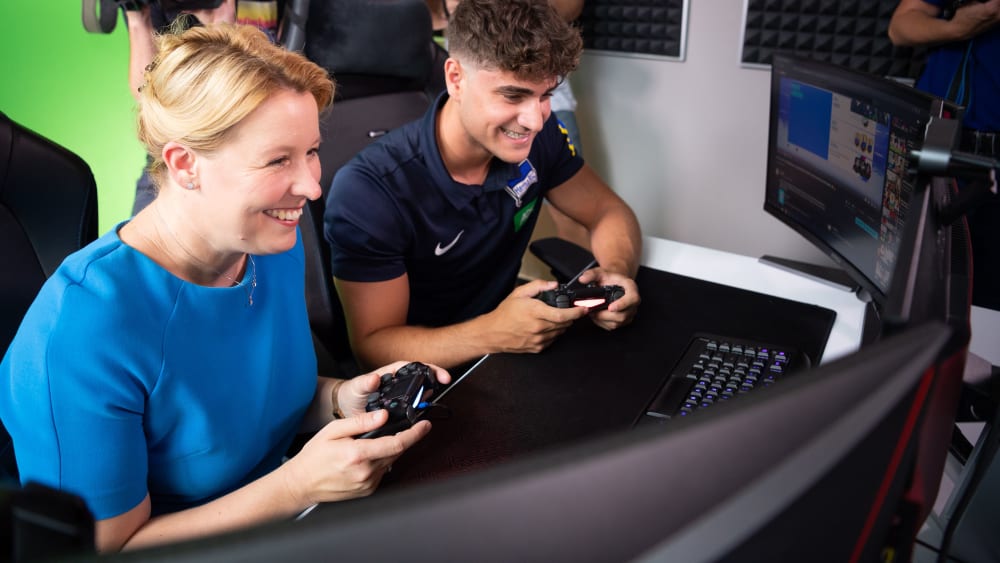
Berlin Senator Franziska Giffey has big gaming plans for Berlin—and eSports plays a central role. Not as a passion project, but as an “important economic factor.”
“Classic Tetris” was her first encounter with gaming as a teenager – but she doesn’t have time for it anymore these days. No wonder: after all, Franziska Giffey is busy with all her other political commitments, including making Berlin the “number one gaming capital.”
That is the goal of the Senator for Economics, Energy, and Public Enterprises. The cornerstones of this initiative are the House of Games, which is scheduled to open in spring 2026, and major events that are to be held more frequently in Berlin in the future. In an interview with eSport, Giffey cites the “Red Bull League of Its Own” from 2023 as an example.
Anyone who wants to host major eSports competitions should ideally also provide players who can participate in them. That is precisely why the Esports Team Berlin was recently launched in cooperation with the esports player foundation (epf). Around 400 applications were received, and 20 talented players were ultimately selected.
“If we want to combine gaming and eSports, we finally need a professional eSports team in Berlin,” says Giffey, explaining the project. “This was a decision we made very deliberately from an economic perspective. Because we see that it is also an important economic factor.”
Berlin is now home to “many companies in the development scene, many new start-ups, many start-ups that use gaming tools to solve other problems.” But according to Giffey, “more and more professional leagues are emerging internationally in eSports. A career profile is emerging that can be used to earn money.”
A calculated look at the financial potential
Young people’s interest in eSports and gaming is “huge.” But it is no longer purely a youth phenomenon. “About half of Germans play games, and the average age is in the late 30s,” says Giffey. To be more precise: 39.6 years, as the industry association game e.V. announced in May. The 40 mark could be broken as early as 2026.
Video games have become a mass medium, which is why Giffey has also “taken up gaming and eSports as economic policy issues.” Not as a passion project of individual decision-makers, but as an economically calculated move with an eye on the financial potential of the industry for a global city like Berlin.