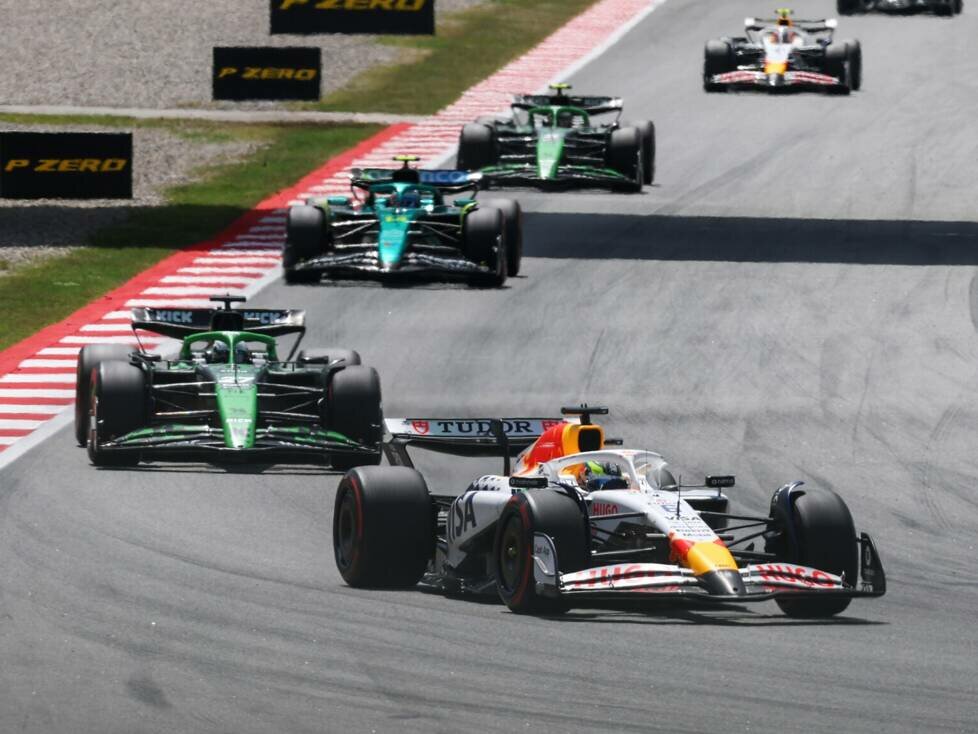
Fernando Alonso scores his first points of the season in Barcelona, but he is far from satisfied—Aston Martin sees clear weaknesses
After a difficult start to the season, Fernando Alonso scored his first points at the 2025 Spanish Grand Prix: The 43-year-old secured his first World Championship points of the current season with ninth place at the Circuit de Barcelona-Catalunya. But he was not truly satisfied.
Alonso confirmed that the team had “undoubtedly taken a step forward.” They had been “always in the top 10 in all sessions,” but Sunday still left the Spaniard with a bitter aftertaste.
“I’m not happy,” Alonso said openly, pondering, “If we had done a few things differently…” As so often, certain elements had not been implemented optimally.
Progress visible, but not enough
The Aston Martin driver is particularly bothered by the fact that he had to admit defeat to names such as Isack Hadjar, Nico Hülkenberg, and Pierre Gasly. “Those are the cars we’re fighting against. We know we’re not going to win the race, but we have to try to beat them.”
“This ‘mini championship race’ we have, if you don’t win it, it makes you a bit angry,” Alonso admits. Nevertheless, he recognizes progress.
In Miami, three races earlier, the situation had been dramatically worse. “We were 20 seconds behind the penultimate car. That was a bit worrying,” he recalls. “Now there’s a change. We’re in the upper midfield.”
The difference is noticeable, but performance still fluctuates greatly: sometimes they finish between tenth and twelfth place, sometimes between 13th and 16th. “But we’re no longer in P19 or P20. That’s what gives us the chance to compete in the first place.”
Saturdays are better than Sundays
A recurring theme is the discrepancy between Saturday and Sunday. “On Saturday, things are going well, I feel competitive, I think I can keep up with Gasly or Hadjar. But then on Sunday, we lose two or three positions and are fighting with Sauber or Williams.”
Aston Martin team boss Mike Krack provided a technical explanation afterwards as to why the AMR25 fell so far behind on race Sunday compared to qualifying.
“The difference is quite simple,” he explains. “In qualifying, you always have new tires. That masks a lot of problems, not just for us, but for all cars.” As soon as the tires are a few laps old, the weaknesses of the cars become apparent, and that’s when the field starts to spread out in the race.
Top speed disadvantage remains a problem
Krack is particularly critical of the AMR25’s performance on the straights. “We were among the slowest here,” he says bluntly. Alonso had hardly any opportunities to overtake, and when he did, it was only on short straights or out of corners. “That makes life extremely difficult for the drivers.”
The choice of rear wing was one of the key decisions – a decision that now needs to be analyzed in detail. “We need to look at how we arrived at this setup,” urges the team boss.
“Because with this configuration, you use up a lot of tires when you have to overtake like that, on the outside, like in turn 3. That costs a lot of tires. We have to fix that.”