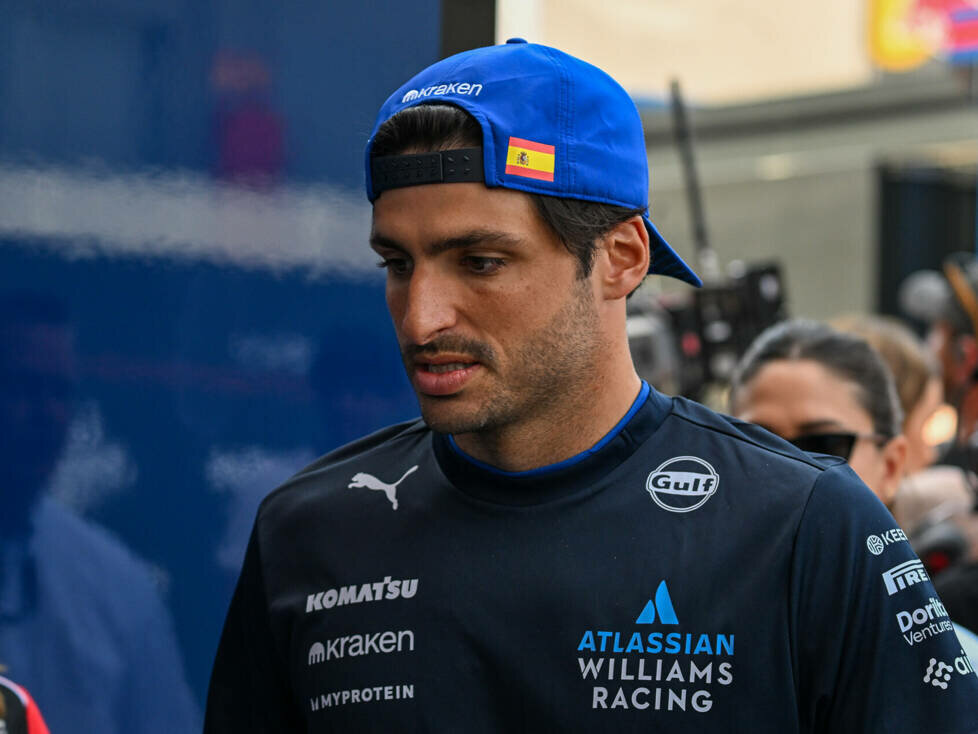
No chance in his home race: Carlos Sainz explains why Williams never got going in Barcelona – and why Canada gives cause for hope again
Carlos Sainz had a weekend to forget at his home race in Barcelona. The Williams driver fell behind in qualifying – through no fault of his own, but due to a chain of unfortunate circumstances, as he later explained.
“We were just unlucky in the second run of Q1,” said Sainz. “Franco’s problem in the pit lane meant we were completely out of rhythm on the outlap and push lap. I had to overtake five or six cars and had a lot of dirty air, which probably caused the tires to overheat.”
In the end, he finished 18th on the grid, just one-tenth of a second behind P7 in Q1. It was a typical Q1 lottery, where every little thing counts. “All the little things that can go wrong in Q1 happened to us today. It was an unfortunate scenario,” said Sainz. “The car actually felt much better.”
The fundamental problem: aerodynamic loss under cornering load
In addition to the botched qualifying, the structural problem with the Williams car was once again evident in Barcelona: it loses a lot of downforce in long corners. Sainz openly addresses this pattern in his analysis and identifies it as a key weakness.
“As soon as you apply combined forces to the car – i.e. steering and braking at the same time – the downforce disappears,” he explains. “That’s why we like long straights and short corners. The longer the corner, the more time the car spends in a state of low downforce.”
The result: Williams only performs well on certain tracks. Barcelona is not one of them – too technical, too many long corners, too little relief for the car. Although the team has already improved the problem compared to last year, “it remains our biggest weakness.”
Race ruined early on – by chaos and damage
The race itself was basically over for Sainz after just a few meters. At the start, he got caught up in a mess involving several cars. “I think there was an accident in front of me, we tried to avoid it, but then we touched each other,” he said. He damaged his front wing and had to pit early.
But that wasn’t all: the Spaniard then struggled with engine overheating throughout the race, especially when driving close to other cars. “Whenever we got within two seconds of another car, we had to manage the engine temperature,” said Sainz. “The few laps I was able to drive in clean air, the pace was good – but by then it was already too late.”
A long pit stop and constant temperature management prevented any kind of comeback. “It was just one of those days when nothing works,” Sainz summed up soberly. He was stuck in “no man’s land” with no real chance of scoring points.
Looking ahead: Hope for Canada
Despite the frustration, the Williams driver remains optimistic. “I hope we’re back in Q3 and in the points in Canada,” he says. The Circuit Gilles Villeneuve suits the Williams much better – short corners, long straights, less lateral load.
Looking ahead to the upcoming races, Sainz only expects similarly difficult weekends in Zandvoort and Qatar. The remaining tracks should suit the FW46 better. At the same time, he is calling on the team to address the underlying problem: “We need to understand why our car is so weak on tracks like this – and make sure that we don’t have such big performance fluctuations between good and bad tracks next year.”
The goal is clear: consistency at McLaren level. Because, according to Sainz, “McLaren is strong in Barcelona – but it’s not really weak on other tracks either. That’s exactly where we need to be.”