


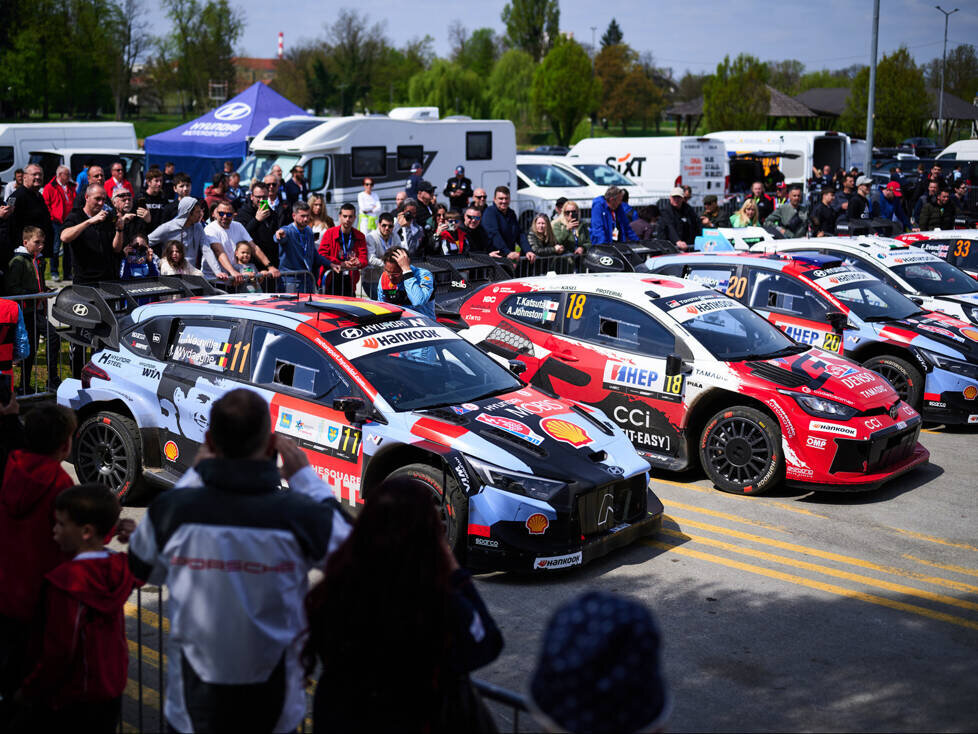
Should the FIA approve a set of proposals from the WRC Commission, from 2027 onwards only Rally1 cars and Rally1 kit cars would compete for the WRC title
A dedicated WRC1 classification and revised rules on the starting order could be introduced in the World Rally Championship (WRC) from the 2027 season. The WRC Commission met on Monday to discuss a series of proposals to amend the sporting regulations. Following the meeting, the proposals were submitted to the Fédération Internationale de l’Automobile (FIA) for approval.
Next year, the World Rally Championship will enter a transitional phase under new technical regulations, during which the performance gap between the brand-new Rally1 cars and the current Rally2 cars is expected to narrow significantly.
As things stand, the 2027 Rally1 cars and the Rally1 kit cars (upgraded Rally2 cars) will compete in a single class (Rally1), with the Rally1 cars having a power advantage of just 10 to 15 PS over the Rally2 cars.
This situation has sparked debate, as Rally2 cars could theoretically be faster than Rally1 cars in certain scenarios, particularly with regard to starting order on gravel.
WRC Commission proposes WRC1 classification
To address these concerns, the WRC Commission has proposed a clearer distinction between the Rally1 and Rally2 classes by creating a WRC1 championship classification for drivers and co-drivers.
Only crews competing in Rally1 or Rally1 Kit Cars would be eligible for these titles, but not those in Rally2 cars. The proposals also include a provision whereby Super Sunday points would be awarded exclusively to Rally1 crews.
” “The Commission has approved a proposal to introduce a separate WRC1 championship standings for drivers and co-drivers from the 2027 season onwards, with World Championship points being awarded via a separate classification comprising exclusively eligible competitors in the Rally1 category,” states a press release from the WRC Commission.
“Under the revised regulations, the World Rally Championship for drivers and co-drivers will be renamed the WRC1 Championship for drivers and co-drivers, thereby introducing a separate points classification for competitors with Rally1 cars, whilst WRC2 and WRC3 competitors will continue to score points in their respective championships.”
“The change creates a separate championship standings for the top category of the WRC, thereby reflecting the introduction of the new Rally1 technical framework in 2027, in which WRC cars to the new specification and WRC kit cars will compete.”
‘The driver and co-driver who score the highest number of points in the WRC1 championship over the course of the season will continue to be recognised as the World Rally Champion for drivers and the World Rally Champion for co-drivers respectively.’
New starting order depending on the length of the opening day?
In addition to the proposed WRC1 classification, the WRC Commission has recommended to the FIA that the rules governing the starting order be amended.
” Under the new provisions, for rallies where Thursday’s special stages account for more than 10 per cent of the rally’s total distance, a separate starting order will apply for Thursday, followed by a revised order for Friday based on the results of the opening day,” the statement reads.
” For competitors in Priority Group 1, the starting order on Friday will be based on the reverse of Thursday’s results. The other priority groups will then follow in the order of their results.‘
’In the event that Thursday’s special stages account for 10 per cent or less of the total distance, the previous procedure for the starting order will remain in place.”
Proposal also for changes regarding test runs
At Monday’s meeting of the WRC Commission, chaired by President Pernilla Solberg for the last time in her current term of office, proposals for changes to the test regulations were also put forward.
” Under the revised regulations for pre-event testing, elite drivers may complete a maximum of one test day per rally entry, up to an annual limit of 10 days. Non-elite drivers may complete two test days per rally entry, with an annual cap of up to 20 days”, the statement reads.
“The additional test days for non-elite drivers are intended to promote driver development by providing more opportunities to gain experience with Rally1 cars. Separate development test days have also been allocated for manufacturers with homologation to meet the requirements associated with the introduction and further development of vehicles with new specifications.”
“For the first and second calendar years of a vehicle’s homologation, manufacturers are allocated 15 development test days per year, which are reduced to 10 days from the third year onwards. Additional test days are specifically reserved for the development of variants of the homologated vehicle.‘
’These provisions are intended to create an appropriate framework for the development of new Rally1 cars whilst at the same time setting clear limits on testing activities and the associated costs”, states the WRC Commission’s announcement.