


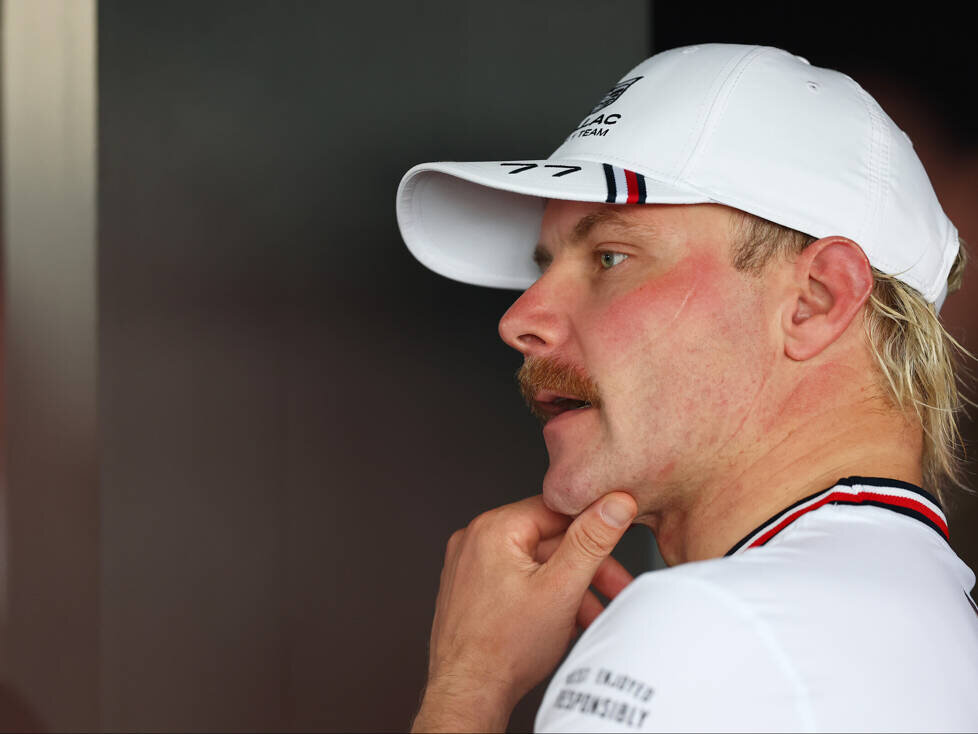
Cadillac was surprisingly quick in Baku, but Valtteri Bottas fell well behind his team-mate Perez: tyre wear and the nature of the circuit remain a mystery
Cadillac had an unusual weekend at the Azerbaijan Grand Prix. Sergio Perez finished the race in 14th place, whilst Valtteri Bottas came 16th and retired shortly before the finish following a bizarre braking problem. The result may not sound particularly spectacular, but the American team’s race pace in Baku was remarkably strong.
It becomes even more interesting when looking at the two Cadillac drivers. Perez was on average around 2.48 seconds per lap slower than race winner George Russell. Bottas, on the other hand, was around 4.3 seconds per lap slower. This meant the Finn’s deficit was almost twice as large as that of his team-mate. The difference cannot be explained by the engines alone.
This is because Perez was already driving Ferrari’s new ADUO-2 engine in Baku, whilst Bottas was still using the older version. However, this difference is said to account for only about one to two tenths of a second per lap. That is not a sufficient explanation for the huge gap between the two Cadillacs.
Perez demonstrates the Cadillac’s potential
Rather, Perez was able to demonstrate that the Cadillac actually had a competitive race pace in Baku. At times, the Mexican was able to battle with Carlos Sainz and the two Audis, thereby holding his own in a group where Cadillac has not been a regular presence this season.
“To be honest, it was one of my best weekends in Baku. I got 150 per cent out of this car,” said Perez. What he found particularly remarkable was that Cadillac was able to compete with cars that, on paper, should have been significantly faster.
“We were battling against cars that are one to two seconds faster than us, and we managed to stay with them during the first stint,” he explained. Among other things, Cadillac forced Sainz into a pit stop and was running in the same group as the Audis.
After the restart, however, the necessary speed on the straights was lacking. Perez therefore fell back. Furthermore, he still sees a significant difference between the manufacturers in terms of energy management and the internal combustion engine. Nevertheless, the Cadillac’s pace in Baku was strikingly strong.
Baku was exactly the right place for the Cadillac
The decisive factor apparently lies in the characteristics of the Baku circuit. Valtteri Bottas explained that the track made one of the Cadillac’s biggest weaknesses barely noticeable: the high-speed corners.
“There aren’t many high-speed corners. As a result, our weaknesses aren’t highlighted as much,” said Bottas. That is precisely what is likely to have been a key factor for Cadillac. At the same time, another well-known weakness of the car was hardly a factor.
Cadillac had repeatedly struggled with increased tyre wear throughout the season. In Baku, however, this effect was comparatively minor. The strain on the tyres was so low that Cadillac hardly suffered from this disadvantage. Combined with the few fast corners, this resulted in an unusually favourable circuit profile.
Added to this was a minor update to the Cadillac. The combination of this development and the circuit characteristics explains why the team was so close to the competition in race pace as rarely before. So far this season, the gap has rarely been so small.
Why was Bottas still so slow, then?
The fact that Bottas was barely able to capitalise on this, however, is what makes the Baku weekend particularly interesting. The Finn had recently been closing the gap on Perez more and more and had beaten him several times in qualifying. In Baku, however, the performance gap suddenly widened significantly.
A look at the season’s statistics, however, shows that the discrepancy between qualifying and the race is not entirely new for Bottas. Over the 15 race weekends so far, Perez has been on average only around 0.13 seconds per lap faster in qualifying. In race pace, by contrast, his lead is around 0.79 seconds per lap.
This reveals a pattern that is already familiar from Bottas’s previous stints. Even during his time at Mercedes, he frequently performed at a very high level in qualifying, whilst falling further behind Lewis Hamilton in the race. A similar picture later emerged at Sauber when compared to Guanyu Zhou.
Tyre wear may be a contributing factor here. Bottas is not regarded as a driver particularly renowned for his tyre management. At the same time, tyre wear is precisely one of the Cadillac’s problems, which could exacerbate Bottas’s downward spiral.
Bottas himself cannot initially offer a simple explanation for the enormous gap. “To be honest, we had absolutely no pace. I could only battle with Fernando,” he says. Nor, he adds, was the intermittent use of lift-and-coast driving the cause of the large gap.
“No, I don’t think that explains the difference. I think there’s something else going on. We’ll have a look into it,” explains Bottas. This leaves open, alongside the engine difference, the question of the individual car set-up or a possible technical problem.
Bizarre retirement deepens the mystery
The unusual retirement shortly before the end of the race provides further evidence that not everything was running smoothly for Bottas. After overbraking at Turn 1 and running off the track, the systems apparently became confused. Bottas then suffered a massive skid at Turn 15. When he braked afterwards, he felt that only the front brakes were working.
“Something was confused there,” says Bottas, describing the situation. What was particularly noticeable to him was that he apparently wasn’t recovering any energy via the rear axle anymore. “It felt as though I’d lost the rear brakes. It felt as though I’d lost the energy recovery at the rear.”
Malaysia is likely to be more challenging again
The fact that Cadillac was so competitive in Baku does not therefore automatically mean that the pecking order has changed permanently. Bottas is already looking ahead to the next Grand Prix in Malaysia with mixed feelings.
“It could be difficult. We overheat the tyres quite a lot when it’s hot. What’s more, we’re still not particularly good in the high-speed corners,” explains the Finn. Sepang thus brings back precisely the conditions that Cadillac barely experienced in Baku.
High temperatures, rough tarmac and correspondingly higher tyre wear are likely to make the car’s well-known weakness more apparent once again. Added to this are the fast corners, where, according to Bottas, Cadillac continues to struggle.