


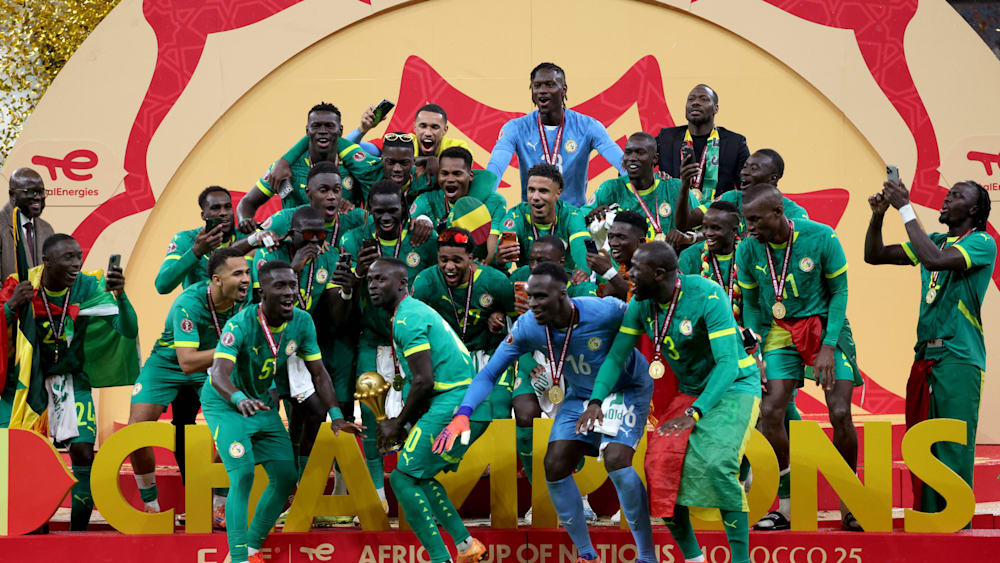
The African Football Association CAF has stripped Senegal of the Africa Cup title. Now the association is taking its case to the International Court of Arbitration for Sport – and can certainly raise its hopes there.
Who will ultimately go down in history as the winner of the Africa Cup 2025/26 is no longer in the hands and feet of the players on the pitch, but in those of the lawyers. After an appeals committee of the African Football Confederation (CAF) surprisingly upheld the Moroccan protest on Tuesday evening and awarded the final 3-0 to the host nation, the Senegalese Football Association announced in return that it would take the case to the International Court of Arbitration for Sport (CAS).
In its statement on Tuesday, the CAF justified its decision with Articles 82 and 84 of the Africa Cup regulations. Article 82 states that if a team withdraws from the competition for any reason, fails to appear for a match, refuses to participate or leaves the field of play before the regular end of the match without the referee’s permission, it shall be deemed to have lost and shall be definitively eliminated from the competition in progress.
As part of the Senegalese team had left the pitch in stoppage time of the final played in mid-January at 0-0 in protest against two controversial decisions by referee Jean-Jacques Ndala Ngambo without the referee’s permission, this article applies here in accordance with the rules. Article 84 continues: “A team that infringes the provisions of articles 82 and 83 shall be permanently excluded from the competition. This team shall lose the match 0:3.
Referee Ndala Ngambo could therefore have stopped the match and awarded it to Morocco after the Senegalese team had gone into the dressing rooms. In this case, Senegal would have had no room for protest. However, because the referee allowed the game to resume and finish after the Senegalese team returned, Sadio Mané’s team can at least have some hope before CAS.
Rule 5 of the international rules authority IFAB gives the referee “full authority” to determine what happens in a match. Rule 5.2 states: “The referee’s decision on facts relating to the match, including whether or not a goal has been scored and the result of the match, shall be final.”
Further inconsistencies arise from the way the CAF ruling came about. Morocco had initially lodged an appeal against the scoring of the match, but the CAF Disciplinary Committee rejected it at the end of January. Morocco appealed against this – and have now been upheld by the relevant appeals committee. The question that now arises: Was this appeal even possible
On what basis did the disciplinary committee make its decision?
After all, article 44.1 of the Africa Cup regulations states: “An appeal may be lodged with the Appeals Committee against the decisions of the Organizing Committee and the Disciplinary Committee, but not against decisions that have been determined as final.”
However, it remains unclear whether the decision of the Disciplinary Committee was considered final. However, Article 44.5 states that “During the final round of the Africa Cup, all decisions of the Organizing Committee and/or the Disciplinary Committee, except those relating to the application of disciplinary measures based on the reports of match officials, shall be final and non-appealable.”
This raises the crucial question: was the decision of the disciplinary committee based on the referee’s reports? If not, then the Moroccan appeal would not have been legal under Article 44.1. Because the decision of the disciplinary committee was communicated in January without further justification, there are also a lot of question marks here.
The exact interpretation of the paragraphs is now in the hands of the CAS. However, the Senegalese protest is not completely hopeless.