


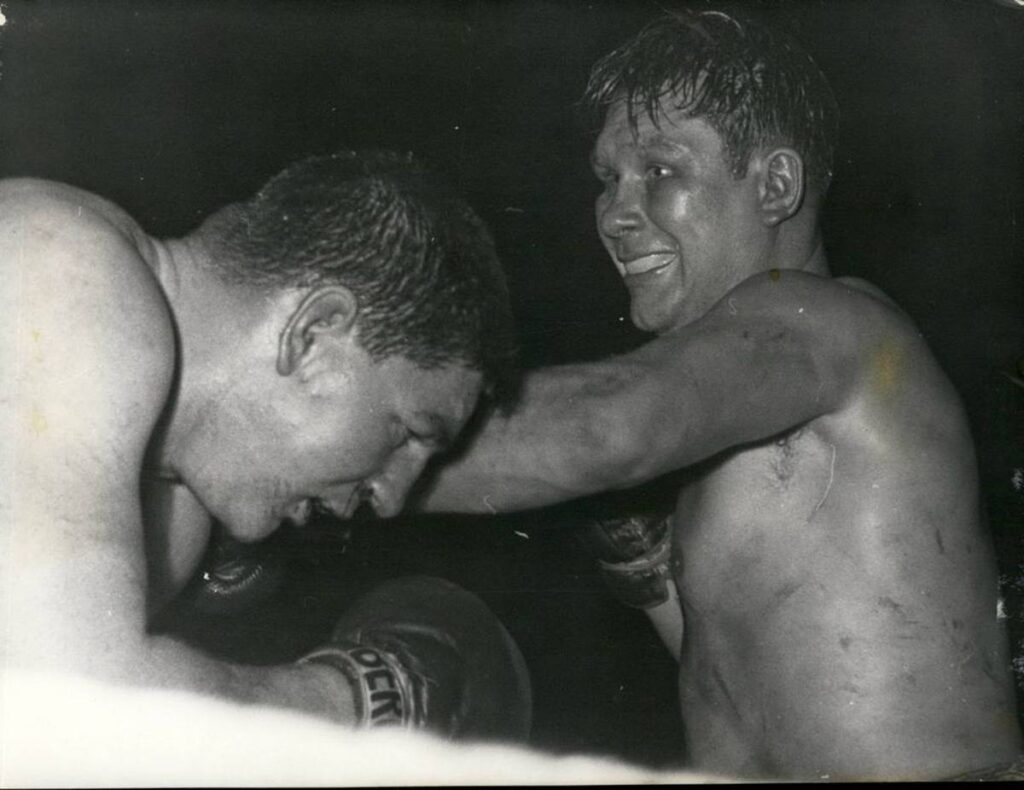
In March 1952, “The King of the Westfalenhalle” was crowned European champion. The hero sacrificed a world career for the love of his city.
Heinz Neuhaus always had crazy ideas. On November 9, 1954, the boxing hero set off on a lap of honor by bicycle at the six-day race in Dortmund’s Westfalenhalle – at half past four in the morning, mind you.
Neuhaus crashed into a photographer, but immediately jumped back up and promptly completed a second lap of honor. Thanks to moments like this, he won the hearts of the German people, and especially those of Dortmund.
But “Der Lange” (The Tall One), who stood 1.88 meters tall, also earned an excellent reputation for his athletic achievements. The Iserlohn native became European heavyweight champion just under a year and a half before his bizarre cycling accident. On March 9, 1952, exactly 74 years ago, the southpaw defeated Belgian Karel Lys in the Westfalenhalle.
Neuhaus the next star after Schmeling
At a time when Max Schmeling had sparked huge enthusiasm for boxing, Neuhaus became the next star – and had a living room.
Because he loved his city so much, Neuhaus almost always fought in the Westfalenhalle and was eventually even renamed the “King of the Westfalenhalle”.
Born on April 14, 1926, the future boxing idol initially had other interests: soccer and athletics dominated his everyday life. At the age of eleven, the boy from the Ruhr region took up boxing and began a meteoric rise. At just 16, Neuhaus won the German championship title as a teenager. Just one year later, the adolescent had already moved up to the heavyweight division.
This step proved to be a stroke of luck, but only after a delay. The Second World War and his subsequent imprisonment as a prisoner of war initially prevented him from pursuing a career as a boxer. Neuhaus became the “King of the Westfalenhalle”
But in 1949, the trained machine fitter’s career as a professional boxer really took off. Neuhaus was European heavyweight champion from 1952 to 1955. He held the German championship title from 1952 to 1955 and from 1956 to 1957.
Throughout his career from 1949 onwards, Neuhaus boxed in every fight he was offered. He never turned down a fight. The spectators always enjoyed spectacular fights. Because “The King of the Westfalenhalle” was never a man of great tactics.
Curiously, Neuhaus’ most legendary moment did not take place in his second living room, but in Dortmund’s Rote Erde stadium in front of 50,000 spectators in July 1952.
Neuhaus knocked out his opponent Hein Ten Hoff in the first round – and his opponent broke his leg when he fell to the ring floor.
Neuhaus didn’t want to leave Dortmund
Many experts and fans were just waiting for the German star to conquer the world – like Schmeling had done a few years earlier.
But Neuhaus didn’t want to leave Dortmund, so he never achieved worldwide fame. Neuhaus certainly had the ability. On September 12, 1954, “Der Lange” (The Tall One) defeated the American Dan Bucceroni, naturally in the Westfalenhalle. Bucceroni was ranked number three in the world by the American boxing magazine The Ring.
But over the years, the heavy defeats also piled up. Cuban Nino Valdés, German Hans Kalbfell, and Swedish ex-world champion Ingemar Johansson each sent the Ruhr Valley native to the canvas.
Neuhaus closely connected to the Westfalenhalle
Neuhaus retired on September 26, 1958, at the age of only 32. Forty years later, on April 6, 1998, the legend died unexpectedly of lung cancer. However, his city of Dortmund has not forgotten one of its heroes to this day. In 2019, a street in the Dortmund-Lücklemberg district was named after the boxer. From there, it is just six kilometers to the Westfalenhalle.