


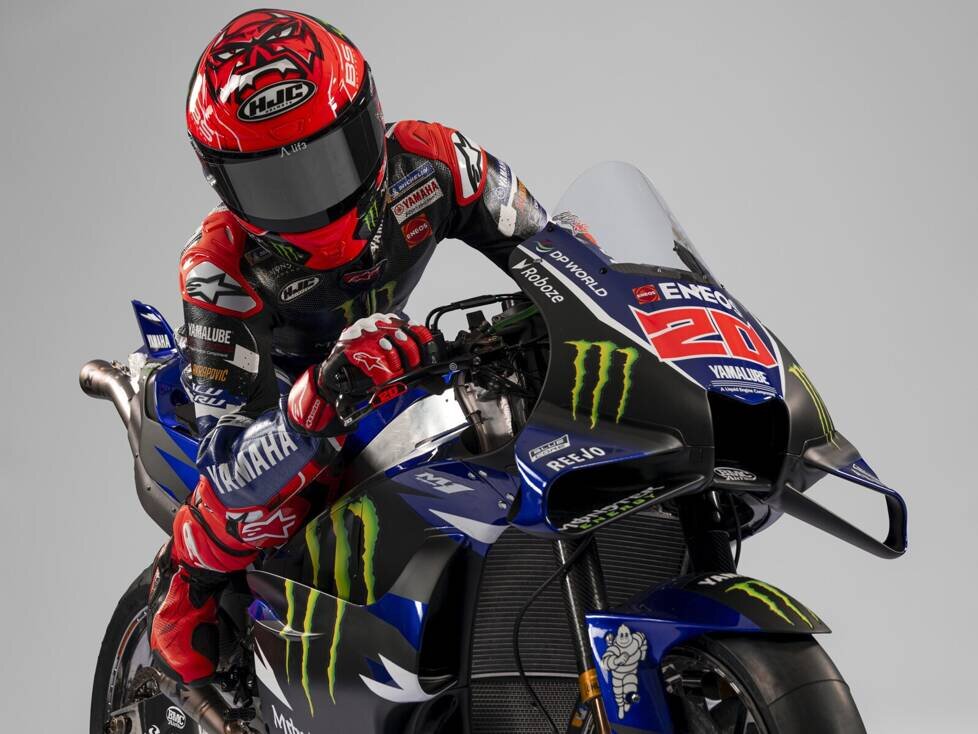
Yamaha is embarking on a radical change of concept in 2026, but it already has clear goals in mind for its first MotoGP season with the new V4 engine.
With the unveiling of the new M1 for the 2026 MotoGP season, Yamaha is opening a completely new chapter. For the first time in decades, the manufacturer is saying goodbye to the traditional inline engine and focusing on a V4 concept—a technical break that is noticeable both in the garage and on the track.
Project manager Paolo Pavesio, team director Massimo Meregalli, and technical director Takahiro Sumi make it clear: 2026 is not just an ordinary transition year, but the beginning of a long-term return to the top of the premier class.
The biggest change in decades
For Meregalli, one thing is clear: On a technical level, this is an unprecedented revolution for Yamaha. “The biggest change of all is technical in nature,” he emphasizes.
Over the past ten to fifteen years, a new bike has usually been just a further development of its predecessor. But now, the team is starting with “a completely new package,” which represents a “huge, huge step.”
They are starting “almost from scratch,” admits Meregalli, well aware that this involves an enormous amount of work. At the same time, however, pride and anticipation prevail: the team is “really excited, very proud, and fully committed” to leading the new M1 to a successful future, even if it will take time.
Yamaha director expects a two-part year
Meregalli is correspondingly cautious in his expectations for 2026. The season will clearly have to be divided into two phases. The first will be about understanding the new motorcycle: an intensive learning process for the team and riders.
It is only in the second half of the season that Fabio Quartararo and Alex Rins are expected to gradually improve their results. One key to this is the full test program.
“The list is quite long,” says Meregalli, looking ahead to the tasks ahead. It is crucial to have as many dry test days as possible in order to collect reliable data. The goal is to complete the first official test “with really strong information” that the manufacturer can build on.
V4 bike to deliver a wider performance window
From a technical perspective, Takahiro Sumi describes the switch to V4 as a conscious step to overcome the structural limitations of the previous concept. One of the main goals is to achieve “a broader performance window.”
“Even at an early stage, we saw encouraging progress in some key areas, such as improved stability during braking and acceleration and a consistent riding feel over the long run,” says Sumi-san.
At the same time, he does not hide the fact that there are still areas where the new V4 does not reach the level of the familiar inline engine. This is precisely where Yamaha’s accumulated experience comes into play to further develop the new architecture. However, success is not only measured by the results.
The aim is to provide “proof that we are heading in the right direction with our development.” If the team and riders maintain their collective momentum, “the results will follow,” and sooner rather than later, the technical director is confident.
“Fully exploiting the potential” as early as 2026
Project manager Pavesio urges realism. “There is no magic in this sport,” he says openly. MotoGP is basically a mechanical sport in which you have to accept that it takes time to get back to the top. And Yamaha has already embarked on this path in 2025. Pavesio recalls that Yamaha certainly found pure speed last year: five pole positions and ten starts from the front row are proof of that. What was missing, however, was consistency, especially over the long race distance. This is exactly where the new package comes in. “We believe it offers us more growth potential during the season. We expect to learn quickly once we start racing, and we anticipate increasing development over the course of the season,” Pavesio predicts.
It is not possible to pinpoint exactly when the breakthrough will come in a specific race. “Our riders are definitely extremely hungry. And we believe that the new M1 will reach its full potential over the course of the season.”
Quartararo: Change yes, no learning process
From a rider’s perspective, Quartararo is not worried about the switch to the V4 engine. He is confident, saying that he does not see a classic learning process for himself.
“Of course, you think it’s a Yamaha, but it’s a completely new bike. However, since my first day in Barcelona, I’ve gotten used to it quite quickly, especially the new torque behavior,” which he sees as the biggest change compared to the inline-engine Yamaha.
Of course, the riding style will have to change, not only because of the engine, but because of the entire motorcycle. The biggest challenge now is to find a solid base and understand where the limit is. “From there, we can really focus on performance,” says Quartararo. Rins also sees the restart as an opportunity, not only for Yamaha, but also for himself personally. Compared to Quartararo, Yamaha’s long-standing figurehead, he has already been able to catch up over the past year, the Spaniard emphasizes.
Now, however, a new project is beginning for everyone. The focus, however, is first and foremost on development, not position. “We have to get this bike to the top,” says Rins. The upcoming pre-season tests will be decisive. Only then will it become clear where the journey is really headed.