


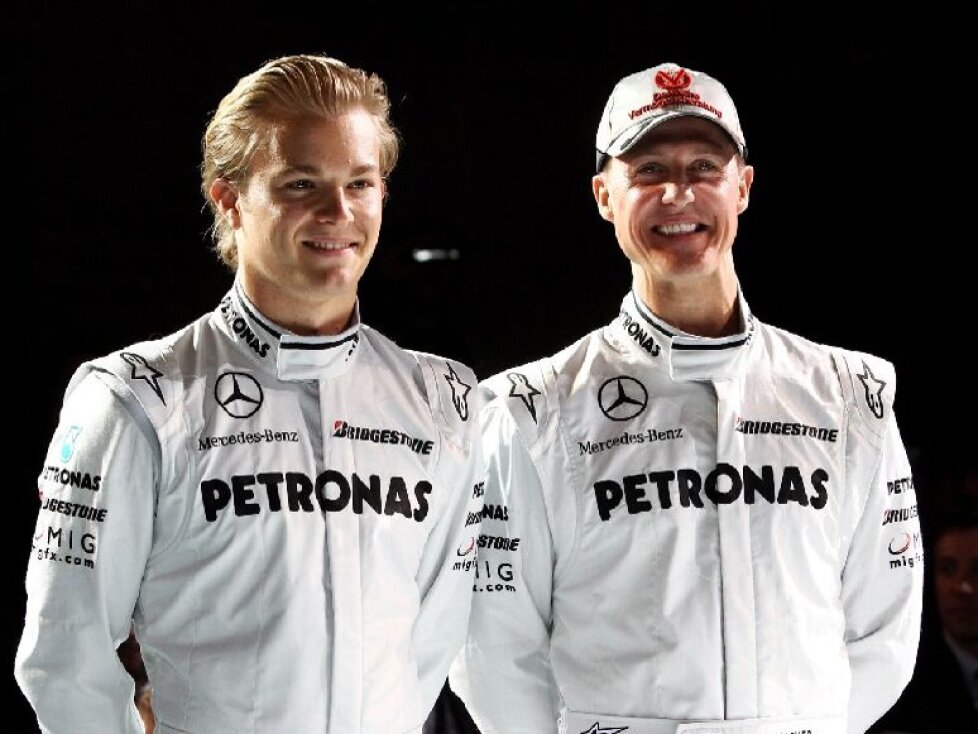
Nico Rosberg talks about his time with Michael Schumacher at Mercedes and explains why his father, Keke, initially warned him about “Schumi”
Nico Rosberg celebrated his greatest success in Formula 1 with Mercedes in 2016. The then 31-year-old won the World Championship with the Silver Arrows – and retired from the top flight just a few days later. But the German’s career could have taken a very different course.
For if the timing of Michael Schumacher’s Formula 1 comeback had been slightly different, Rosberg might never have signed for the Silver Arrows. “That’s when I really panicked. That wasn’t how I’d planned it,” laughs Rosberg in an interview with Der Spiegel.
The interview in question is an extract from the book *Über Michael Schumacher und die deutsche Ära in der Formel 1* (*On Michael Schumacher and the German Era in Formula 1*) by former *Der Spiegel* editor Alfred Weinzierl, who spoke to seven drivers in the book, including Sebastian Vettel and Nico Hülkenberg.
Background to the statements: Rosberg had already signed for Mercedes for the 2010 Formula 1 season when the Silver Arrows announced Schumacher’s signing in December 2009. So would Rosberg also have switched from Williams to Mercedes if ‘Schumi’s’ comeback had already been a done deal at that point?
“ “I don’t know,” admits Rosberg, emphasising: “Mercedes is Mercedes. And there weren’t that many attractive alternatives anyway. But perhaps I would have politely declined, because my father [Keke Rosberg] would have strongly advised me against it.”
“Once it was confirmed that Michael was coming, he said: ‘You’ve got to get out of there as quickly as possible.’ Those were his exact words: ‘Get out of there as quickly as possible’,” he reveals. The background to this was an experience from the 1990s, when Keke Rosberg had taken the Finn JJ Lehto under his wing.
Rosberg, compared to Schumacher, “a nobody”
Lehto became Schumacher’s team-mate at Benetton in 1994. “By then, Michael had already built the whole team around him according to his own vision – very clever and determined. JJ wasn’t even allowed into the engineers’ meetings; he wasn’t supposed to know anything and was completely excluded,” says Rosberg.
“ “My father was extremely traumatised because his protégé was sacked by Benetton at the end of the season and couldn’t find another job in Formula 1,” explains the 2016 world champion. It therefore came as a “massive shock” to him when he learnt of Schumacher’s signing.
“Compared to Michael, I was a nobody. Michael had won 91 Grands Prix; I was a nobody and he was God,” explains Rosberg. Schumacher was “the greatest of all time”, “the untouchable one, the one nobody could ever beat”.
In fact, as feared, the team’s entire focus was on the record-holding champion at the start of their time together. “It went so far that, before the first race in Bahrain, we were sitting together in the strategy meeting. The first thing our head of strategy did was discuss Michael’s race strategy with Michael himself.”
“Then he explained my strategy to Michael. I was sitting right there. I felt as though I didn’t even exist. I was just hot air in the room. Something like that is naturally difficult for a young driver,” recalls Rosberg, who nevertheless managed to beat Schumacher on the track in 2010.
Why Schumacher struggled with his comeback
In the World Championship, he actually finished well ahead of his compatriot, with 142 points to 72. Rosberg explains: “After four years in Formula 1, I was already quite experienced and, at 24 or 25, was gradually reaching my prime. Michael, meanwhile, was 41 and had been away for three years.”
“He simply wasn’t at 100 per cent anymore,” he believes, explaining: “It was, of course, a disadvantage for Michael that test drives were so restricted. One of his strengths – optimising everything through painstaking attention to detail during test sessions – was thus taken away from him.”
“You could also see that he was struggling a bit to adapt from Grand Prix to Grand Prix, from situation to situation. He wasn’t as consistent as he used to be. Yet there were weekends when he was as brilliant as in the old days.”
Rosberg secured three podium finishes in their first year together, whilst “Schumi” didn’t make it onto the podium at all. His sporting achievements also improved internal support, “because the team knew I’d be the one to score the most points,” he explains.
What Rosberg learnt from Schumacher
“But it was all relative, because Michael was still the god,” says Rosberg, who is nevertheless grateful in retrospect for the three seasons they spent together. Because the time spent alongside Schumacher helped him “immensely”. “I tried to learn a little from him,” says Rosberg.
This applied not only to sporting aspects but also to matters off the track. “I learnt and saw how to approach things mentally in sport. When you want to hold your own against a rival,” explains Rosberg, who describes himself as “rather conflict-averse”.
He also admired Schumacher’s ability to build a team around him. “The effort he put into building the team around him, motivating them, inspiring them. Michael organised parties for the mechanics and all the other staff,” he reveals.
“He kept lists of who had a birthday and when. And he’d ring everyone to say happy birthday. Those are the sort of things that win a team over. Brilliant,” says Rosberg. 2012 was ultimately their last year together at Mercedes; after that, “Schumi” was replaced by Lewis Hamilton.
In all three seasons, Rosberg finished ahead of Schumacher in the World Championship. “That was crucial for my career,” emphasised the future world champion, because: “If Schumacher had been ahead of me, Lewis Hamilton would have come in, and I would have had to leave.”