


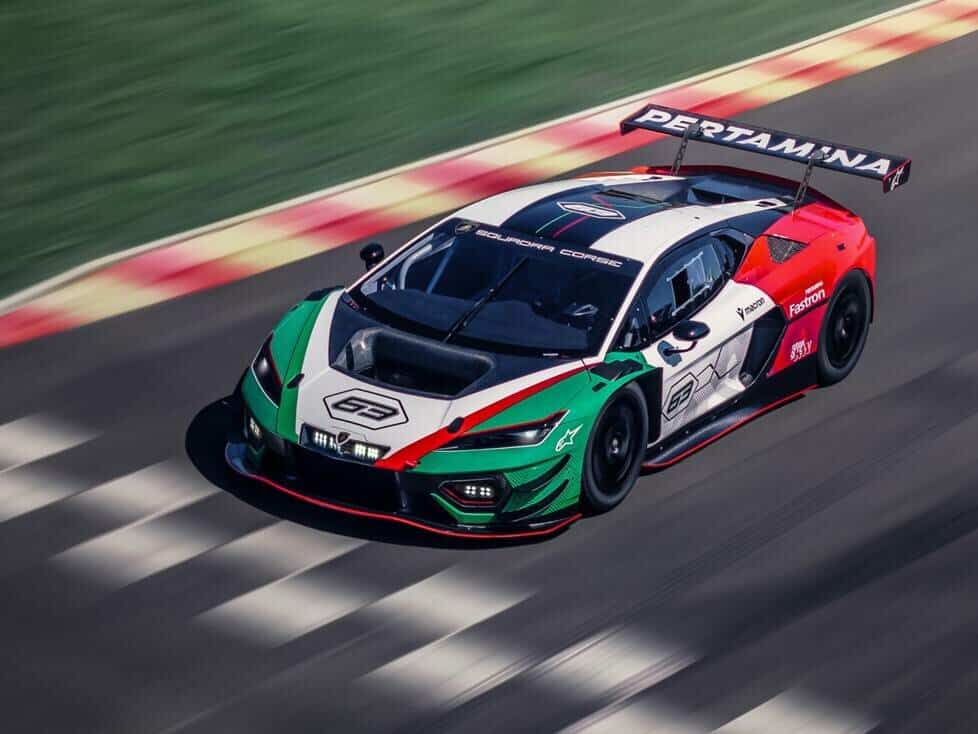
Lamborghini’s new GT3 successor has been undergoing testing since the end of May: How it has gone so far, what the test drivers say about the Temerario, and what the focus has been on
On Friday, Lamborghini officially unveiled the new Temerario at the Festival of Speed in Goodwood. However, the vehicle has already been in testing for more than a month. This was by no means a certainty, as the Italians cannot benefit from Audi’s slipstream with the GT3 successor to the Huracan this time around and are largely on their own.
“I have to admit that we have made faster progress than expected, because the rollout went without a hitch and the functional test also went well,” “So we have extended the test to include the initial setup work.”
The rollout with the new Temerario took place in the last week of May on the Bridgestone test track near Rome, followed by the first serious test with the turbocharged car in Vallelunga in the first week of June. The test was carried out by the factory itself.
Mapelli: “It was immediately clear that the car works well.”
“It was immediately clear that the car was working well,” said Lamborghini factory driver Marco Mapelli, who is conducting the tests together with his colleague Andrea Caldarelli, on Instagram. “At this stage, we didn’t expect to be discussing set-ups with the vehicle during the first tests. That’s a good sign.”
But which set-up areas were targeted first? According to Mohr, they talked about the “steering ratio,” which they are still working on. “And of course, it’s also about the suspension setup, because we have a six-way damper system for the first time and no longer a four-way damper system,” he says, referring to the new KW suspension.
“We have a lot of adjustment options in the car, traction control, boost control, all these things – and we’ve already worked on the basic setup,” Mohr reveals. “I don’t want to make it bigger than it is, but it went further than expected.”
“Definitely a step forward”
But how do the test drivers compare the Temerario with its predecessor, which is already ten years old in its basic version? “The difference to the Huracan is definitely very clear,” says Mapelli. “Here we have a biturbo engine, while the Huracan is powered by a naturally aspirated V10. That alone offers a different driving experience. In terms of driving setup and comfort, it’s definitely a step forward.”
And Caldarelli, who was involved in the LMDh project with the SC63, also sees parallels in this regard: “In terms of numbers, the car is much more similar to a prototype than a GT car. And even in terms of driving, it’s very similar.”
Testing will continue into 2026, when the car is scheduled to make its racing debut in March at the 12 Hours of Sebring. However, Lamborghini wants to monitor progress and then decide whether to stick to the plan or make changes.