


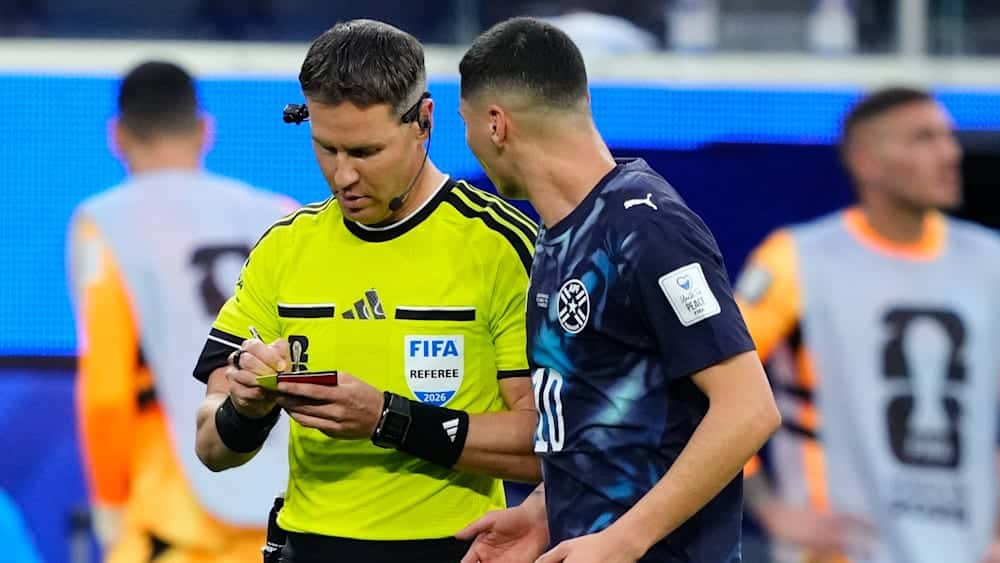
The U.S. team’s opening victory over Paraguay early Saturday morning also marked a first in terms of the rules. For the first time, VAR exercised its new powers, belatedly penalizing Miguel Almiron for diving. However, it is doubtful whether the interpretation of the rules was actually correct.
The 50th minute at SoFi Stadium in Los Angeles had a historic feel to it, even if no one likely realized it at first. Instead, the 70,492 spectators actually witnessed a relatively unspectacular yellow card for U.S. captain Tim Ream, who had allegedly brought down Paraguay’s Miguel Almiron. The free kick had already been taken when, a good minute later, the VAR intervened—and made history.
For the first time in this World Cup, video assistant referee Carlos del Cerro Grande of Spain exercised his new powers. The relevant term in the International Football Association Board (IFAB) rules is “Mistaken Identity.”
The VAR protocol on page 172 of the official rulebook stipulates that the VAR may intervene if the referee penalizes an offense but has “clearly identified the wrong player.” In this case, “only the identity of the offending player may be determined via video review.”
Makkelie rules “no contact”
A new development is that the VAR may also intervene in cases of player mix-ups if a player from the wrong team has been cautioned or shown a red card. Previously, cases of player mix-ups could only be reviewed if the referee had shown a card to the wrong player from the same team.
Presumably for this reason, del Cerro Grande brought the matter to the attention of head referee Danny Makkelie. The Dutchman paused the game—which had already resumed—following a VAR signal, reviewed the play on the monitor once more, and effectively reversed the yellow card.
“No contact,” Makkelie announced over the stadium PA system, explaining his assessment of the play after reviewing the footage. In fact, contact was barely discernible; Almiron went down only shortly after his opponent’s slide tackle. Instead of calling a foul on Ream, the referee ruled that Almiron had dived, issuing a yellow card to the Paraguayan and awarding a free kick to the U.S.
Ittrich questions the decision—and sees a “procedural error”
However, even Patrick Ittrich is unsure whether the rule was interpreted correctly in this instance. The 47-year-old former referee had ended his active career after the conclusion of the Bundesliga season, but as a referee expert on MagentaTV, he now raised the question of whether the IFAB’s wording refers “to the person or the action.” In other words, are fouls and dives not two different offenses, and therefore does this not constitute the “mistaken identity” defined in the rules? Ittrich: “I doubt that it really is ‘mistaken identity.’” We will now have to wait for the IFAB’s assessment.
Either way, Ittrich sees a “procedural error” in any case, because: “Normally, the VAR can’t intervene at all once play has resumed. We don’t know how communication took place. What’s certain: The process was flawed.” At least this incident didn’t affect the result. The U.S. was already leading 3-0 at halftime, and the match ended in a comfortable 4-1 opening victory.