


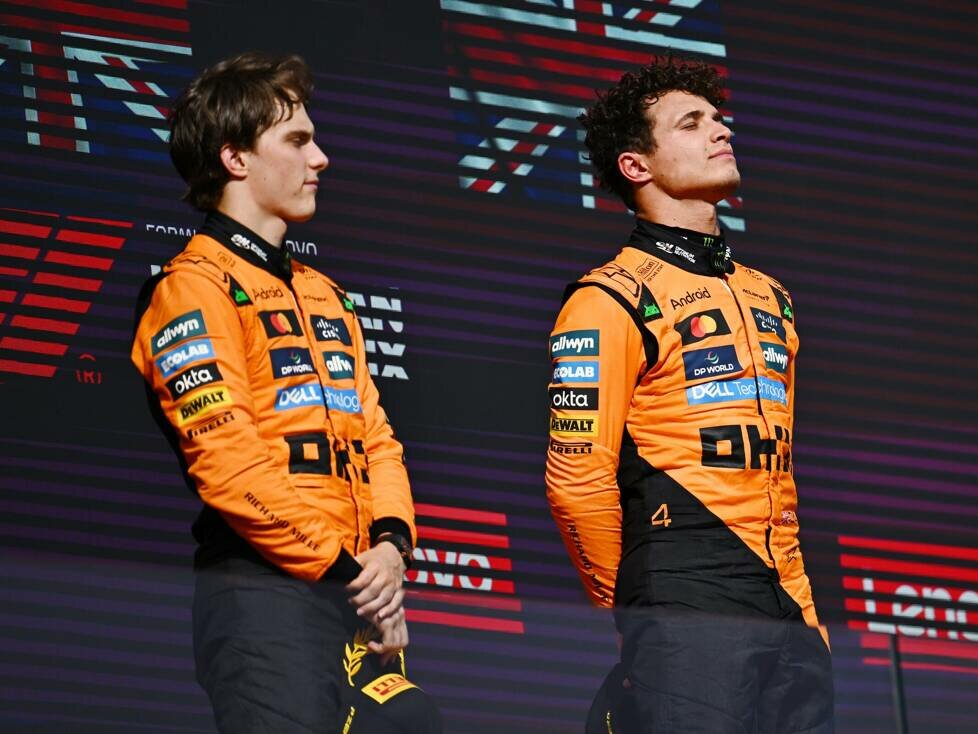
Oscar Piastri leads the 2025 World Championship and is battling his teammate Lando Norris for the first time – what are the parallels to the junior series?
Oscar Piastri leads the Formula 1 World Championship by nine points ahead of his McLaren teammate Lando Norris and has a realistic chance of winning the title. The Australian won the Formula 3 championship in 2020 and the Formula 2 title in 2021. The 24-year-old feels like he’s back in the junior series in the Formula 1 title fight. But the duel with his teammate makes the 2025 season something very special for him.
He already battled a teammate in Formula 3 in 2020: Logan Sergeant from Team Prema. The dynamics are different in the junior series than in Formula 1: In the junior series, drivers usually have to pay for their cockpits, while in Formula 1 they are on the payroll and earn a lot of money from racing.
But what makes the difference when it comes to winning the Formula 1 title? In Formula 3, Piastri’s focus was on delivering clean races, whereas in Formula 2, tire management played an important role. Formula 1 is a whole different level. Nevertheless, Piastri sees many parallels to his previous title fights.
The differences and parallels
“It actually feels quite similar to the championships I’ve competed in in the past,” said the youngster. “The biggest difference is that for the first time I have to fight so hard against a teammate for the title.”
“I raced against Logan Sergeant in Formula 3, but there are fewer hurdles in Formula 1. There are no pit stops, no strategy. You just go out there and try to beat each other and finish ahead of your teammate.”
“In Formula 1, there are bigger hurdles with the strategy,” he explains. “There are so many different things that can influence the result. So there’s a different dynamic. That means other things are more important: being at the front before the pit stops and taking risks at the right time, or not taking them.”
Formula 1 one level higher
According to Piastri, this is what makes the difference, which also proves to be a big mental challenge. “In the end, the position to secure the title is similar,” the Australian clarifies. “I know that what worked in the past has been different in every championship. There’s not just one way to try.“
”In the position we’re in, we can’t just consistently score points. I have to beat everyone because we often fight for first and second place on many weekends,“ Piastri continues. ”If you consistently finish second, you score good points, but one person wins. And if they win all the races, then they’re consistent too.“
In the junior classes, due to the larger number of races per weekend, he often looked at how many points would be enough to maintain a good position in the overall standings. That only works to a limited extent in Formula 1. ”There’s less incentive to calculate because there’s only one race at the weekend. In the junior series, there are two, and in Formula 2 back then, there were even three per weekend.“
In Formula 1, you always have to be at the top
”You can calculate an average, but just because it worked once doesn’t mean it will work again. We take it one race at a time. That sounds boring, but it’s the truth,“ the McLaren driver explains. ”You can’t worry about what happens in Abu Dhabi if it takes your focus away from the current race weekend – especially at the top of Formula 1.”
According to Piastri, it is fundamentally important to give your best in every race, to be fully focused and to get the most out of the present moment. “It’s a cliché to say you’re fully focused on the current race, because we’re trying to score the maximum number of points.”