


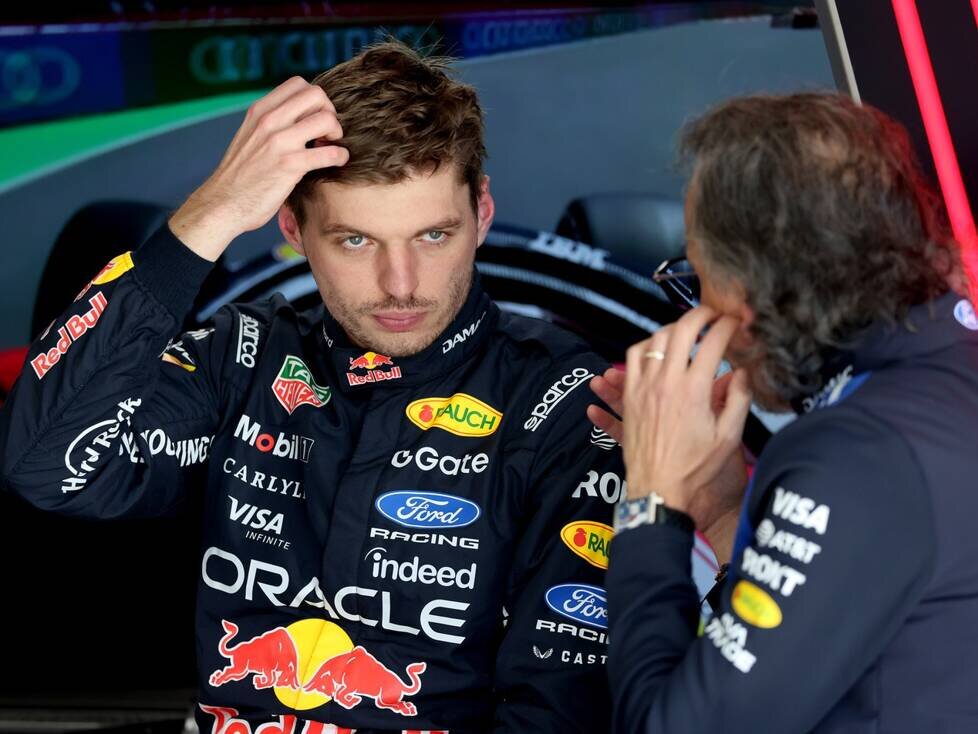
Red Bull’s weaknesses on curbs persist – Verstappen speaks openly about the consequences, Mekies believes a solution is possible
Max Verstappen could compete in the Monaco Grand Prix with a Red Bull that has been modified once again. The Dutch driver is struggling with the RB22’s weaknesses on bumps and when making contact with curbs. However, Red Bull team principal Laurent Mekies is confident that the problems can be resolved before the end of the season.
During the Canadian Grand Prix, Verstappen spoke again about the difficulties in navigating the curbs. Although Red Bull had already made changes last year to improve the car’s behavior on curbs, the problem persists.
Curbs remain Red Bull’s weak point
“It’s not so bad over bumps, but it’s very difficult with curbs,” Verstappen explained to Motorsport.com in Montreal. “That has to do with the philosophy of our car right now, with how you build a car that’s fast. Of course, we’re trying to better balance the two, but right now we can’t find a compromise. That’s why it’s still a bit difficult for us.”
According to Verstappen, the extent of the problem was particularly evident during qualifying in Montreal. After he hit the curbs in the final chicane, the effect was immediately noticeable. The Dutchman then jokes: “When that happened, I just thought: Oh yeah, this is going to be great. I think I’m going to have to order a new back.”
Can the problem be solved by 2026?
Red Bull still expects to get the difficulties under control over the course of the season. While the transition from the ground-effect era to the new cars—which, starting in 2026, will feature flatter underbodies, less aerodynamic downforce, and a reduced influence of the Venturi tunnel—has made the problems more visible, the team has essentially been grappling with these issues for several years, even though the relevant technical regulations have hardly changed.
Verstappen expressed surprise that the problems with bumps and curbs have remained so persistent. “If we had known exactly what the cause was, we would have solved it already, and that’s exactly what we’re working on now,” he said.
When asked whether Red Bull could resolve the issues by the end of this year or whether this was a structural issue that would not be fully resolved until 2027, Mekies replied confidently: “There is no reason why this cannot be resolved by 2026.”
Solution not at the expense of performance
However, Mekies also emphasized that the engineers face a difficult balancing act. Red Bull does not want to eliminate the problems at any cost, but rather maintain a competitive overall package for all track types.
“You can solve the problem in a way that not only eliminates these issues but also slows down the car overall,” explains the Frenchman. “We have to find a solution that fixes these issues but improves the car at the same time. For me, that’s the challenge. That’s why it will take time.”
Nevertheless, Mekies remains optimistic that Red Bull will make progress as the season progresses. According to him, the team has already identified and resolved several fundamental issues with the car.