


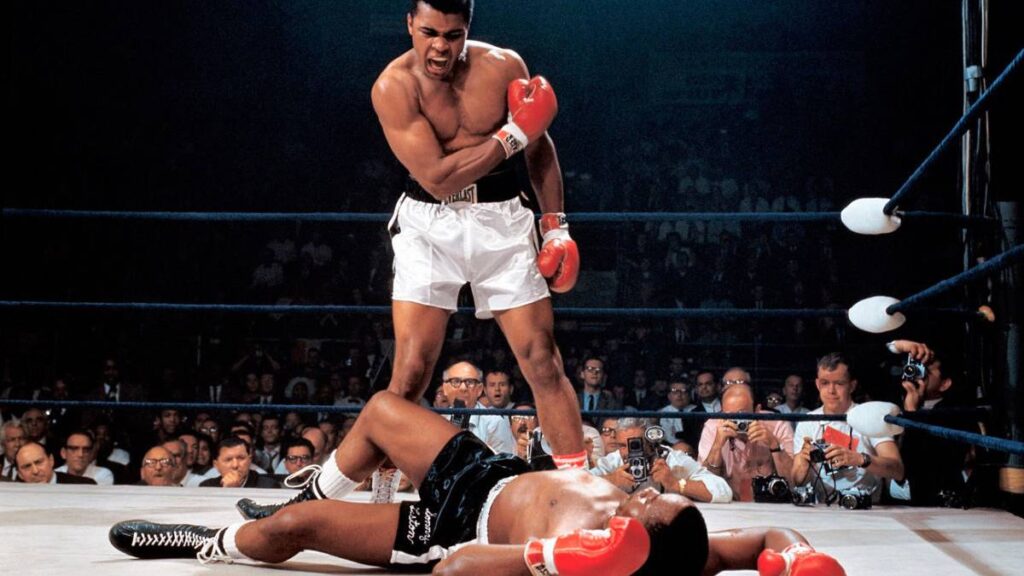
Sonny Liston became world champion in 1962 with a historic demolition, only to be defeated in turn by the young Muhammad Ali. Fifty-five years ago today, the news of his untimely death shocked the world.
Almost everyone knows his most famous photo, even though he is not the main character in it.
It was May 25, 1965, when Muhammad Ali surprised former world champion Charles “Sonny” Liston with his legendary “phantom punch” after 105 seconds and sent him to the ground.
The photo of Ali yelling “Get up, you bum!” at the downed Liston is the iconic Ali image par excellence, one of the most famous photographs in sports history.
While Ali established his enduring legend with his two victories over the “Black Bear,” Liston’s personal downfall began. On January 5, 1971, the news of his untimely death shook the sporting world.
Like his later rival Ali, Liston grew up in poor, racist circumstances: Born around 1930 as the twelfth of 13 children of a cotton farmer in Arkansas (his exact date of birth is unclear), his childhood was marked by a violent father, forced child labor, and poor education—Liston never learned to read or write until the end of his life.
From felon to boxing world champion
After his father’s death, his mother moved to St. Louis, where Liston turned to crime: he committed several robberies and thefts and was sentenced to five years in prison.
In prison, his boxing talent became apparent, paving the way for his early release and the pursuit of the heavyweight world championship.
Liston remained involved with the underworld—his manager Frankie Carbo was a well-known mafioso—and an assault on a traffic cop led to another prison sentence.
In terms of sport, however, the “Black Bear” turned out to be a phenomenon who achieved the unprecedented: On September 25, 1962, Liston captured the world championship crown with a first-round knockout of Floyd Patterson. Liston also won the rematch before the first bell. No heavyweight champion had ever been dismantled in this manner.
Liston vs. Patterson: A charged rivalry
Even before his rivalry with Ali, Liston’s career was politically charged: because of his criminal history and his manner, which many perceived as unfriendly, he was widely hated, especially in contrast to Patterson, who was considered a gentleman.
The Patterson-Liston duels were told by many as a good-versus-evil story, with racism among the white majority playing a major role.
The famous author Norman Mailer saw a lot of hypocrisy in the contempt for Liston: He criticized Patterson’s “shabby righteousness” and instead romanticized Liston as “a hero to all those who took on fate as long as they had fun doing it; the cigarette smokers, the drunks, the junkies, the hashish smokers, the fixers, the bitches, the gays, the switchblades, the revolver swingers.”
The great African-American novelist James Baldwin also saw the contrast between the boxing rivals as a metaphor for the question of “which attitude is more effective in our terrible American dilemma: Patterson’s disciplined friendliness or Liston’s frank relentlessness.” However, Liston was never a folk hero in the African American community because of his tarnished reputation.
Liston mocked and insulted before fights
Liston’s reign was shorter than generally expected, because no sooner had Patterson been defeated than the young Cassius Clay raised his head and shocked the world with his sensational victory over Liston.
The 22-year-old Clay had already caused a stir before the first fight on February 25, 1964, by taunting and insulting Liston for weeks. Clay appeared at the weigh-in wearing a jacket with the words “Bear Hunt” on it.
When the bell rang, Clay dominated provocatively, always leaving his guard down, dancing around and repeatedly countering the sluggish-looking Liston until he gave up in exasperation after the sixth round. As it later transpired, Liston had prepared poorly, trained little, and indulged in escapades with prostitutes.
After losing the rematch against the champion, who had been renamed Ali by Clay, Liston never got another chance at the world championship. The already unpopular Liston was shunned even more, partly because of rumors of manipulation surrounding the second fight against Ali, which were probably unfounded.
Liston’s death: Horrific and still not fully explained
On June 29, 1970, Liston fought and won his last fight against Chuck Wepner. About six months later, on January 5, 1971, the former world champion was found dead in his apartment in Las Vegas.
Liston’s wife Geraldine returned home after a two-week vacation and was met with a scene of horror: Liston had been dead for several days and was in a state of decomposition.
A few weeks before his death, Liston had been in the hospital for heart problems, and he was also said to have been addicted to drugs. A police investigation concluded that Liston had died of a heroin overdose on December 30, 1970, 55 years ago today.
However, the exact circumstances of his death could not be completely clarified, and conspiracy theories about a mafia murder flourished but were never confirmed. Sonny Liston—epitaph: “A Man”—rests in a cemetery in Las Vegas.