


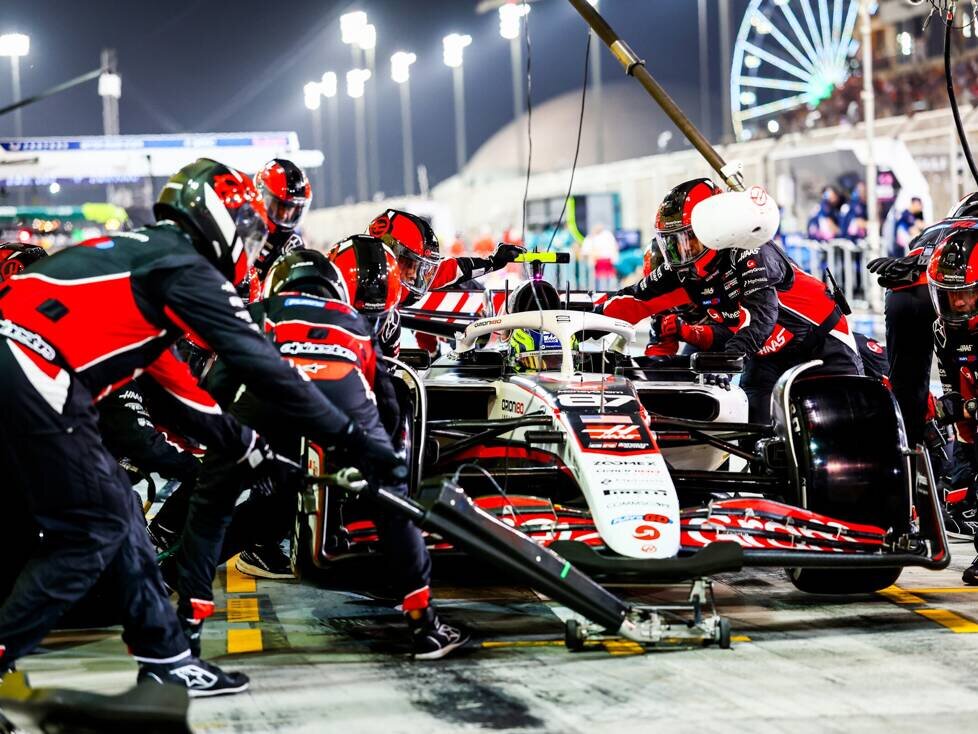
Around 20 people work on a pit stop in Formula 1: one position is more extreme than all the others and is directly in front of the arriving car.
A pit stop in Formula 1 is a precisely rehearsed interplay of precision, agility, and speed. Within a few seconds, the teams change all four tires, make adjustments to the front wing if necessary, and send the car back onto the track. Around 20 people are involved in such a stop.
Three mechanics work on each wheel, two more stabilize the vehicle, and two are on standby for possible front wing adjustments. In addition, there is a mechanic who lifts the rear of the car. However, the most demanding task is performed by the operator of the jack at the front. He stands directly in front of a race car weighing around 800 kilograms, which is heading towards his position at high speed and comes to a stop just a few centimeters in front of his feet. “You have to be pretty brave to do that,” explains Mark Lowe, sporting director of the Haas team. “A car is coming towards you at around 80 km/h. Although the driver has a stop sign for guidance, he also uses the front jack to align himself precisely and come to a stop correctly in the pit.”
Woe betide the driver if he doesn’t stop in time
There have been incidents in the past. One accident that stands out in particular was at the 2020 Emilia Romagna Grand Prix, when Lance Stroll drove into his front jack operator, who fell to the ground after the collision.
If the stop goes according to plan, the front jack lifts the car so that the other mechanics can do their work on the wheels. Once all the tires are correctly fitted, the front jack must be pulled out of the way at lightning speed so as not to cause any delay in getting going.
“The front jack has to remove the device as quickly as possible so that the car can be released immediately,” says Lowe. To perform this explosive task, front jacks must meet certain physical requirements.
They also train for pit stops repeatedly throughout the season.
Procedures are constantly being practiced
“At every race, we also complete real pit stops during practice sessions so that the team can internalize the procedure under race conditions,” explains Lowe. “We also practice different scenarios, such as what happens if a jack fails, who steps in, and what procedures then come into effect.”
In addition, working in the pit lane is not the only task for crew members on a race weekend. “Everyone on the pit crew actually has a main function, and working during pit stops is an additional task,” says Lowe. “The pit crew consists of mechanics, garage technicians, and electricians.”
The front jack operator is an example of how much responsibility and preparation goes into the spectacular seconds of a Formula 1 pit stop.