


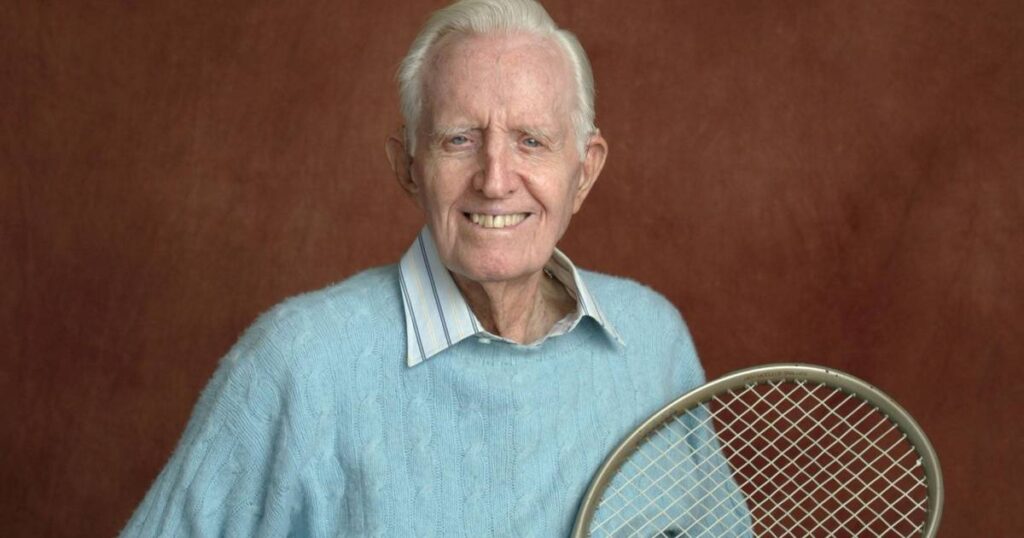
Seventeen years ago today, former tennis prodigy Sidney Wood, who made history at Wimbledon in a curious way, passed away.
Gottfried von Cramm, the legendary German tennis baron, was there. So was Fred Perry, the future Grand Slam serial winner from England, who later immortalized his name with an iconic fashion brand.
The 1931 Wimbledon tournament featured many prominent names that are still remembered today. In the end, a young man from the USA made history – in more ways than one. Sidney Wood, who died 17 years ago today at the proud age of 97, was the second-youngest winner of the traditional tournament before a certain Boris Becker pushed him back one place in 1985.
However, the circumstances under which Wood won at the time are a curiosity that remain unique to this day.
The youngest Wimbledon participant ever
Wood, born on November 1, 1911, in the town of Black Rock, Connecticut, celebrated a major tennis breakthrough on his 14th birthday in 1925: he won the Arizona State University tournament, which earned him the right to compete in the French Open (then known as the French Championship) and Wimbledon.
In 1927, the then 15-year-old cashed in his Wimbledon ticket: he lost in three sets to René Lacoste – another tennis and fashion icon – but remained in the memory as the youngest male participant ever.
The young top talent developed into a top player of the 1930s, reaching his peak in 1931 – once again at Wimbledon. However, it was a victory with a bitter aftertaste.
Sidney Wood won the 1931 Wimbledon final without playing
With a semifinal victory over Perry, who would go on to become a three-time champion, Wood advanced to the final at the All England Club. However, it never took place: his opponent and compatriot was unable to play the match due to an ankle injury.
Wood became the first and only player in history to win a Wimbledon final without playing. Wood was annoyed about the footnote to his greatest triumph: “Frank wanted to play, but he wasn’t allowed to. It was an insult to Wimbledon and the spectators,” he said later. Wood had been pressured to withdraw by his country’s Davis Cup committee – and had given in.
The walkover victory at Wimbledon remained Wood’s only major success. In 1935, he reached the final of the US Open, but lost to Wilmer Allison.
Emotional moment at the turn of the millennium
After his career, Wood made a name for himself as an inventor. He developed a synthetic surface for indoor courts, which was used in various major US tournaments in the 1970s. In 1964, he was inducted into the Tennis Hall of Fame, and in 2000, he led the parade of champions at Wimbledon to mark the turn of the millennium as the oldest living winner at the time. Wood, father of four children—one of whom died in a car accident in 1961—died on January 10, 2009. He was the last representative of a mythical era that included Perry, “Big” Bill Tilden, the Four Musketeers (Lacoste, Henri Cochet, Jean Borotra, Jacques Brugnon), and Suzanne Lenglen, the first female tennis star who died prematurely.