


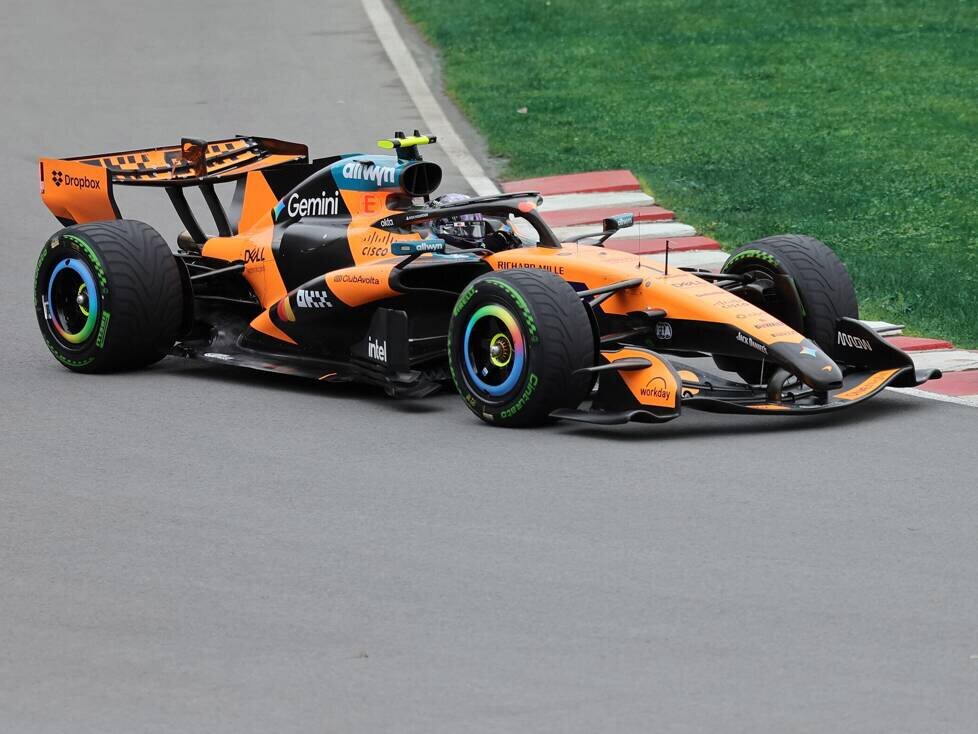
McLaren Team Principal Andrea Stella explains why the risky decision to start on intermediates at the Canadian Grand Prix was absolutely the right call at the time
Light rain had the track in Montreal firmly in its grip all morning, but conditions improved just in time for the 4 p.m. local time start. The vast majority of the field opted for slicks.
Not so McLaren. Lando Norris and Oscar Piastri were the only ones in the front row to take a gamble on intermediates from the second row of the grid. A choice that quickly turned out to be a costly mistake. Both drivers headed for the pits almost immediately to switch to medium tires.
From that moment on, the race spiraled completely out of control for McLaren. During his recovery drive, Piastri collided with Alex Albon, while Norris later had to retire his car early due to a mechanical failure. (To the race report)
The misfortune with the extra formation laps
But after the race, Team Principal Stella emphasized that the decision to go with the intermediates at the time it had to be made was by no means wrong. Arvid Lindblad’s stranded Racing Bulls car forced two extra formation laps, robbing McLaren of any potential starting advantage.
Precisely when track conditions were at their worst, these crucial laps under race conditions were missing. “You have to keep in mind that the tires are fitted five minutes before the start, and we had a window of about seven minutes to make an operational decision,” Stella explained.
“From our perspective, the track was extremely slippery. It was already difficult enough to get the tires up to temperature on dry asphalt, but at that moment it was slippery and it was raining. In a situation like that, you have to weigh which tire is the right one for that exact moment.”
And then the battle for survival began“
”After that, the rain stopped very quickly, and in my opinion, the double formation lap cost us the entire advantage of that decision,” the Italian continued.
“I would have really liked to see how the cars would have handled it on dry tires if the race had started on time. So we were just a bit unlucky that the rain stopped right then and we had to do those extra-long formation laps. In hindsight, we were punished for the decision, but when we had to make it, the conditions absolutely called for the intermediates.”
Stella, who had already warned of rain beforehand, also revealed that he personally intervened in the decision-making process. He was determined to ensure that his drivers made it through the first few laps unscathed. Cool conditions also made it difficult for those starting on slicks to get their front tires up to temperature.
Stella wanted to get through the first laps unscathed
Just how much grip the Inter initially offered became clear right at the start: Norris, who started from third place, catapulted himself to the front with an outstanding launch before his tire advantage turned into a tangible disadvantage.
“As far as the actual decision-making goes, the command center and the drivers divided that up relatively well. When the call for a decision came, I even gave my own input,” Stella added. “I just wanted to make sure we were on a tire that would get us through the first lap.”
In closing, the team principal asked for understanding: “We always have to be a little cautious when judging decisions based solely on the final result. You have to evaluate such decisions at the moment they have to be made. If the rain had lasted just a few minutes longer and the race had started on time, we would have seen cars struggling massively on dry tires.”