


The Audi R26 is being tested at the Circuit de Barcelona-Catalunya – the first glimpse of the new 2026 Formula 1 car generation!
A first taste of the 2026 Formula 1 season is making the rounds on social media. Video footage of the new Audi’s shakedown in Barcelona has appeared on YouTube and Instagram.
The car, which will compete under the name R26, completed a handful of laps at the Circuit de Barcelona-Catalunya as part of a film day. This makes the German newcomer the first team to put its new car on the track ahead of the official (and closed to the public) test at the end of January.
Both Nico Hülkenberg and Gabriel Bortoleto are said to have taken part in the film day. The main aim was to test Audi’s very first F1 powertrain under real conditions while the former Sauber team familiarizes itself with its new identity.
Technical check: What the video reveals
While some fake images had previously been circulating online – obviously AI-generated and disguised with a soft focus – the video footage from the YouTube channel F1 A TODO GAS shows the real R26 in action. Although the footage was shot from a distance behind turn 13, it still provides exciting details.
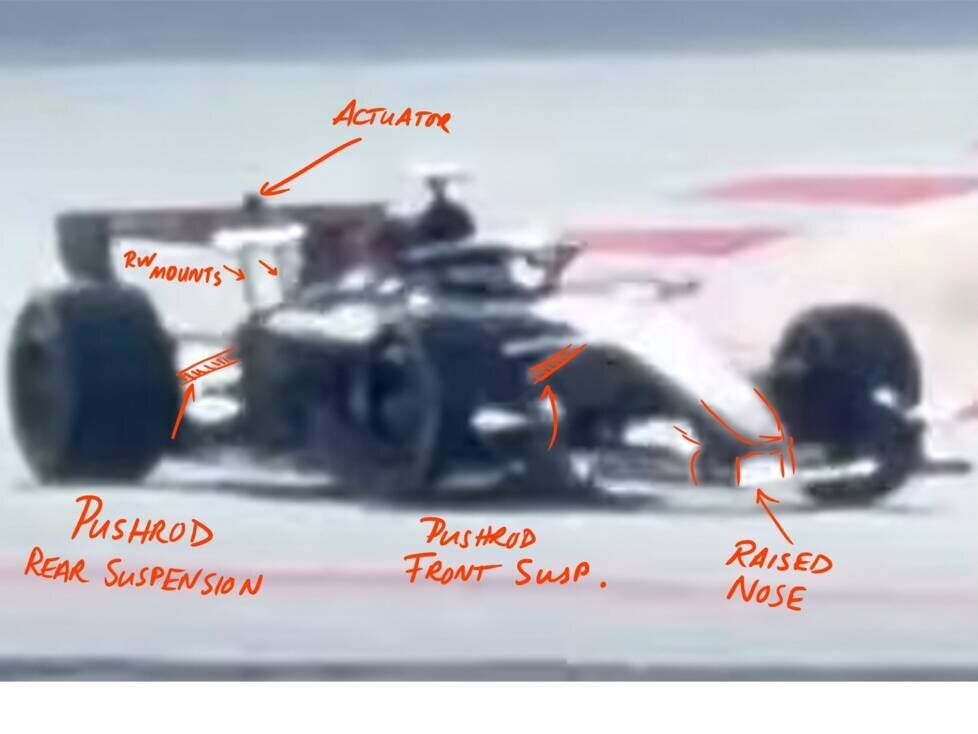
Proportions & front: The 2026 cars are 100 mm narrower, which is immediately noticeable. You can see a slightly raised nose and an “inwash” front wing. The end plates have footplates and superstructures to better control air turbulence at the front wheels.
Suspension: The biggest surprise is the switch to a push-rod front suspension. In 2024, Sauber had still relied on the pull-rod design used by Red Bull and McLaren. Now, the tie rod runs from the top of the chassis to the lower part of the wheel carrier.
️ R26 CARRO DA AUDI DE BORTOLETO NA PISTA EM BARCELONA audif1
YouTube/ F1 a todo Gas pic.twitter.com/eD0LaPSnMt
— Padoque Motor Brasil (@padoquemotorbr) January 9, 2026
Background: Under the old rules, pull-rods were considered ideal for “anti-dive” kinematics, which were designed to prevent the vehicle from diving during braking so that the airflow to the channels in the underbody would not be interrupted.
However, since the new underbodies are less sensitive to changes in ride height and the spring rates are likely to be softer, a return to push rods appears to be more efficient. There are also many indications of a push rod layout at the rear.
Side pods: Interestingly, Audi is not relying on Red Bull’s classic “downwash” concept, but on an inwash solution. This was the original concept planned by the FIA for the 2022 season before Mercedes went in a completely different direction with the zero pods and Red Bull with the downwash solution.
Here, the airflow is directed around the side pods in such a way that the effectiveness of the bottleneck area at the rear is maximized. As long as the flow is maintained, this improves the flow in the center instead of exposing the rear tires to unnecessary turbulence.

Sound and rear section
As for the sound, the new engine is not dissimilar to the current generation, but feels a little more powerful and throaty when accelerating.
The rear wing is also striking: instead of a single gooseneck mount on the DRS actuator, Audi uses a double mount attached to the underside of the main blade.