


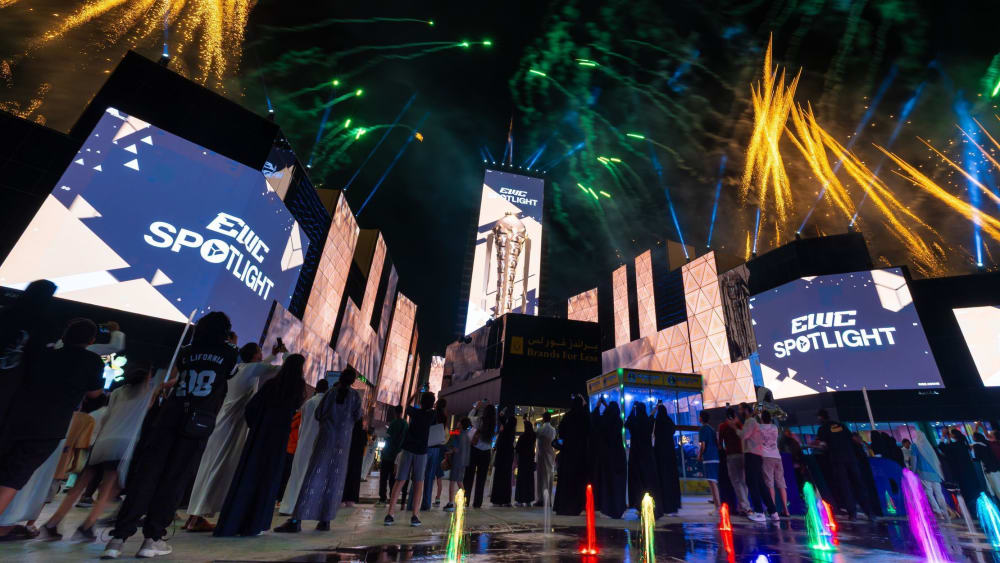
Halls, money, visions – it’s all there. But is the Esports World Cup in Riyadh really such a big deal? A look at the state of play between ambition and reality.
In arenas designed for eSports, teams from all over the world compete for big money in prominent titles. Surrounding the stadiums is a huge complex full of video game-related activities organized by publishers, organizations, and sponsors. With the help of the Esports World Cup, Riyadh is attempting to establish itself as the new capital of eSports. But what does that actually mean?
Riyadh wants more than just a mega event
For Mike McCabe, COO of the Esports World Cup Foundation, one aspect is particularly crucial: regular events. “If you can generate interest in esports with multiple events throughout the year and make the city a recurring destination,”
That is precisely what the Arab capital aims to achieve. The arenas were built by the national eSports federation for gaming events. The EWC will soon be followed by the Olympic Esports Games and other events: “We are striving to create more events,” says McCabe. However, that is still a long way off.
However, a global capital is defined by more than just its events: infrastructure, local communities, political support, and the interest of the rest of the world. These are all things that Riyadh needs to demonstrate.
Vision 2030: the road to becoming an eSports metropolis?
The question of political support is quickly answered: Gaming and eSports are a declared part of Saudi Vision 2030, Saudi Arabia’s reform plan to make the country less dependent on oil. Crown Prince and Prime Minister Mohammed bin Salman said back in 2023 that the Esports World Cup was “the next step in Saudi Arabia’s journey to become a global center for gaming and eSports.”
The associated investments are helping to build local infrastructure and attract skilled workers from all over the world to Riyadh – because that’s another thing that stands out: the majority of technicians, specialists, referees, and decision-makers are not from Saudi Arabia. Many will leave again after the Esports World Cup.
A local scene should and must grow. McCabe explains that one of his tasks is to “help train talent from the kingdom and support their growth.” The foundation seems to be there: according to an official government report, over 60 percent of the population identify as gamers.
To promote this and esports, tournaments have been held regularly in Riyadh since the announcement of Saudi Vision 2030. Esports teams from Saudi Arabia are also gaining popularity: as soon as players from local heroes Team Falcons, reigning club champions of the Esports World Cup, show up outside the arena, a crowd gathers.
White robes and Fnatic jerseys
The international media are also taking a closer look: CNN, NBC, and many other journalists from around the world are at the EWC. “It’s like a conga line,” says Fnatic’s Jake ‘Boaster’ Howlett about the rows of cameras and microphones in front of the Valorant finals. “It feels like a mountain I have to climb.”
The only thing missing is the fans – apart from the locals, only the most devoted fans have dared to travel to Saudi Arabia. There are always free seats to be found in the arenas, and for some matches the hall is half empty.
Nevertheless, the atmosphere is exuberant. Chants ring out amid Fnatic jerseys and traditional white robes. Many Saudis cheer not only for the local teams, but also for Gen.G and KCorp.
Not yet a capital city – but under construction
When asked, an Uber driver knew about the advertising along the main road, but thought it was just a small FIFA tournament. He had never heard of the term “Esports World Cup.” An isolated case? Perhaps. But it’s also an indication of how much pioneering work still needs to be done.
Riyadh is not yet the world capital of esports. But it is a place that is working at unprecedented speed and with government support to become one. The city has the necessary foundation and support – but whether it will truly become the center of a global scene will only be decided once the community has fully arrived.
We also spoke to Ralf Reichert, CEO of the Esports World Cup Foundation, about the goals and visions of the Esports World Cup ahead of this year’s edition. We also discussed accusations of eSports washing and his view of Saudi Arabia, which has repeatedly been criticized for its human rights record.