


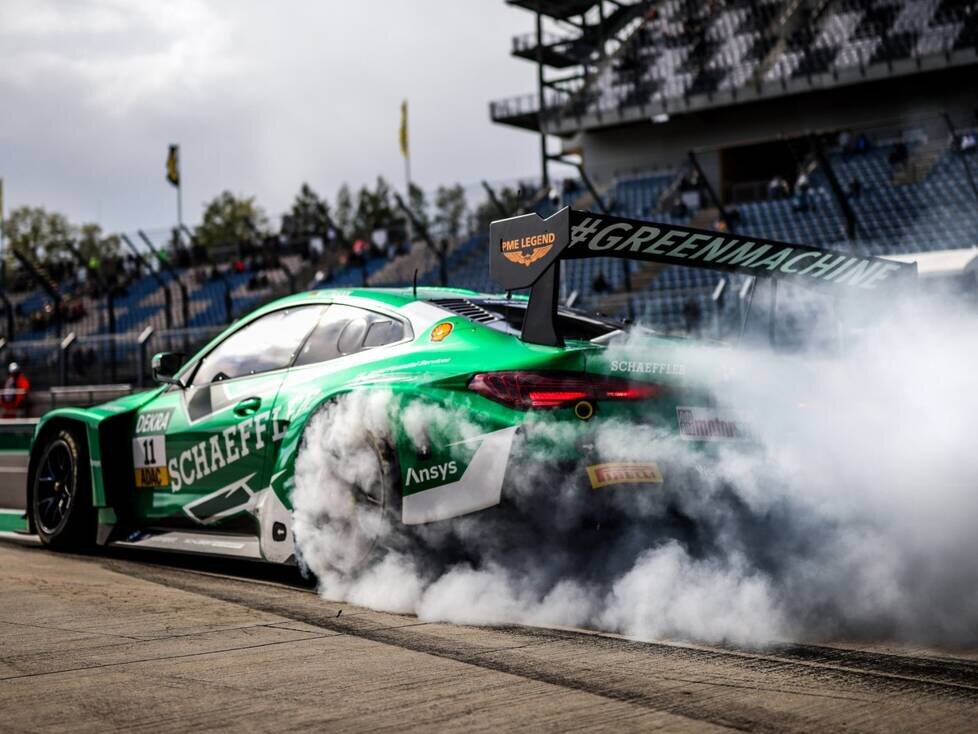
Following tire failures in earlier tests, Pirelli is playing it safe just before the DTM season opener: Nevertheless, further experimentation will take place at the Vallelunga test
The decision regarding efforts to develop an exclusive DTM tire for the 2026 season—in which the tire will be made available to all teams for the first time—has been made: Pirelli has decided to give preference to “Option 4.”
This is the most conservative choice among the four test tires that were tried out on the cars of all DTM manufacturers during test drives at Le Castellet and Vallelunga. And it is the one most similar to the DHG tire from Pirelli previously used in the series—which is actually intended for endurance racing.
Pirelli had originally planned to supply a tire that would enable better lap times and wear out more quickly. However, with the season opener in Spielberg (April 24–26) just around the corner, the company apparently does not want to take any major risks in this regard, following damage and significant criticism of the tires during the test at Le Castellet in late November 2025 with the more extreme “Option 1” and “Option 2” variants.
In the end, the “Option 3” and “Option 4” variants, which had been tested for the first time on March 2 and 3 during the tire test in Vallelunga, made the shortlist. The decision was made based on manufacturer feedback and data collected by Pirelli
According to team sources, “Option 3” features the same construction as the Pirelli tires previously used in the DTM, but with a different compound. With “Option 4,” it’s the other way around: the compound is the same as on the Pirelli P Zero DHG, but the construction is different. The lap times are correspondingly similar.
With “Option 3,” ‘peak’ performance and degradation were more pronounced than with “Option 4.” However, there were also concerns that the tire might not hold up on all cars during hot races and on aggressive asphalt, leading to excessive variations among the GT3 cars, which are balanced against each other via the Balance of Performance (BoP).
But has it now been definitively decided what the tire for the DTM season will look like? No, there are further adjustments to come. At the Pirelli test in Vallelunga, where all teams were scheduled to try out the new tire for the first time, “Option 4.1” will now be compared with “Option 4.2.”
What’s behind this? While both tires feature the same construction and compound as “Option 4,” there are differences in the manufacturing process of the two tires.
It is unclear what Pirelli hopes to gain from this comparison. However, there are rumors that the severe graining during the Le Castellet test in November may have been related to the manufacturing process. This is because as early as October 14 and 15, Pirelli had the DTM manufacturers test the more extreme variants “Option 1” and “Option 2” at Le Castellet, though without any significant issues.
The fact that two different tires must now be used again on March 24 and 25 also affects the schedule of the test in Vallelunga. Despite the new production facility in Breuberg, Hesse, Pirelli has only about a week to prepare—and is unable to manufacture enough tires for the entire field for both days.
While on the first day the two variants are to be compared with each other and with the reference tire DHG, on the second day only the tire that has proven to be the better choice is scheduled to be used. Although the teams are also to receive free testing time in Vallelunga to run through their own programs, so-called “performance sessions” are also planned.
During these sessions, the cars will be sent onto the track with a predetermined amount of fuel for qualifying and race simulations and will then be inspected during technical scrutineering. In this way, officials aim to collect important data so they are prepared to establish the Balance of Performance even with the new tires.