


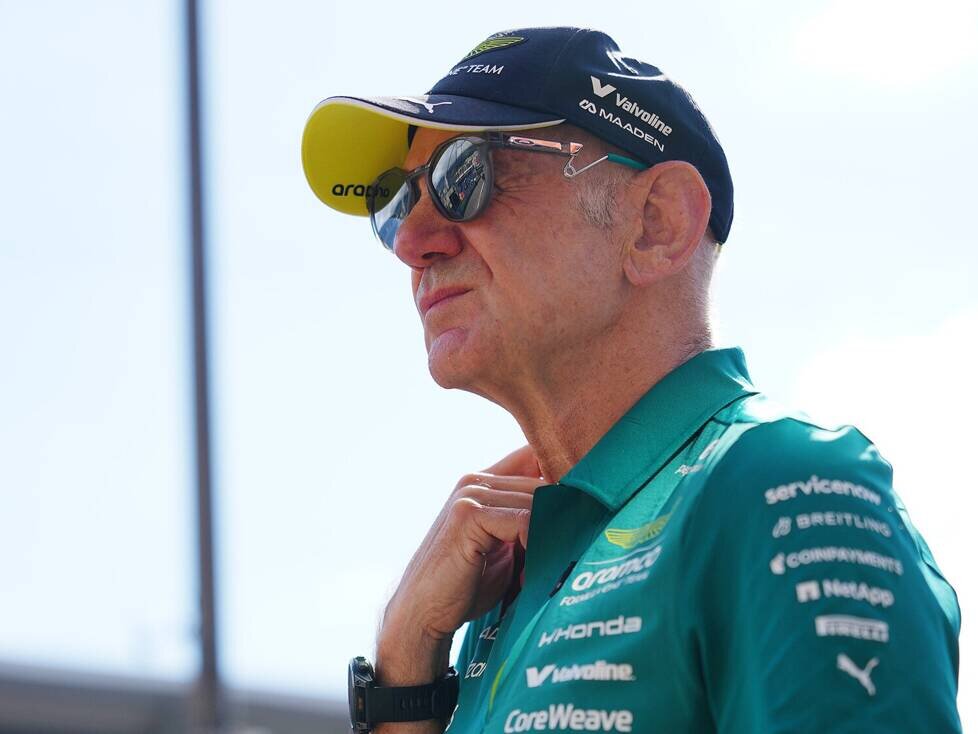
For Adrian Newey, skipping several minor updates is the “right decision,” even if the current races are “painful”
The Austrian Formula 1 race highlighted Aston Martin’s bitter reality. The team was nearly three seconds off the pace in Q1—and that on one of the shortest laps of the year. Even worse: Fernando Alonso was a full second behind even newcomer Cadillac. The Americans are pulling away from Aston Martin.
But: This is also due to their development strategy: Cadillac brought a comprehensive package with ten stated upgrades, while Aston Martin had: nothing. Along with Williams, it was the only team that hadn’t introduced any new parts for the car in the two weeks since Barcelona.
Aston Martin is banking on a major upgrade scheduled to arrive for the race in Hungary before the summer break, rather than bringing minor improvements to every race. This, of course, is having a negative impact on their current pace. “That was a painful decision,” designer Adrian Newey admits.
“While the others have stepped up their performance, we’ve practically stood still in comparison,” the Englishman says on AstonMartinF1.com. “As a result, every weekend can feel even more painful than the one before.”
This became evident in Austria, where Fernando Alonso and Lance Stroll once again stood no chance. Stroll had to retire early yet again due to an ERS problem, while Alonso finished 18th and a distant last, three laps behind the winner.
Here’s what’s in the new upgrade
But for Newey, temporarily foregoing upgrades is “the right decision” and “the right investment in our future,” as he puts it. “Our partners understand that this is a necessary rough patch that, quite frankly, we simply have to get through in order to come out stronger in the end.”
“We want to take a solid step forward in the second half of the season and an even bigger one for next year,” says Newey.
The focus is on a major upgrade set to be introduced on both cars in Hungary—the final race before the summer break.
Newey explains what will change on the car: “The front suspension remains unchanged, while the rear suspension has been slightly modified. We’ve developed a new nose and fundamentally redesigned the aerodynamic surfaces,” he lists.
“So even though the core structure remains similar, this is a major aerodynamic package, paired with a significant weight reduction. The goal is to get very close to the weight limit,“ says the designer. This will also require a new homologation and a new crash test of the front chassis section.
Why Newey is still holding back on predictions
Newey himself says he expects ”a big step forward,” but wants to hold back on specific figures. Because: “Our simulation tools simply aren’t advanced enough yet, and the data hasn’t been calibrated to reality as precisely as it needs to be.”
He criticizes: “In the past, this team simply invested too little in technical simulation tools—and by that I don’t just mean project management systems, but the fundamental physical tools themselves.”
“We’re now making up for those investments, but you can’t write and validate such programs overnight. It takes time to fine-tune them exactly to the real car,” says Newey. “They’re improving at the moment, but the real benefits of this work won’t become apparent until later this year.”