


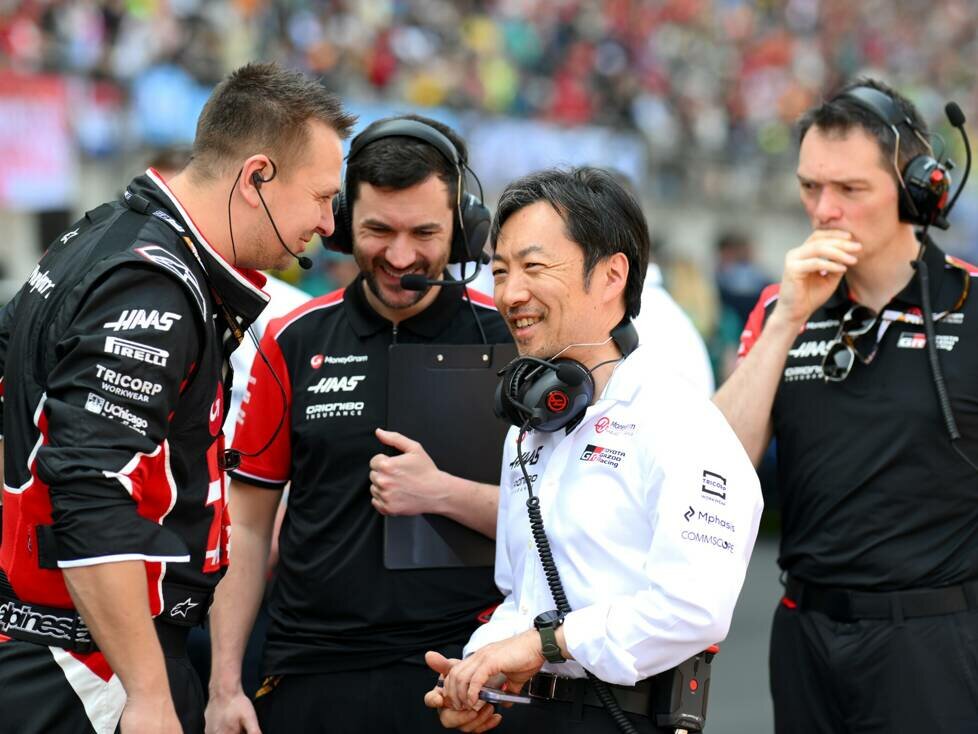
Haas and Toyota have entered into a technical partnership in Formula 1 – but the relationship appears to be closer than that, as there is a shared culture
The ink on the contract has long since dried: In October 2024, Toyota and Haas agreed on a technical partnership in Formula 1. But the partnership goes deeper than initially suspected: A unique culture is forming between the Japanese brand and the US team.
Haas will conduct the long-awaited TPC (Testing of Previous Cars) test in Fuji on August 6 and 7, 2025. On the first day, Japanese reserve driver Ryo Hirakawa will get behind the wheel of the two-year-old VF-23, followed by current Super Formula champion Sho Tsuboi on August 7.
Toyota is also present on the Gene Haas racing team’s car, as the Toyota Gazoo Racing (TGR) logo adorns the current car in the premier class. In addition, Toyota drivers are regularly used in test drives: Kazuki Nakajima, Kamui Kobayashi, Ritomo Miyata, and now Hirakawa and Tsuboi.
Toyota is monitoring developments
TGR motorsport boss Masaya Kaji is involved in the program and said back in January 2025: “We are looking at the current technology and what is coming in 2026. Formula 1 is slowly evolving in a direction that is valuable for Toyota.” However, with the potential return of V8 or V10 engines with sustainable fuel, some innovations would be scaled back.
“There is still uncertainty regarding the powertrains, and discussions and new rules are ongoing. It is not yet the right time for us to comment on this,” says Kaji. “Nevertheless, I believe that the pinnacle of motorsport should also stand for sustainability and technical innovation.”
“Formula 1 will certainly take these factors into account when the decisions are made,” Kaji hopes. “I don’t think any manufacturer will continue if these values are not pursued.”
Innovation and sustainability are important
Toyota believes in Formula 1 and its commitment to innovation and sustainability. That is why the Japanese are closely monitoring developments in the premier class. However, Toyota is not heavily involved, as the manufacturer does not supply either the engine or the chassis. Nevertheless, Kaji considers Toyota an important partner for Haas, with whom it competes in Formula 1.
“We are currently focused on building a strong team with Haas,” Kaji continued. “That won’t change in the future. We are steadily moving forward, step by step. I believe we will slowly see results. People will notice them soon. That’s great because we’re helping to build a shared culture.“
Kaji speaks of ”a team“ that stands ”side by side.“ ”The entire Haas team is proactive, thinks very positively, and tries to work with us. We are very grateful for that and hope it continues.”
A joint effort on many levels
In Ayao Komatsu, Haas has a team principal who embodies Japanese culture. He also emphasizes that Haas is “officially competing in Formula 1 with Toyota.” “Thanks to this joint initiative, we have achieved this,” Komatsu continues. “We conducted a TPC test in Jerez in January, which would not have been possible without Toyota.” According to the man behind the scenes, the cooperation with the Japanese is already bearing fruit.
“Haas and Toyota are currently building a team culture,” Komatsu said. “We are creating a team together. That’s a great thing. I don’t represent a manufacturer and can’t say what it means for them. But Formula 1 is a world championship, and technical innovation and sustainability are important issues. This includes the introduction of sustainable fuel and improving the efficiency of the powertrain.”
According to Komatsu, such a development is only possible with the commitment of the manufacturers. “Economically, Formula 1 is in a great phase and the teams are reaping the benefits,” says the team boss. “The engine manufacturers have to make large investments and do not necessarily get the same economic returns.”
According to the Haas team boss, this is a case for the F1 Commission. “As a team, we really appreciate the performance of the engine manufacturers,” he said. “It’s because of them that we have such technical development. We are discussing long-term ways to make Formula 1 valuable not only for the teams, but also for the engine manufacturers and other partners. Formula 1 must become a series where the manufacturers say, ‘It’s worth being here.’”