


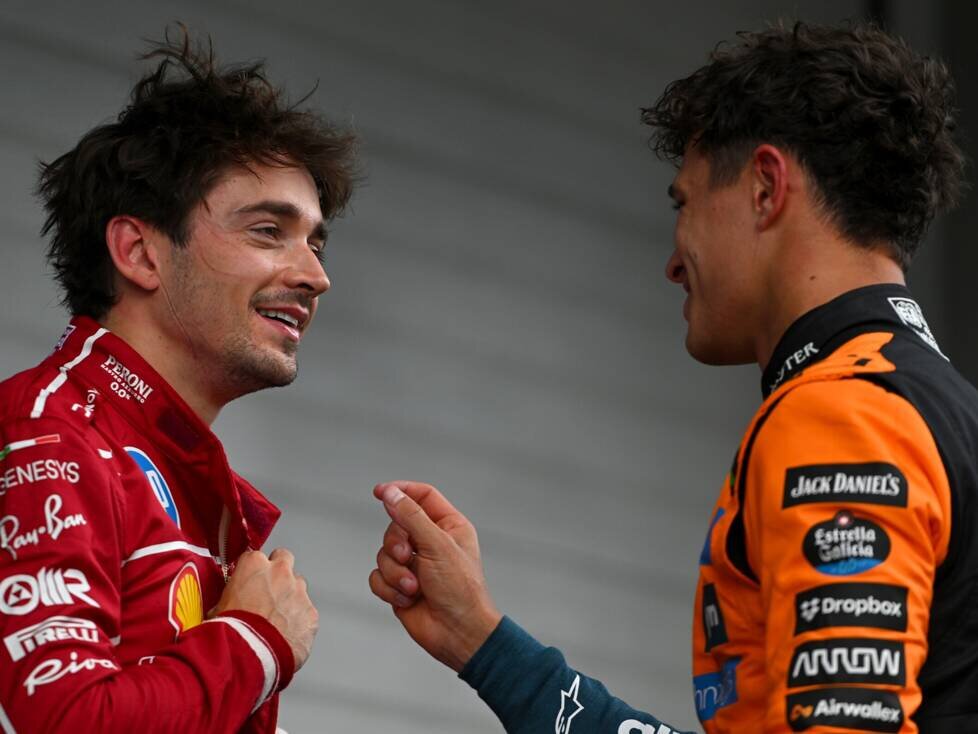
The new Formula 1 technical regulations are showing their first effects in Miami—but Lando Norris and Charles Leclerc still see fundamental problems with the rules system
The adjustments to the Formula 1 technical regulations have shown their effects under race conditions for the first time at the Miami Grand Prix. While the FIA classifies the changes to energy management as a step toward improving the quality of racing, the drivers have so far seen only limited effects on the actual race action.
Lando Norris describes the changes as a step in the right direction but still sees unresolved issues. “Some things have stayed the same as expected. There are still certain points where you get penalized the faster you go. And that’s something we drivers want to solve in the future, and I think Formula 1 as a whole does too,” explains the McLaren driver after his sprint victory.
Norris emphasizes that while driving in qualifying feels somewhat more natural, fundamental problems remain. “You want to go full throttle everywhere and get the most out of it. You don’t want to drive faster in a qualifying lap and be penalized for it. That’s not how it should be, but it’s heading in the right direction,” he continues.
Track characteristics influence assessment
At the same time, the world champion made it clear that the track in Miami is not one of the most critical circuits in terms of energy management. As a result, potential problems would be less noticeable than on other tracks.
In the race itself, the effects of the rule changes were also barely noticeable. “In the sprint race, nothing really changes,” said Norris. Overall, however, it was a step forward, even if further improvements could only be expected in the future.
Leclerc calls for realistic expectations
Ferrari driver Charles Leclerc also sees progress, but urges caution regarding expectations. “It’s also true that we need to have realistic expectations because we can’t change that much. I think some of these technical rules and the problems we’re facing will still persist in some way,” said the Monegasque driver.
While Leclerc praises the direction of the changes, he doubts that the current problems can be completely resolved. “We can minimize them, and I think the approach was right, and the steps the FIA has taken here have improved things. Whether we’ll ever get to a situation where these problems no longer exist, I’m not sure,” he says.
Another point of discussion is so-called yo-yo racing—that is, the difficulty of staying close to a car ahead for an extended period. According to Leclerc, the limited number of overtaking maneuvers in the Sprint is more due to external conditions. “I think today, the fact that it was so hot also led to the tires overheating very quickly when driving behind another car,” he explains.
Norris also expects this phenomenon to persist. “I do think it will still be there. There’s no reason why it shouldn’t,” says the McLaren driver. The conditions in Miami merely masked the effect.
The drivers largely agree that the changes are bringing initial improvements, but the fundamental challenges in the current rule package remain.