


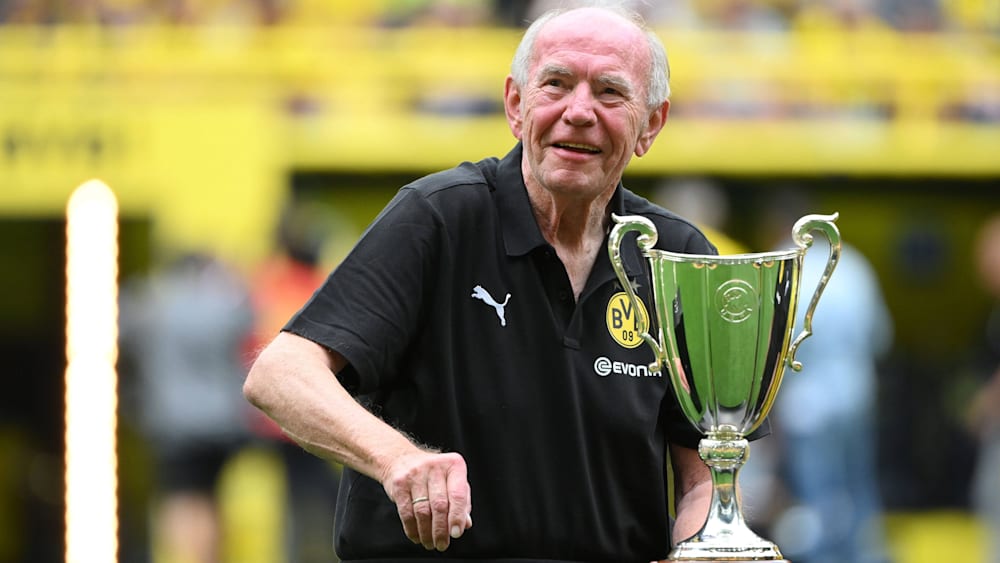
Borussia Dortmund mourns the loss of club icon Wolfgang Paul. The captain of the 1966 European Cup-winning team died at the age of 86 after a long illness.
Just recently marked the 60th anniversary of that historic day. On May 5, 1966, German soccer history was made at Hampden Park in Glasgow. Borussia Dortmund became the first German team to win a European Cup. With their victory over Liverpool FC in the European Cup Winners’ Cup, the team secured its place in history.
The team included greats such as Hans Tilkowski, Rudi Assauer, Siggi Held, Reinhard Libuda, and Lothar Emmerich. But the captain of coach Willi Multhaup’s squad was Wolfgang Paul. Now, it’s not just in Dortmund that people are mourning the defender, who passed away on Sunday at the age of 86. “This news makes us infinitely sad. Wolfgang was modest and down-to-earth. A loyal soul. A man of integrity. A truly fine person. A BVB icon. Wolfgang was more than a friend. I will miss him dearly,” said BVB President Hans-Joachim Watzke about Paul, who was the club’s first honorary captain, an honorary member, a recipient of the club’s golden pin, and chairman of the Council of Elders for many years.
It was hard to get past the “Stopper”
The 2-1 triumph in the Scottish metropolis—secured in a highly emotional match by a Libuda goal in extra time—was the highlight of the defender’s career; the fans had given him the nickname “Stopper.” He cleaned up at the back, he provided cover—Paul was always where the action was.
Especially on the way to Glasgow, in Glasgow itself, and everywhere else, Paul—who grew up in the Sauerland region—enjoyed the highest regard. His nickname was his trademark: It was always hard to get past “The Stopper.” These qualities had already come to the fore in 1962–63, when he won the championship with BVB; the DFB Cup victory followed in 1965.
Paul was appreciated not only in the Ruhr region because of his modest nature. The trained watchmaker remained connected to BVB even after his playing career; in 2024, he was named honorary captain. He continued to “defend” his nickname “Stopper” even after his 148 Bundesliga appearances, a career that ended in 1968 due to a serious injury.
No DFB appearances, but part of the 1966 World Cup squad
A career with the national team eluded him. In the spring of 1966, national team coach Helmut Schön had taken notice of him, but Paul never played in an official international match. Still, in 1966 he was part of the squad that finished as World Cup runner-up in England, though Paul did not see any playing time. By then, however, no one could take away his place in soccer history.