


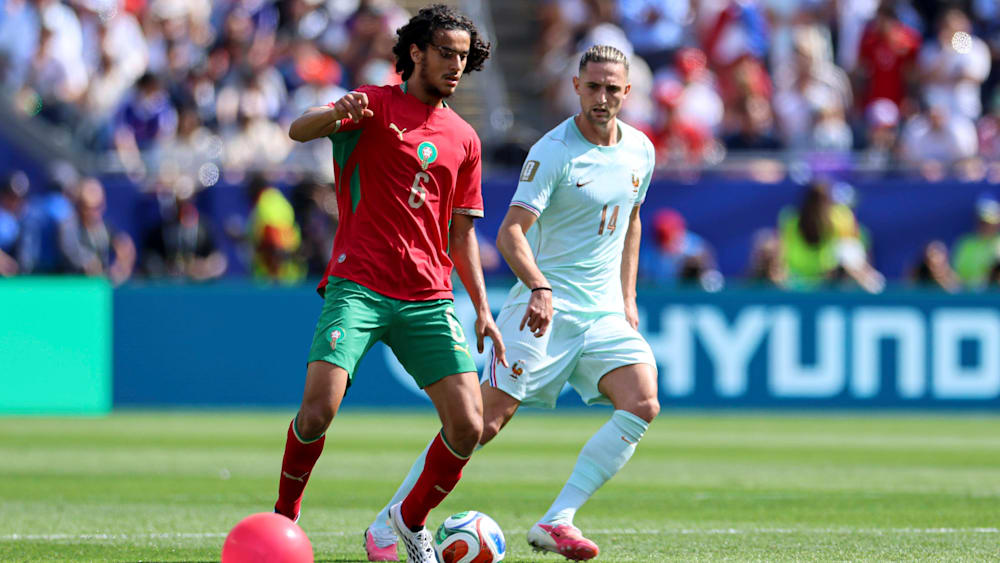
With a 0–2 loss to France, Morocco bids farewell to this World Cup. Africa’s best team has lived up to its performance from four years ago. But something is still missing to make it all the way. For now. And in four years, they’ll be hosting the World Cup.
Were the French too good, too dominant? Or did Morocco just have an off day? The truth probably lies somewhere in between. The fact is that while the North Africans defended well and tightly for one half, they ultimately lost 0–2—a defeat as deserved as it was one-sided—and hardly ever gave the impression, throughout the 101 minutes of play, that they wanted to contribute creatively to this quarterfinal.
The Moroccans were unable to compensate for the absence of their top striker, Ismael Saibari—whom the Bundesliga can look forward to seeing in a Bayern jersey. Brahim Diaz was just as ineffective on offense as Stuttgart’s Bilal El Khannous. Young star Ayyoub Bouaddi gave away the ball badly in the first half and rarely had control in the center. And even a world-class fullback like Achraf Hakimi couldn’t turn the game around. In short: Morocco reached its limits.
Despite the initial disappointment, Morocco can look back on this tournament with satisfaction. Four years after finishing fourth in Qatar—the furthest any African team has ever advanced in a World Cup—the country has proven that this was no flash in the pan, no fluke. Morocco has joined the world’s elite, becoming the only non-European country besides Argentina to reach the quarterfinals.
The Big Breakthrough with Home-Field Advantage?
In the group stage, the team led by head coach Mohamed Quahbi held record World Cup champion Brazil to a well-deserved 1-1 draw and defeated Scotland and Haiti. Sure, they could have been eliminated as early as the Round of 32 against the Netherlands, but the team showed resilience, equalizing in stoppage time and winning in a penalty shootout. In their subsequent victory over Canada, the Moroccans suddenly looked like the seasoned favorites; the 3–0 result was better than their performance.
The next step could come in four years. That step must be to hold their own—and even win—against the three or four top nations on the planet. The conditions for that aren’t bad. As a co-host with Spain and Portugal, Morocco is likely to enjoy home-field advantage for a long time, at least early in the tournament, and must ensure that this advantage inspires them rather than holds them back.
More importantly: This team has a bright future. Perhaps even with Bono in goal—even though he’ll be 39 by then—he once again confirmed his reputation as a penalty-kick specialist against France, making a save against Kylian Mbappé. The rest of the team will still be at an age where they can compete in a World Cup. They’ll be joined—or perhaps even replaced—by players who won the U-20 World Cup in 2025. So there’s no shortage of talent.
Morocco has proven for the second time that it can hold its own on the biggest stage. And, based on both a hunch and my impression: there’s even more to come.