


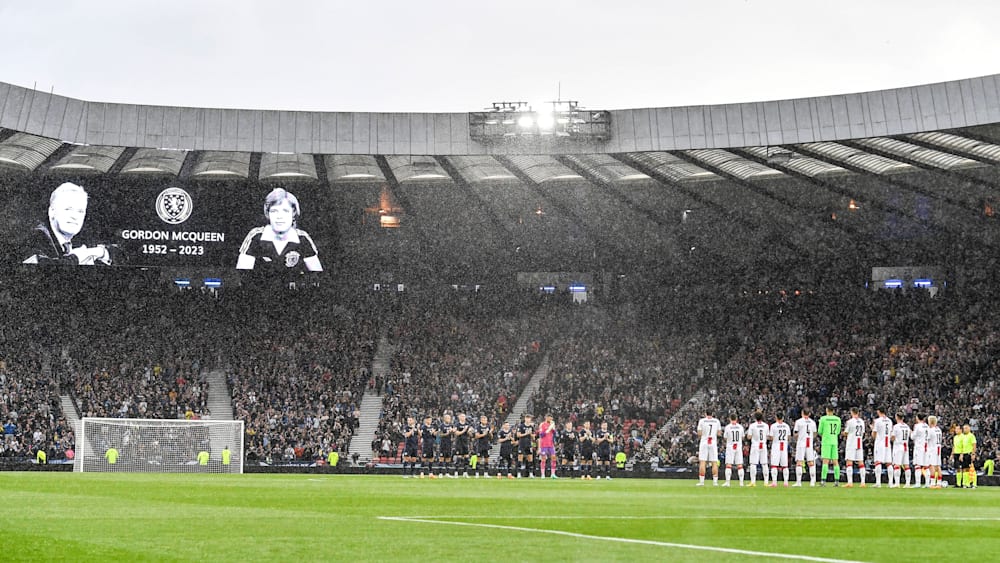
The debate about the harmful effects of headers on health has been reignited. According to a study, the death of former Scottish international Gordon McQueen can be attributed, among other things, to the headers he made during his active career.
There are already discussions in Germany about banning headers in youth soccer, and a case from the United Kingdom is now fueling the debate. According to the results of an investigation published on Monday, repeated heading was “probably” a factor in the death of former Scottish international Gordon McQueen.
The defender died in 2023 at the age of 70, and his family had already made his dementia public in early 2021. After his death, McQueen’s brain was examined at Queen Elizabeth University Hospital in Glasgow. Chief coroner John Heath now says he is “convinced” that the many headers in McQueen’s career led to chronic traumatic encephalopathy (CTE).
CTE is a degenerative brain disease caused by repeated traumatic brain injuries and can only be diagnosed posthumously by examining the brain. It is particularly common among American football players and boxers. CTE has also been diagnosed in isolated cases among former soccer pros, including Hilderaldo Bellini, captain of the Brazilian World Cup-winning team in 1958. In McQueen’s case, medical examiner Heath stated: “The combination of CTE and vascular dementia led to pneumonia. I determine the cause of death to be pneumonia, vascular dementia, and CTE.“ Neuropathologist Willie Stewart, who was also involved in the investigation, explained that the symptoms of CTE are cognitive decline and changes in nerve behavior that ”cannot be explained by any other disease.“ The symptoms are ”typical of professional soccer and rugby players after a long career.”
Debate also in Germany
McQueen played professional soccer from 1970 to 1985, including for Leeds United and Manchester United, winning the FA Cup with the Red Devils in 1983. In 1974 and 1978, he participated in the World Cup with the Scottish national team, but did not play in either tournament. McQueen played a total of 30 international matches.
“Dad loved everything about soccer, but in the end, soccer killed him,” McQueen’s daughter Hayley told the BBC. “I know many soccer players whose families have come forward with symptoms very similar to my father’s, and I think we will see more and more cases like this.”
At the end of 2019, an initial study in Scotland showed that professional soccer players are at increased risk of dying from dementia. At the time, a link with concussions and heading the ball was suspected. England, Northern Ireland, and Scotland have now banned heading the ball for children under the age of twelve. Although the DFB has not issued a ban, it does recommend “targeted training” because incorrect technique can pose a health risk. For example, heading training should not take place in wet and cold weather.