


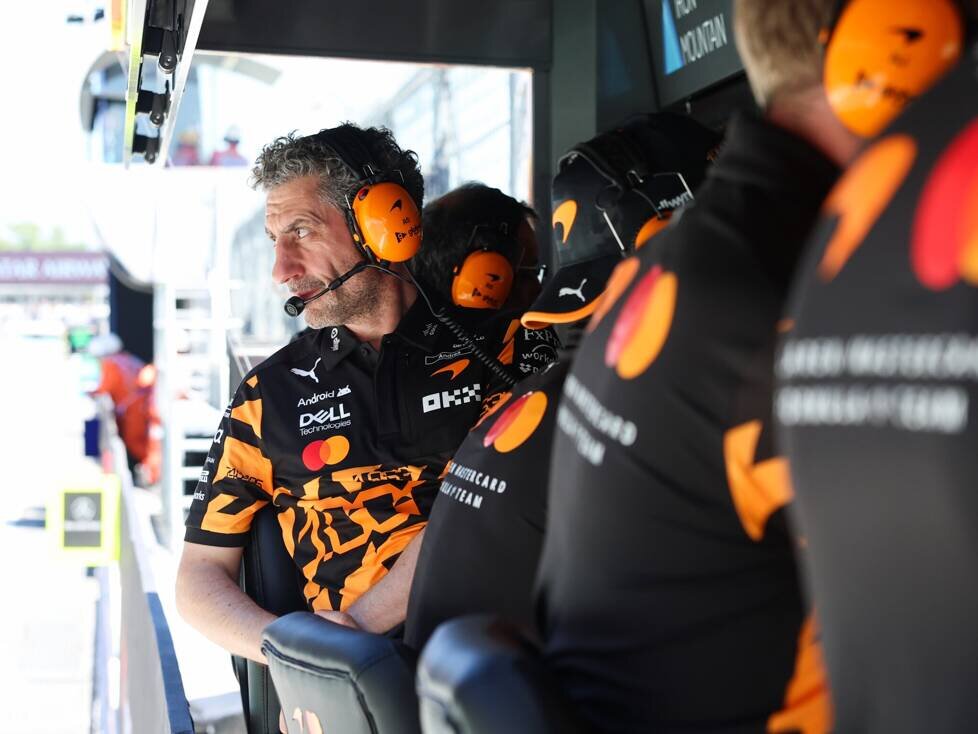
Why didn’t McLaren intervene despite Lando Norris’s pace advantage? — Andrea Stella explains the team’s decision and Lewis Hamilton’s role
After the Hungarian Grand Prix, Andrea Stella defended McLaren’s strategic decisions and emphasized that, despite Lando Norris’s obvious pace advantage, the team never at any point considered swapping positions between its two drivers.
After the race, Stella was asked whether McLaren had considered swapping the drivers’ positions given Norris’s higher pace, with the intention of reverting them later if necessary. “When you’re in second place, you’re naturally constantly evaluating all options,” Stella explained.
“You look at it from different angles. You ask yourself how you can win a race like this, how you can secure the maximum number of points for the team, but also how you can remain true to your own racing principles in the process.” Until Piastri’s first pit stop, the Australian had taken the lead fairly.
McLaren wanted to stay true to its own principles
“Up until the moment Oscar came into the pits, he had earned the lead fairly with his move through Turns 1 and 2. That’s why he deserved the chance to fight for the win,” says Stella.
The Italian acknowledges that Norris might have been able to pass his teammate on the track at other circuits. On this track, however, that would have been significantly more difficult.
“At other circuits, Lando probably would have passed Oscar. But here, it’s difficult. You need a very significant pace advantage on this track to pull that off. That’s why we were satisfied with giving Oscar the opportunity to fight for the win while also ensuring that we stayed true to our racing principles.”
Although McLaren had run through various scenarios, ultimately the race went perfectly from the perspective of the team’s philosophy. “There are always many possibilities to consider. But I think today’s race was very well executed from the perspective of our racing principles. I have to thank Oscar and Lando for that, because without two drivers who accept and support our approach to racing, that wouldn’t be possible,” Stella emphasized.
Hamilton forced McLaren to react
Another question concerned the timing of the pit stops. Stella made it clear that the strategy was not determined by the internal battle between the two McLaren drivers, but by the threat of an undercut by Lewis Hamilton.
“If you look at how the race unfolded, you can see that Hamilton would have been able to overtake both McLarens via an undercut with his pit stop. That’s why we had to react. If that was the right path to victory, we had to make sure that one McLaren stayed ahead of Hamilton.”
Since Piastri was in the lead at that point, the decision was made in favor of the Australian. “It had to be either Oscar or Lando. Oscar was in the lead, so we thought he was the right car to bring in.”
Norris benefited from his alternative strategy
“This opened up a different strategy for Lando. It had nothing to do with wanting to differentiate between Oscar and Lando. It was solely about preventing Ferrari from taking the lead.”
Ultimately, Norris’s race pace made the decisive difference. “On used tires, Lando was barely slower than the cars on fresh tires. That’s where he won the race today,” explains Stella.
“It was a victory based on his pace, and Lando had the opportunity to capitalize on it—but not because the team deliberately created that situation. The team simply had to react to Hamilton,” the McLaren team principal continues.
With this approach, McLaren ultimately secured the race win, although, according to the team, it both reacted to the competition and remained true to its own principles in managing the two drivers.