


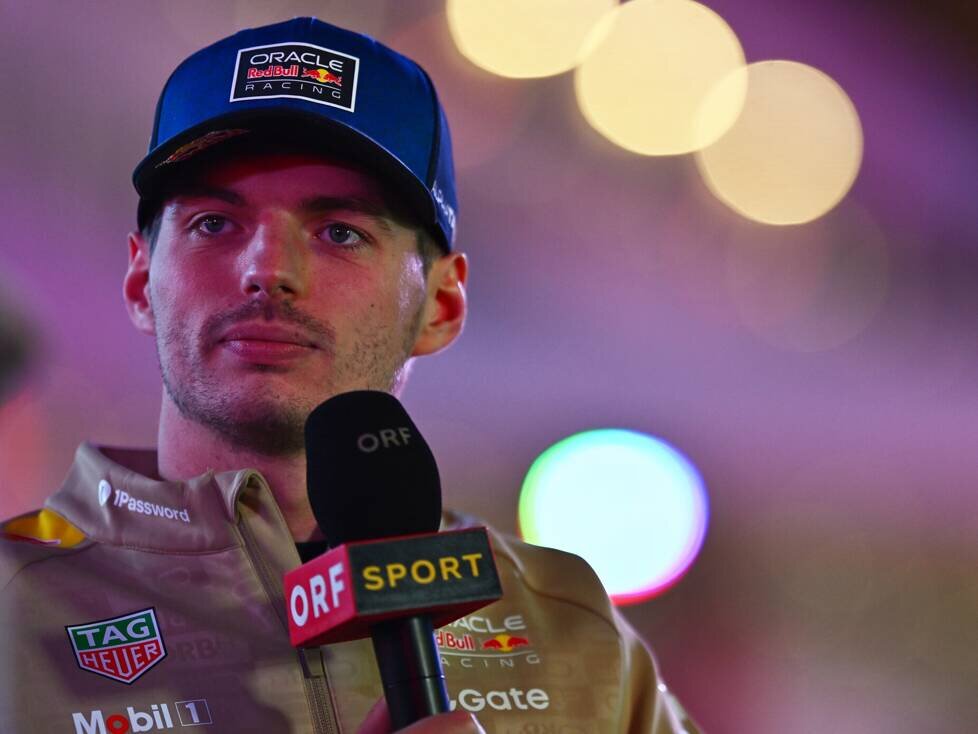
Max Verstappen welcomes the planned return of V8 engines from 2030 as a step in the right direction – though he himself would take a much more radical approach
Although the announcement by the Fédération Internationale de l’Automobile (FIA) was only online for five minutes, there is no doubt in the paddock that V8 engines will return to Formula 1. A framework agreement provides for a 2.1-litre V8 turbo engine with a smaller electric component, which is set to be introduced as early as 2030 rather than 2031.
Max Verstappen is one of the fiercest critics of the current regulations and thus one of the most vocal advocates of a change of course. The Red Bull driver welcomes the top-flight series’ plans for the future, but believes it is too early to say whether the new rules could keep him in the sport beyond 2030.
“I don’t know. It’s certainly better, but I can’t tell you yet what I’ll be doing after 2030. For the sport itself, however, it’s a good choice,” says Verstappen.
His contract, signed ahead of his home race at Zandvoort, runs until the end of 2030; he will therefore experience the new generation of engines for himself. As well as the eight-cylinder engines, the future regulations are also set to bring a further reduction in car weight.
When asked whether the plans for 2030 correspond exactly to what he himself would have drawn up as a rule-maker, the Dutchman waves the question aside: “No, but that’s also because, under my plans, you wouldn’t be allowed to race on some circuits at all – it would be too loud! If it were up to me, I’d scrap the turbo.”
“And I’d do away with the electric power. Perhaps you could use it as a ‘push-to-pass’, but not too much on the battery side. But then you simply wouldn’t be allowed to race on some circuits,” adds Verstappen, referring to the strict noise regulations at many modern race tracks – a problem that is naturally even more acute on street circuits in major cities.
Furthermore, there are sound technical reasons for retaining the turbocharger: “Fuel consumption also rises sharply without a turbo, so you’d need a larger fuel tank if you didn’t want to refuel during races. So, of course, I understand why people would want a turbo.” Apart from this practical argument, the turbocharger was also politically indispensable for keeping manufacturers such as Audi and Honda on board.
In view of all these factors, Verstappen regards the compromise reached as an important step forward. “If it were entirely up to me, I’d naturally go back to a V10 or something like that. That sounds even better, but I know that’s not realistic,” he admits.
“But this is good. It’s definitely a step in the right direction. However, it hasn’t been finalised yet, so there are probably still a few things they need to agree on.”
Nevertheless, the agreement in principle suggests that Formula 1 and the FIA have taken the drivers’ criticism of phenomena such as clipping and the peculiarities of the 2026 power units seriously.
Verstappen agrees, but also believes that those in charge have realised for themselves that things cannot continue as they are – even if they would be unlikely to admit this publicly.
“It’s probably a combination of them perhaps having listened to our advice, but also having realised that what we have now isn’t what we want! “Yes, it’s probably a mix of both,” Verstappen analyses.
Russell: Hybrids are a must
Support for the V8 plan also comes from George Russell, although the Mercedes driver takes a slightly different view to Verstappen on the subject of hybridisation: “Yes, absolutely. I’d love to see that happen. When I watch old videos of the earlier engines, I get goosebumps. It’s just that high-pitched screech that I miss from that era.”
At the same time, the Brit warns against completely demonising the electric component: “The purists will say: get rid of all the electric power. But if you look at how these cars have developed in recent years and the power some electric motors deliver nowadays: Formula 1 must continue to produce the fastest racing cars in the world. You simply need that. That’s the reality.”
Without hybrid support, today’s performance levels could hardly be achieved by an internal combustion engine alone: “If we return to V8 engines and also have a form of electric power that gives you those extra 400, 500 or 600 kilowatts to take the cars beyond 1,000 PS – that’s exactly what we want.”
He points out that the past wasn’t better in every respect: “It’s also worth thinking back to the last V8 era. They sounded fantastic, but the cars weren’t actually that fast. I don’t think many people realise that.”
Track records set in 2004 often remained unbroken for more than ten years, until the formula made a significant leap in performance in 2017.