


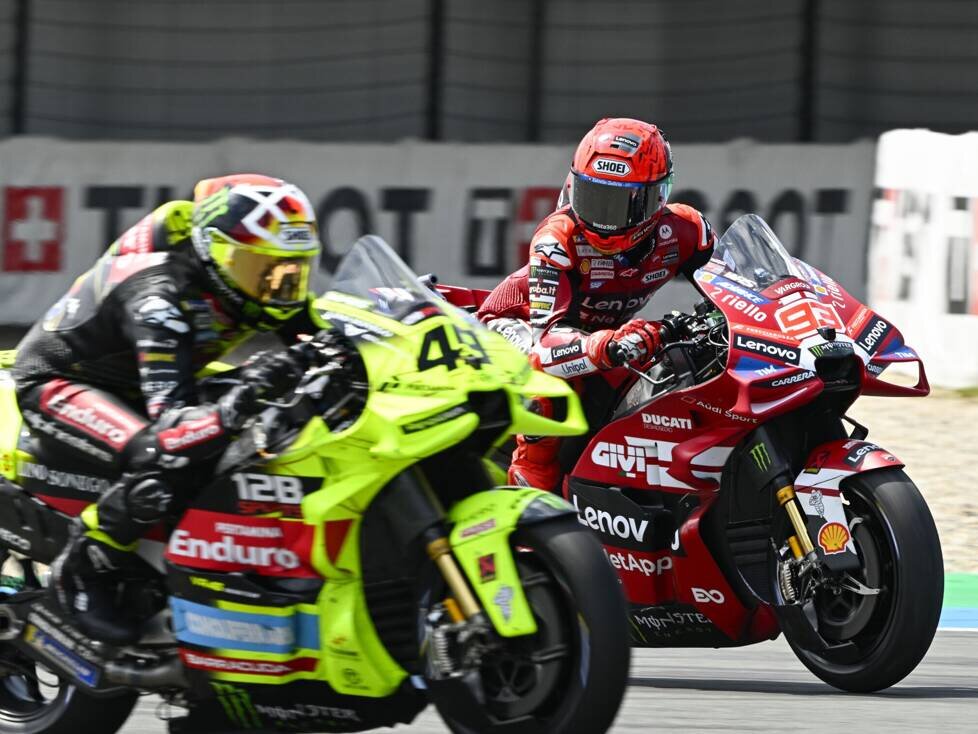
Will MotoGP be more action-packed in 2027? Marc Marquez has serious doubts and explains why, in his view, the tires in particular will be the deciding factor
In 2027, MotoGP is facing one of the biggest technical overhauls in its history. Smaller 850cc engines, significantly restricted aerodynamics, the elimination of ride-height devices, and the switch to Pirelli as the sole tire supplier are intended to make racing closer and more spectacular again.
But World Champion Marc Marquez, of all people, is tempering expectations. After his first experiences on the 2027 prototype, he appears surprisingly pessimistic.
In an interview with MCNews, the Spaniard explains that while MotoGP is generally heading in the right direction with the new rules, in his view it needs to take even more decisive action against the effects of aerodynamics.
“If it were up to me, I’d go even further,” says Marquez. That’s because the current generation of aerodynamics makes overtaking considerably more difficult. The Ducati star vividly describes the difference compared to the past: In the past, if a rider was two or three tenths slower than his competitor in practice, he could still keep up with the competitor’s pace in the race after a good start by riding in his slipstream.
Today, he says, that’s hardly possible anymore: “If you’re three-tenths slower today and riding behind another motorcycle, you’re suddenly five-tenths slower.” He explains that following another rider has become significantly more difficult due to aerodynamics.
As a result, passing maneuvers have become less frequent, and larger groups in the race are practically prevented. In general, the handling of modern bikes has changed significantly.
Due to the enormous downforce, today’s motorcycles lie “flat as a table” on the track. Slips that used to be recoverable often lead directly to a crash today because even small irregularities affect the aerodynamics.
Little Hope for a Major Impact from the 2027 Rules
Marquez doubts that the new generation of bikes will solve this problem. After his first test laps on the 850cc prototype, his assessment is sobering.
“Right now, I’m not very optimistic,” he openly admits. While he hopes the new motorcycles will lead to better racing, “based on what I’ve ridden so far, the bikes are more or less the same.”
In his estimation, the smaller engine alone will hardly lead to more passing maneuvers. Although the engine has less power, this also shortens the braking zones. “We’ll be braking even harder to compensate. In the end, passing will remain difficult—maybe even more difficult.”
From the grandstands, the difference in performance between the previous 1000cc bikes and the new 850s will likely be barely noticeable anyway, Marquez says.
Even today, full engine power can’t be fully utilized on many straights. Even at Misano, the current bikes don’t consistently reach their maximum torque. With the new machines, however, the full potential will be harnessed as soon as riders accelerate out of the corners.
Tires Could Become the Decisive Factor
The Ducati rider therefore doesn’t expect the biggest impact on racing to come from the engine or aerodynamics, but from an entirely different component: the tires.
“The biggest difference will be the tires,” he says. Depending on how the new Pirelli tires perform, the character of the races could also change: “Depending on the tires, we’ll see one type of race or another.”
In doing so, Marquez indirectly confirms the assessment of many engineers. While engine power and aerodynamics are clearly defined in the new regulations, the tire change is considered the biggest source of uncertainty. Pirelli is taking over from Michelin and is currently developing completely new slicks for the next generation of motorcycles.
Riders already have more influence—but is that enough?
Marquez generally welcomes the direction MotoGP is taking with the new regulations starting in the 2027 season. The introduction of standardized electronics alone has already increased the rider’s influence again, the Spaniard explains in the same interview. He also considers the reduction in aerodynamics to be sensible.
Nevertheless, the Spaniard remains cautious. His first impressions of the prototype do not lead him to believe that fans will automatically experience more spectacular races.