


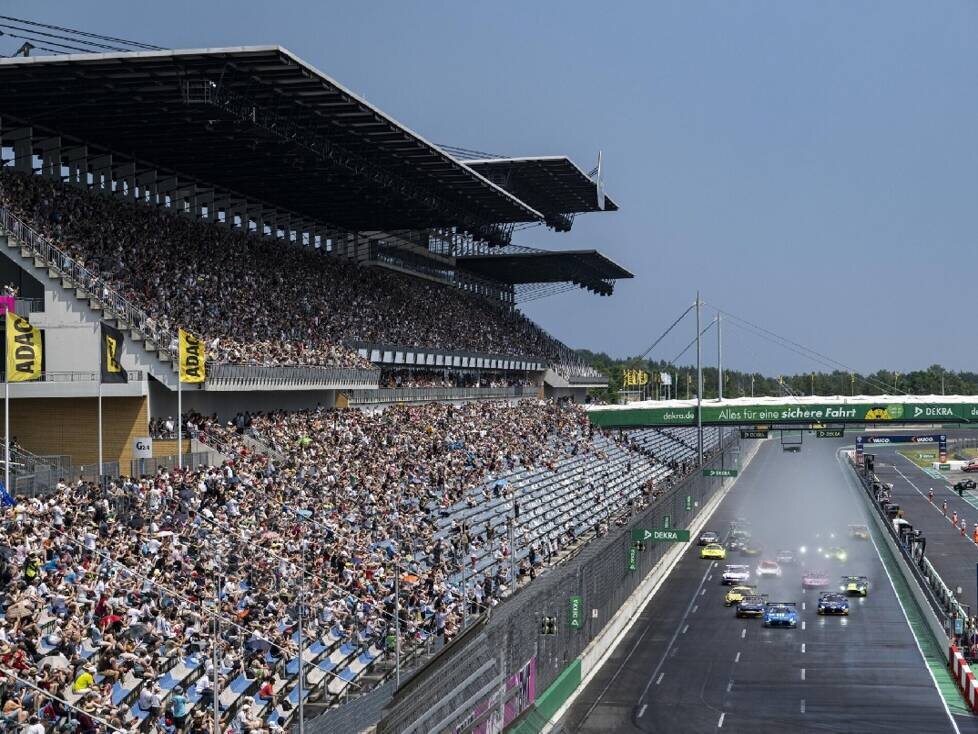
The Lausitzring will be modernized by 2027: What this means for the track’s DTM future and why a comeback for Turn 1 cannot be ruled out
What’s next for the DTM at the Lausitzring? According to official figures, the long-standing series drew 58,000 visitors to the former IndyCar track last weekend. That’s 6,000 more spectators than in 2025—an increase of nearly 12 percent. And there’s more good news: The track is set to be modernized soon.
The DTM operator, ADAC, has been calling for some time for a renovation of the aging racetrack, which has become an extremely bumpy surface due to severe ruts and consistently poses challenges, especially in the rain.
The renovation is intended to improve the drainage system, which caused major problems in 2024 because water could not drain away after rainfall. Above all, however, a new layer of asphalt will be laid to permanently eliminate the bumps. Core drilling has already been carried out to inspect the subgrade, and the entire track is scheduled to be repaved this winter.
Will the steep Turn 1 curve return to the DTM?
To be on the safe side, Lausitzring owner Dekra has asked the DTM to schedule the 2027 season slightly later. The repaving had actually been planned before this year’s event, but the work was postponed.
This likely had to do with the fact that Dekra wanted to make several investments in the facility—which also includes a test track and, since last year, Europe’s largest battery testing center—but then adjusted its plans. Now, however, the time has finally come, meaning nothing stands in the way of a long-term future for the DTM.
Interesting: Officials have also discussed whether the steep Turn 1 curve—which was part of the DTM layout until 2022—should be repaved. A decision has not yet been made.
However, repaving would theoretically make it possible to use the spectacular turn—which is currently barely drivable due to bumps—for the DTM again, even though the ADAC currently prefers the layout with the twisty first sector because of the overtaking opportunities it offers.
The drivers were informed at the drivers’ briefing at the Lausitzring that the track will be repaved by next year—and this was received very positively.
“My hands and my back were wrecked”
“My hands and my back are wrecked,” says DTM leader Matteo Cairoli after his triumph on Sunday. “It’s really bumpy, really rough, so you really have to stay strong and suffer a bit, but it had a happy ending,” says the Italian, who made his breakthrough in motorsports at the Lausitzring 13 years ago, delighted with his victory. What does the 30-year-old have to say about the planned repaving? “Sounds good!”
While some drivers at the Lausitzring reportedly even lost their fillings due to the asphalt, not all reactions are negative. “I’d be happy if that’s the case,” says Lausitzring specialist Lucas Auer, who has already secured four victories on the track, viewing a resurfacing positively. “But even as it is now, the bumps make it exciting. It’s really hard to brake.”
According to Auer, the bumpy asphalt gives the track its own character—and poses a driving challenge. “Sometimes you have to hit the line exactly,” he says. “If you cut in on the inside, you have to know exactly where, because there are a few bumps.”
ADAC had wanted new asphalt earlier
In some places, there are also different lines you can choose to avoid the bumps—and especially for the ABS system, which is installed in all GT3 cars, the unevenness is a major problem. Does Auer want the track to remain on the calendar? “Ideally three times—at the start, in the middle, and at the end,” the Austrian replied after Sunday’s scorching race.
Rumor has it that the ADAC, as the DTM promoter, had previously called for new asphalt at the Lausitzring, but the project was postponed. This likely had to do with the fact that Dekra wanted to make several investments in the facility—which also includes a test track and, since last year, Europe’s largest battery testing center—but then changed its plans.
But now it seems the time has finally come. Despite the extreme heat, this year’s event was a success—and last year, too, the event attracted more visitors than the Sachsenring and Oschersleben, making it the number one venue in the former East German region in this regard.