


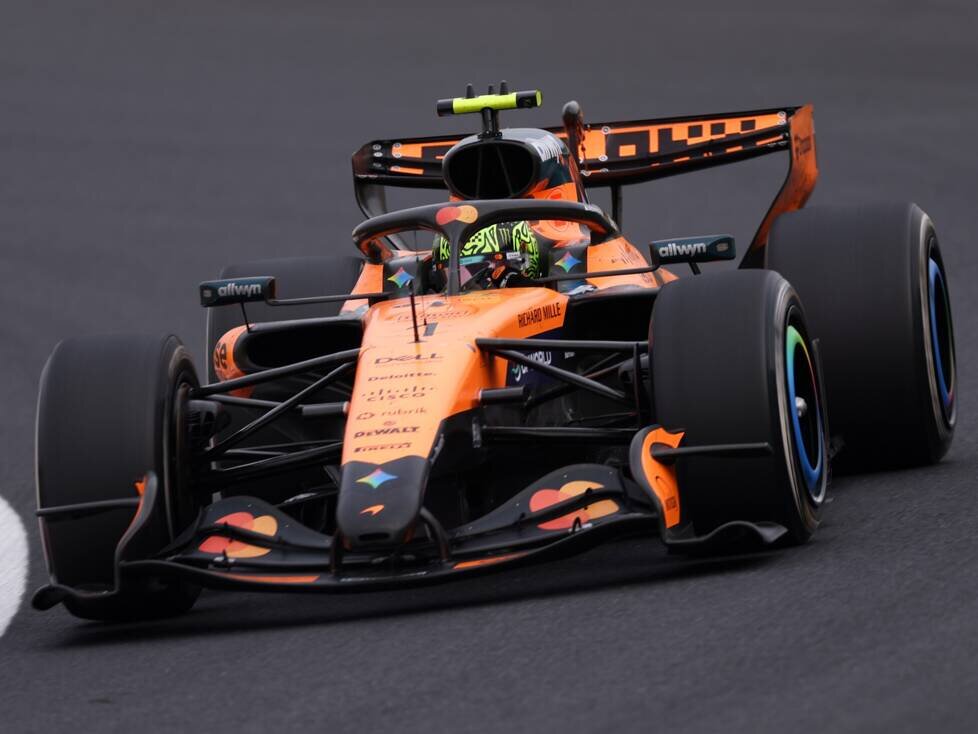
Lando Norris explains why many Formula 1 drivers have been so annoyed by qualifying recently – they are currently forced to drive against their own instincts
The rule changes that Formula 1 and the FIA decided on last week will come into effect from the Miami Grand Prix this weekend. Among other things, these are intended to ensure that the drivers can push more to the limit again in qualifying.
Lando Norris explained in this context why he and many other drivers were so frustrated, especially in qualifying at the beginning of the year. At the heart of the problem is the fact that you often lose time, even though as a driver you actually have the feeling that you are faster.
In the past, qualifying was simply a case of trying to “brake as late as possible” in every corner, carry as much speed as possible into the fast corners and be back on the gas as early as possible at the exit of the corner.
In summary, the aim was simply “to be as close to the limit as possible at all times”, explains the world champion. Ultimately, it was about which driver could push “one to two percent” more than everyone else. But this element has disappeared in 2026.
“It’s precisely this one to two percent that makes things exciting,” Norris emphasizes, explaining that a driver has surprisingly been able to secure pole position in the past “because he has taken these few small risks.”
Risk is no longer rewarded
“And you’ve sort of taken that element away,” he says in frustration. But why is that? The background to this is the new cars this year, which force the drivers to pay attention to their battery even in qualifying. If you are too fast, you run out of energy too quickly.
Norris cites an example from China this year: “I accelerated five or ten meters earlier [in a corner]. That feels good. You can see the delta getting smaller. Then you come onto the straight and just slow down. That doesn’t feel good in the car.”
“You think to yourself: I did a better job here. I took the risk,” says Norris. But the consequence of the resulting lack of energy is “that you drive ten km/h slower on the straight and you lose more than you ever gain.”
While the corresponding situation in the past would have led to a better lap time, Norris was even slower in this case – although the driver did nothing differently. The only difference is the car or the drive system.
It still depends on the driver, but …
Even more absurd, according to Norris, are cases in which a driver “sometimes even benefits from a mistake because it saves battery in a certain way,” explains the world champion, emphasizing that as a driver you have to drive against your own instincts, so to speak.
“In an ideal world, none of this would exist and you would simply drive as fast as possible. You still drive as fast as possible, but from a certain point of view, you can’t accelerate here, you can’t accelerate there,” explains Norris.
The situation is particularly complicated because the driver has no influence on the energy output. This is controlled automatically by a machine learning algorithm. According to Norris, however, this does not mean that the computer is now primarily responsible for the qualifying result.
“As a driver, you still have to do a good job,” he clarifies and emphasizes: “You can’t deny the person who gets pole position anything, because ultimately they have to drive.” You simply have to “make the best of what you have”, says the world champion.
However, the “special feeling” from qualifying in the past is no longer there. It remains to be seen whether this will change with the rule adjustments for Miami.