


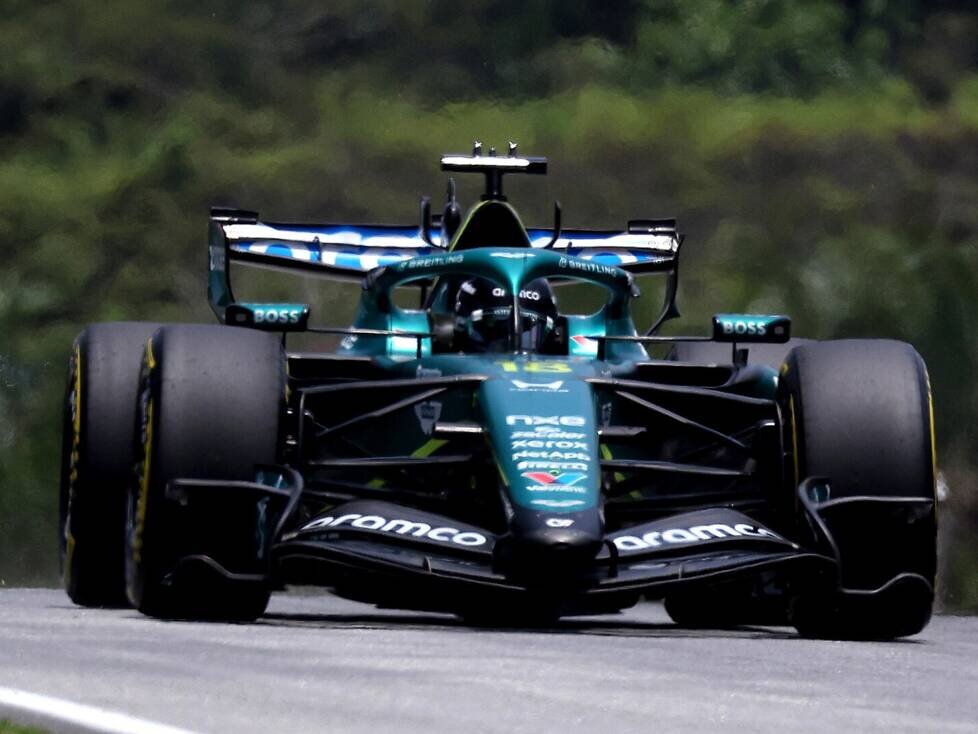
According to Lance Stroll, Aston Martin is losing two seconds per lap to the competition because of Honda’s power unit: the car has made good progress
It’s well known that the Honda engine is Aston Martin’s major weak point, but this is the first time the drivers themselves have put a figure on just how far behind the Japanese power unit is: “We’re two seconds off the pace because of the engine,” reveals Lance Stroll in Malaysia.
In doing so, the Aston Martin driver makes it clear just how serious the problems are from his perspective. Admittedly, the team took a step forward in Budapest with a major upgrade package. Yet whilst chassis development appears to be heading in a clear direction, the powertrain remains the big unknown – including with a view to 2027.
“I think the big question mark is the engine. We don’t know where we’ll be at the start of ’27,” explains Stroll. When it comes to the car, however, they know what needs to be done: “We have a plan, we’re heading in the right direction. We know what we need to do to generate downforce on the car.”
Honda remains Aston Martin’s biggest challenge
The gap varies depending on the circuit. Stroll estimates that the Honda power unit costs them one to two seconds per weekend. This becomes a particular problem on circuits with long straights. “Circuits with long straights are worse for us,” he says. “On circuits like Baku and Monza, there’s not much you can do if you’re two seconds off the pace because of the engine.”
However, it is not easy to determine exactly how much of the deficit is down to the engine. Honda supplies Aston Martin exclusively, so there is no direct comparison with another team using the same power unit. This also leaves open the question of how much the chassis, with its aerodynamic drag, contributes to the shortfall.
Nevertheless, it is no secret that Honda is under pressure. The manufacturer has already been granted additional development opportunities this year under the so-called ADUO regulation. Because the internal combustion engine was more than four per cent behind the Red Bull and Ford benchmark, additional resources were released for improvements.
Originally, Honda intended to focus largely on the power unit for 2027 and introduce only one upgrade this season. However, a revised turbocharger has since been introduced. Among other things, this is intended to improve drivability, something with which Alonso and Stroll have struggled so far. There are also continuing issues with energy recovery and the delivery of electrical power.
Aston Martin sees progress with the chassis
A look back at history shows that the engine is not the only possible cause. When McLaren ended its partnership with Honda in 2017 and switched to a different engine supplier, it became clear that its own chassis had also contributed to some of the problems. High aerodynamic drag can slow down even a powerful powertrain on the straights.
Stroll nevertheless believes the development of the AMR26 is on the right track. “As far as the car is concerned, we know that, compared to everyone else, we started development for the new regulations late. We took a big step forward in Budapest,” he says.
Just how much progress has actually been made, however, also depends on how much power Honda can still unlock by the end of the season. According to Stroll, Budapest – with its many corners and few long straights – was probably the best race of the year. On circuits with long full-throttle sections, however, the gap is particularly noticeable.
“We need to work on issues relating to drivability. That’s a major limitation for us. And then simply on the power on the straights,” explains the Canadian.
This leaves Aston Martin with a crucial question: how much further can the car be improved if the engine continues to cost them up to two seconds? Stroll’s contract extension for 2027 has already been confirmed. Whether the team can make a comparable leap forward with the power unit by then, however, remains unclear.