


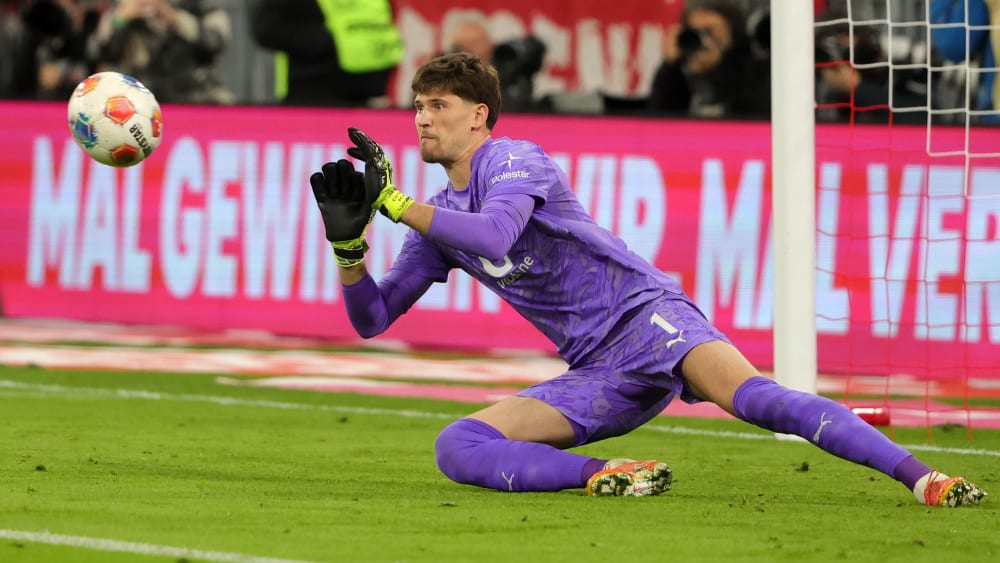
It was a top match with two completely different halves—from which BVB was able to draw encouraging conclusions despite the 1-2 defeat in Munich.
When the whistle blew at the end of the top match of the seventh Bundesliga match day and the points were distributed, at first glance everything was as it had always been recently: The FC Bayern players celebrated with their fans, while their opponents—this time Borussia Dortmund—hung their heads in disappointment. Once again, the winner on Saturday came from Munich. For the seventh time in seven games in this still young season. With a goal difference of 27:4. Was the 2:1 victory against their supposed fiercest rivals an expression of the invincibles’ total dominance? Almost!
45 minutes to forget for Dortmund
No other team this season has come as close to winning a point against FC Bayern as BVB did this time – despite a completely botched first half that led to the visitors’ first defeat since March. “To survive in Munich, you have to play with courage, you have to play with drive, you have to play with guts. We lacked all of that before the break,” said Dortmund center back Nico Schlotterbeck, annoyed about 45 minutes to forget, after which the score of 0-1 was still the best outcome from Dortmund’s point of view.
BVB coach Niko Kovac had mismanaged his old stomping ground, as he himself admitted after the game when he complained about referee Bastian Dankert’s lack of consistency: “My first half wasn’t good, but his entire game wasn’t good,” he grumbled in the direction of the referee, who took a generous line on Harry Kane’s push against Serhou Guirassy before the 1-0, which he then failed to follow through on consistently. But even Dortmund’s coach knew that it wasn’t Dankert’s fault that the first half went against BVB – rather, it was down to their own plan and its implementation by the players.
At half-time, Kovac corrected his changes – with success.
Out of respect for FC Bayern, BVB had changed their recently successful 3-4-3 formation to a 5-3-2, thereby limiting themselves. Eight out of ten field players were primarily defensive, so there was no relief up front against an opponent who, led by the ubiquitous Harry Kane, ran the ball and their opponents like a perfectly tuned clockwork. “The fact that Kane dropped back caused us problems,” admitted Kovac – and he responded to his team’s weak performance at half-time by reversing the tactical changes.
From then on, it was clear to see why BVB had been so difficult to beat recently – and that even the seemingly invincible FC Bayern had weaknesses that no competitor had been able to expose this season. Neither RB Leipzig nor Eintracht Frankfurt, nor Chelsea FC in the Champions League. In their tried-and-tested 3-4-3 formation, BVB attacked earlier, increased their possession, fought hard in direct duels, and thus provoked Munich into making mistakes. “We were the only team that came close to FC Bayern in recent weeks,” said BVB sporting director Sebastian Kehl, who was all the more annoyed about what he considered to be a “poor” first half.
Kobel: “Maybe it will get exciting again”
“We have to focus on ourselves. We saw today how good we can be. We have the quality. We have the power,” said Gregor Kobel, summarizing Dortmund’s insights from the avoidable defeat against the absolute favorites for the championship. And yet: Munich now has a five-point lead over Leipzig, six over VfB Stuttgart, and even seven over BVB. So is it all over after less than a quarter of the season? Wait a minute! In any case, BVB – which has not officially positioned itself as a contender for the title – has not given up yet, as Kobel made clear: “We want to get the most out of it – and who knows: maybe it will still be a close race.” Just like in the second half in Munich, where only at first glance was everything the same as in the previous six match days.