


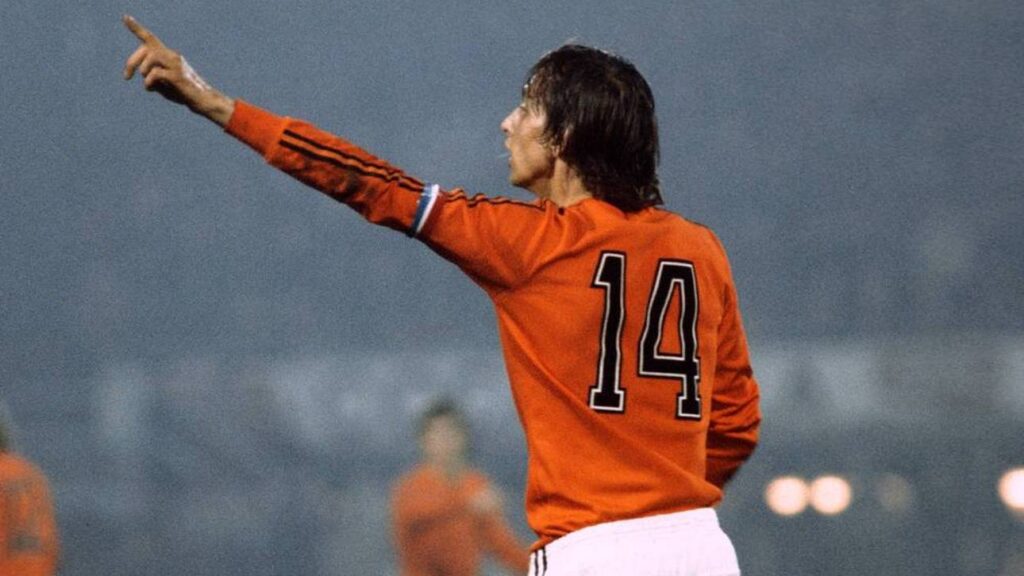
Johan Cruyff changed the game of football – both as a player and as a manager. His legacy lives on, not least through his influence on Pep Guardiola.
There are players whose names need not even be mentioned. For some, a number is enough – and everyone knows who is meant.
14 is the number that Johan Cruyff wore. At Ajax Amsterdam, where that shirt number has not been assigned for years. In the Dutch national team, which he almost led to the World Cup title as captain at the 1974 World Cup in Germany.
But it is not just the Netherlands that owes Cruyff a debt of gratitude, nor just Ajax and FC Barcelona, where Cruyff set new standards as both a player and a manager. The whole world of football owes a debt of gratitude to the man who died of lung cancer eleven years ago today at the age of 68. On the very day of his death, the Elftal face Germany at the Johan Cruyff Arena, named after him.
Radical reformer
Michel Platini, who like Cruyff was voted European Footballer of the Year three times, regarded the Dutchman as “a friend” and even the “greatest player of all time”.
The Spanish press, in particular, mourned him as, depending on the outlet, a genius, a visionary, a legend or simply a revolutionary. “Heaven has a new playmaker,” wrote the English *Sun* aptly. “The Golden Tulip bids farewell,” read the Portuguese sports newspaper *Record*.
At Ajax, Barcelona and the Dutch national team, there was a time before Cruyff and a time after him. The lanky striker not only brought success to his teams, he revolutionised them.
Together with manager Michels, Cruyff embodied ‘Voetbal Totaal’
Together with the then manager Rinus Michels, he radically transformed Ajax’s style of play in the early 1970s; on the pitch, he embodied the entirely new concept of “Voetbal Totaal”.
In this approach, which saw Ajax win the European Cup three times in a row, the boundaries between defence and attack became blurred. The players were freed from the constraints of their positions and operated as a single unit.
In contrast to the strategy that had prevailed until then, the team no longer sought to control the opposing players, but rather to control the space.
“The Pythagoras of football”
Like a swarm of bees, the players changed positions, shifting across the pitch as a unit, always depending on where the ball was. The players effectively formed geometric shapes. A journalist from The Times once described Cruyff as the “Pythagoras of football” for this reason.
However, this tactical revolution also involved consistent counter-pressing after losing possession. Instead of retreating to defend their own goal, they would immediately put the opposition under pressure again in such situations.
“When we have the ball, the others can’t score” – with this approach, Cruyff also shaped FC Barcelona’s style of play as a manager – and his influence continued long after his tenure had ended.
Cruyff placed his trust in Guardiola
The big stars of his team, which brought the European Cup to the Catalan metropolis for the first time in 1992, were Ronald Koeman, Michael Laudrup and Hristo Stoichkov. The mastermind, however, was Pep Guardiola.
It was with him that Cruyff discussed the tactical finer points; he possessed the ability to implement last-minute changes even during the match and to communicate them to his teammates.
In 1996, the Dutchman left FC Barcelona as manager. His philosophy, however, lives on to this day – in Guardiola, who had his teams at Barça and later at Bayern Munich and Manchester City play the dominant, possession-based football that Cruyff had taught him.
And it lives on in Barcelona’s youth academy, La Masia. It was designed according to the Dutchman’s vision. To this day, strength and fitness training are largely avoided there, with the focus instead on ball control and creativity.
Just as Cruyff championed throughout his life as a player and manager – long after he had hung up his legendary ‘No. 14’ shirt.