


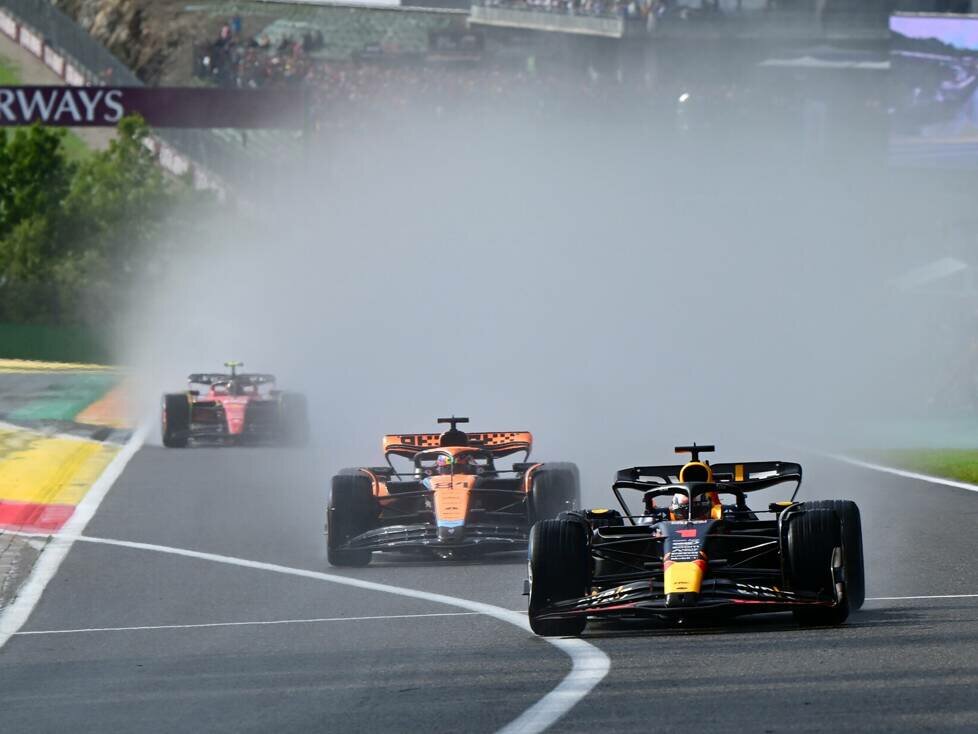
Tire manufacturer Pirelli wants to conduct an experiment with tire compounds in Belgium, but the weather could throw a spanner in the works
In northwestern Europe, the recent heatwave has given way to a low-pressure system bringing rain from the Atlantic. Heavy thunderstorms are expected in the UK, northern France, and Belgium over the next four days, with up to 50 millimeters of rainfall.
If conditions do not improve by Sunday, an experiment that Pirelli has been preparing since the beginning of May is in danger of failing. When the race was shaping up to be fairly predictable at the start of the season – with most teams opting for a one-stop strategy – the tire supplier looked for ways to introduce more uncertainty into the tactical decisions.
Since the compounds are homologated at the start of the season and cannot be changed, Pirelli had to get creative with the existing range. The decision: In Spa, the harder C1 will be used as the hard tire instead of the C2. The medium and soft compounds will remain the same as last year, C3 and C4.
“The teams always find a way to go for a one-stop strategy,” said Pirelli’s motorsport boss Mario Isola.
“It’s not about forcing them into a two-stop strategy just because it makes for more action, more unpredictability, and better races—but when the three compounds are so close together, they always try to use the hard and medium for one stop.”
The theory behind this is that With a bigger performance difference between Hard and Medium, a one-stop strategy should come with a noticeable time disadvantage. Teams usually go for just one pit stop to keep their track position and minimize the risk of mistakes during the stop.
Ideally, neighboring compounds should always have clear differences in durability and grip. However, track layouts, asphalt surfaces and, above all, changeable weather conditions have a significant impact on tire performance.
In addition, Pirelli was given a target for 2024 that required, among other things, that the tires be less sensitive to thermal wear so that drivers could push harder and longer.
Pirelli met this requirement, but this led to unintended consequences: even more races with only one stop. And because vehicle performance has also become more similar, overtaking has become increasingly difficult, resulting in procession races.
With the “leap” in tire selection—on a sprint weekend, of all times—Pirelli wanted to increase the variety of strategies. Spa, with its demanding high-speed layout, was considered the ideal venue. But the weather in the Ardennes is notoriously unpredictable.
If rain significantly affects the weekend, as it did in Miami, the race could still be exciting. But the actual experiment would have to be postponed. However, simply conducting the same test elsewhere is more complicated than many people think, because swapping one compound for another is not a trivial matter.
If the difference between the compounds is too big or too small, both will lead to the same result: the teams will agree on the same strategy. Belgium was considered the perfect test case, but if it doesn’t work here, Pirelli will run out of alternatives.