


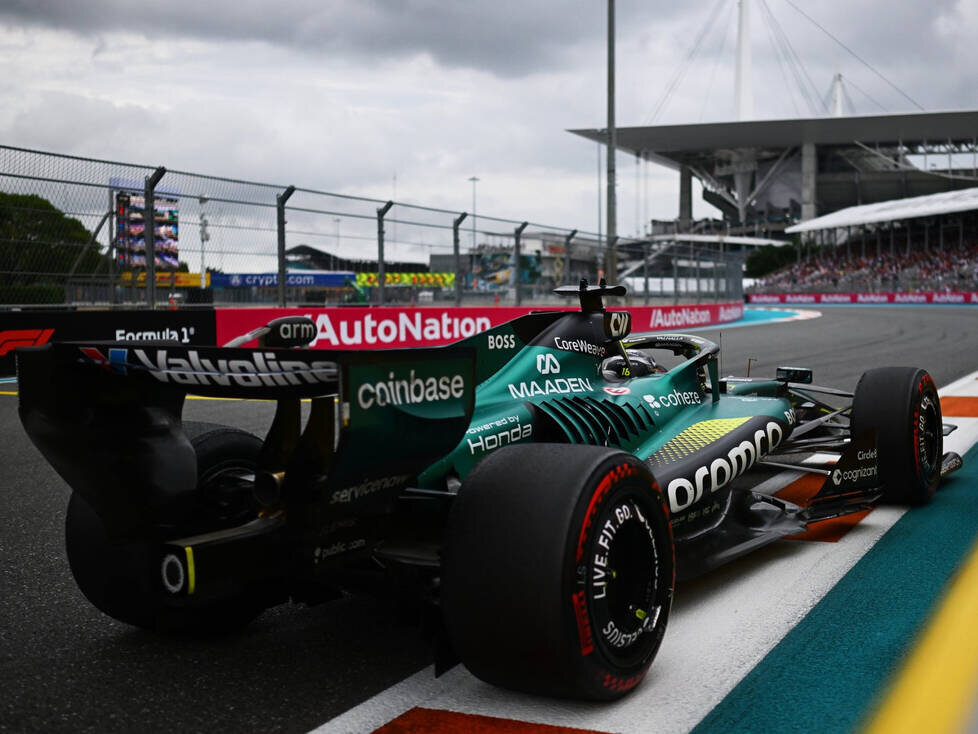
Honda receives additional support for the further development of its power unit: World Motor Sport Federation makes adjustments to the ADUO system
This is news that should bring some relief to Aston Martin and its engine partner Honda: The FIA has made significant adjustments to the so-called ADUO system (which stands for “Additional Design and Upgrade Opportunities”).
This mechanism is intended to prevent a manufacturer from remaining unsuccessful for years on end by allowing additional development leeway and exceptions to the budget cap during the current season.
A clear mechanism applies here: The greater a manufacturer’s deficit—specifically, the performance of the internal combustion engine (ICE) compared to a set reference value—the more extensive the concessions will be.
However, Honda’s deficit is currently so large that the FIA has now expanded the scale and added an additional tier to the regulations. New to the regulations is a category for manufacturers that lag behind by more than ten percent in ICE performance, whereas the previous limit had been eight percent.
The affected manufacturers—primarily Honda—are thus granted up to an additional eleven million dollars as well as up to 230 extra hours on the test bench. In addition, there is a supplementary allowance of eight million dollars exclusively for this year.
Aston Martin wants to rethink integration of the Honda engine
However, the Technical Regulations precisely define which components may be modified via the ADUO mechanism outside the usual homologation deadlines. And the system is not a sure thing: The catch-up effort must succeed under their own steam, which could still take some time in Honda’s case.
Especially since the engine is not currently the only area of concern at Aston Martin: In Miami, the transmission also caused problems. Furthermore, it appears that the integration of the power unit into the AMR26’s chassis still has room for optimization.
“The collaboration we’ve had over the past few weeks, and the time we had available for it, may have also allowed us to carry out one or two conceptual studies or reviews,” reveals Chief Race Engineer Mike Krack.
“And all of that will feed into the development of the car over the next few years,” the Luxembourger emphasizes, noting that the integration of the Honda powertrain will be re-evaluated for the future. “I think that was pretty good, and we’ve learned a lot in that regard.”
First ADUO period begins after Canada
Originally, the ADUO allocation was to be based on performance data at three fixed points in the season: after races six, twelve, and 18. Due to the cancellation of the races in Bahrain and Saudi Arabia, the FIA has adjusted this schedule: The first evaluation will take place after the fifth race of the season, namely the Canadian Grand Prix.
The subsequent evaluation dates are after the eleventh race in Hungary and the 18th Grand Prix in Mexico. However, the FIA intends to remain flexible: “These ADUO periods may be adjusted by the FIA in the event of significant changes to the race calendar,” it states.
“The proposed two-percent threshold, as well as the subsequent determination of the ICE performance index, will be reviewed and adjusted, respectively, following the completion of ongoing activities between power unit manufacturers and Formula 1 teams to measure ICE performance on the track.”