


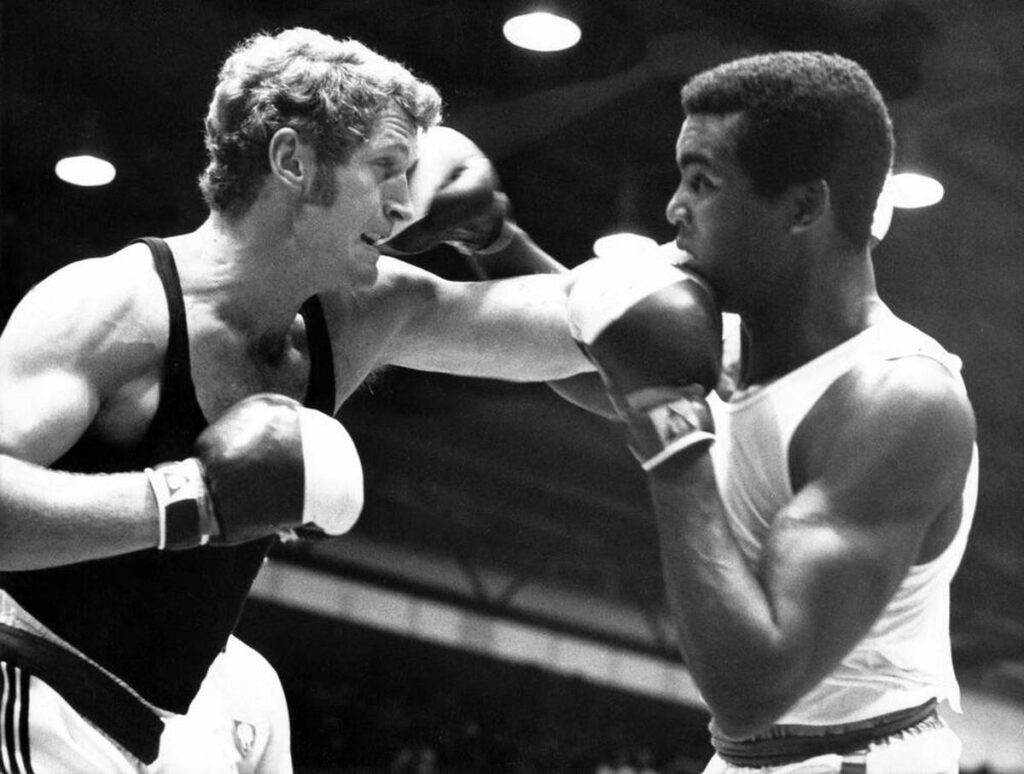
Teofilo Stevenson was a record-breaking champion with the potential to become as great as Muhammad Ali—yet the Cuban, who died 14 years ago today, sacrificed his professional career for communism.
Mourning filled the streets of Havana, and the international boxing world was in mourning.
On January 11, 2012—14 years ago today—Teofilo Stevenson, the great hero of the proud boxing nation of Cuba, died at the age of 60 from a heart attack.
The man who became the first heavyweight to win three consecutive Olympic gold medals was already a legend in his own lifetime. And he could have become an even greater one—had he not insisted on principles that seem unthinkable from today’s perspective.
Teofilo Stevenson refused to fight Muhammad Ali and others
“The best heavyweight boxer is Teofilo Stevenson. None of today’s champions would stand a chance against him,” claimed George Foreman, who passed away this year, during Stevenson’s heyday.
Muhammad Ali and Joe Frazier, both ten years his senior, wanted to shatter Stevenson’s special magic and lure him into the professional ranks with million-dollar purses, but Stevenson remained stubborn.
The amateur boxer followed the dictates of his communist president, Fidel Castro, like a loyal soldier and turned his back on money and glamour.
“What is a million dollars compared to eight million Cubans who love me,” said Stevenson, speaking from the heart of his head of state.
Under Cuban socialism, all people were to be equal; athletes were to be no exception. Instead of succumbing to the sweet temptations of the capitalist world abroad, Cuba’s fighters had to promote their country at the Olympics. Stevenson took this national mission to heart with full conviction.
A defining moment at the 1972 Olympics in Munich
His star rose immediately upon his first Olympic appearance in Munich in 1972: the boy from a humble background swept his first opponent out of the ring in 30 seconds. In the semifinals, he knocked out German champion Peter Hussing. When his opponent failed to show up for the final, Teofilo Francisco Stevenson Lawrence became an Olympic champion—at the age of 20.
“I’m totally shocked. He was such a fine person and couldn’t hurt a fly. He just boxed; that was his goal,” Hussing said after his defeat in Munich. “I’ve never been hit that hard before,” the “Bear of Brachbach” had admitted.
Boycott prevented fourth Olympic victory
In 1976 in Montreal and 1980 in Moscow, Stevenson also won gold—without much resistance.
The Cuban dominator became the first boxer in history, after Hungary’s Laszlo Papp (1948 to 1956), to win gold at three consecutive Olympic Games.
In 1984, he set his sights on a fourth triumph, but once again his head of state threw a wrench in his plans: Cuba boycotted the Games in Los Angeles after Western nations had stayed away from Moscow four years earlier due to Russia’s intervention in Afghanistan.
Perhaps it was for the best for the Stevenson legend: At the 1982 Amateur World Championships in Munich, he lost some of his luster, surprisingly being eliminated in the preliminary round by the Italian Francesco Damiani.
Discovered by a German
The lanky Stevenson, who always boxed with an upright stance—and was also a three-time world champion as an amateur—was regarded in his heyday as a stylist who, like Ali, could box with extraordinary speed for his weight class.
Stevenson, born on March 19, 1952, in Puerto Padre, was once discovered by a German: East German boxing coach Kurt Rosentritt provided development aid on the Caribbean island from 1964 to 1968; the father of Berlin sports journalist and Sebastian Deisler biographer Michael Rosentritt entrusted his discovery to the care of Cuban master trainer Alcides Sagarra, who molded Stevenson into a top-tier fighter.
In Cuba, Stevenson remained a national hero until the end. In 1976, he was elected to the National Assembly, followed by positions as director of the Cuban Sports Organization and vice president of the national boxing federation.
He was also part of Fidel Castro’s inner circle—who outlived his star boxer by four years.