


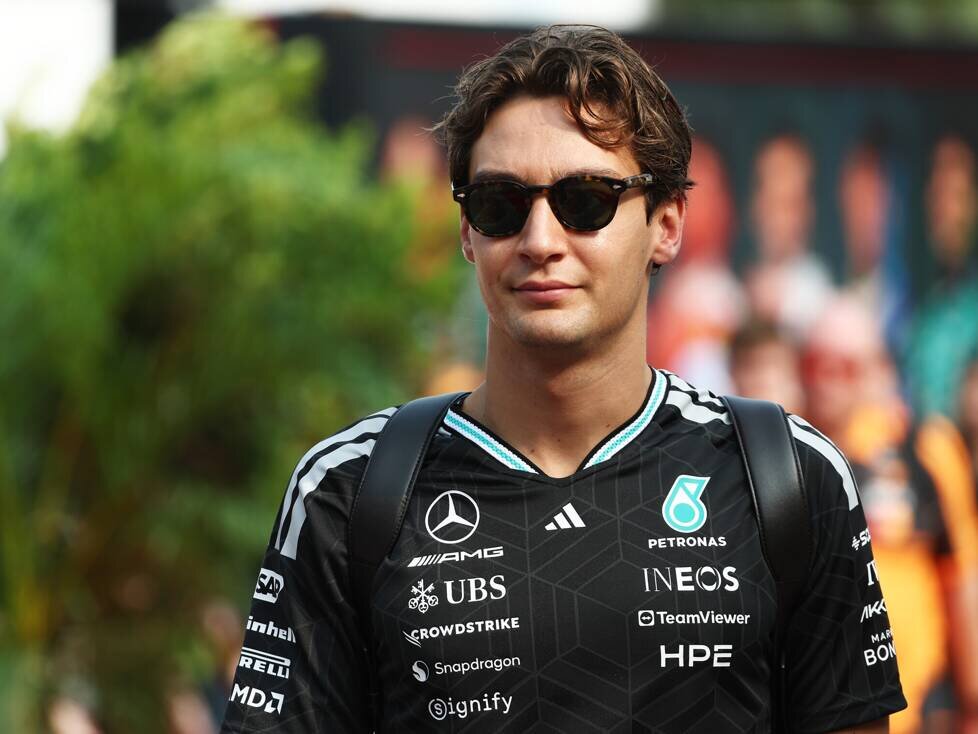
Formula 1 is expecting extreme heat in Malaysia – yet George Russell will still be racing without a cooling vest because Mercedes is allocating its resources elsewhere
George Russell faces a particular challenge at the Formula 1 race in Sepang: despite the extreme heat expected on Sunday, the Mercedes driver will compete without a cooling vest. His team-mate Kimi Antonelli will also be doing without one.
Mercedes has deliberately decided against further developing the drivers’ cooling systems in order to make better use of its available financial resources. This is because the development of the cooling system is counted towards the budget cap. At Mercedes, the priority has been placed on the car’s performance.
Russell calls for support from the FIA
Russell considers the current method of funding the development of cooling vests to be problematic. In his view, the cooling vest should, in principle, be available to all drivers and should not be subject to the budget cap. “We won’t be using the cooling vest because we haven’t allocated the resources to make it robust enough,” explains the Mercedes driver.
The Briton therefore believes the FIA must step in to facilitate a solution outside the teams’ normal development expenditure. “I think the FIA simply has to step in and say: ‘Here is additional funding within the budget cap’, or there could be an external company that develops them for everyone, and the money is simply made available for that. Because, really, we should all be wearing them,” said Russell.
The problem stems from the fact that it is not just the vest itself that is required. The teams also have to develop their own system to ensure the fluid circulating within it remains sufficiently cool. It is precisely this development that must be financed from their respective budgets.
60 degrees on the tarmac at Sepang
Just how great the strain might be on Sunday was already evident on Friday. The air temperature in Sepang was over 33 degrees Celsius, whilst the track temperature reached around 60 degrees. At the same time, humidity levels are high.
The FIA has therefore classified the Grand Prix in Sepang as a heat-stress race. For the drivers, this means they can, in principle, rely on the standardised cooling system. Anyone who chooses not to use it must carry an additional five kilograms of weight in their car to ensure a level playing field.
However, using the cooling vest does not only have advantages. If the cooling system does not function adequately, the fluid in the pipes heats up and thus has the opposite effect on the driver. It is therefore important to carefully weigh up exactly what risk one is willing to take on Sunday.
Russell knows the strain from his own experience
Russell knows the physical effects that high temperatures can have during a race. At the 2024 Singapore Grand Prix, the Mercedes driver lost four kilograms in body weight. After the race, he was hyperventilating in an ice bath; his body temperature had reached a dangerous 42 degrees Celsius during the race.
In Singapore, the Grand Prix is therefore held at night, which is intended to at least reduce the strain caused by the weather. In Malaysia, this option is not available: the race starts as early as 3 pm local time on Sunday.
Under these conditions, Russell would have liked to have used the cooling vest: “If it works, it works brilliantly. That’s why I’d like to wear one this week and next week too. But the team asked me … we can develop it and invest money in it, but then it comes at the expense of performance.”
Mercedes is trying a different solution
Both Mercedes drivers will have to manage without the cooling system at Sunday’s Grand Prix. Instead, Mercedes has tried to reduce cockpit temperatures by other means. According to Russell, openings leading to the car’s radiators have been sealed off.
Ferrari and McLaren have opted for a different approach. According to Russell, both teams will be using cooling vests at the Bahrain Grand Prix. It is currently unclear what Red Bull has decided. What is known, however, is that Max Verstappen generally finds the cooling vests uncomfortable.
After the drivers reported that the standard system only worked for a limited period and was also found to be uncomfortable, the FIA did indeed introduce a corresponding exemption from the budget cap from the 2026 season onwards.
Teams were granted the option to claim an exemption from the budget cap of US$50,000 if they succeeded in developing a cooling vest whose functionality could be demonstrated over the entire race distance. It did not matter whether the development was carried out in-house or in collaboration with clothing manufacturers.
In addition, teams were granted a further allowance of US$75,000 to improve the comfort and ergonomics of the system. Both allowances could be combined, meaning that teams had a total of up to US$125,000 available in addition to the budget cap for a custom-developed cooling vest. Several teams made use of this provision.