


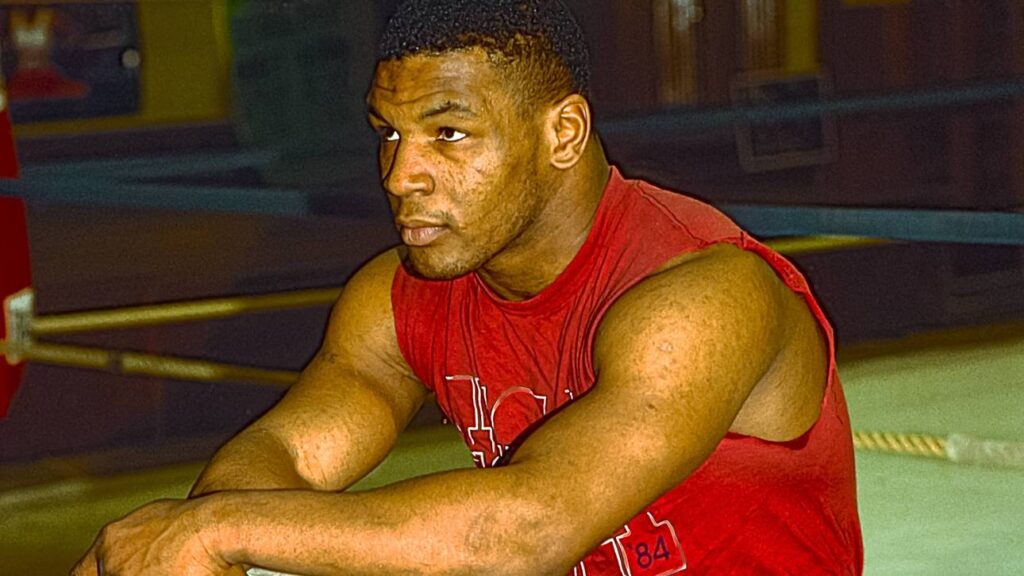
On 22 November 1986, the young Mike Tyson became world champion. Anyone who knows him only as a scandal-prone figure and a has-been boxer can only guess at what his legend was truly based on back then.
Trevor Berbick got to his feet – and fell backwards into the ropes again. His second attempt to get up also failed. And whilst Berbick, struggling to get back on his feet, was being counted out by the referee, the boxing star of a 20-year-old was rising in the other corner of the ring: Mike Tyson.
On that 22nd November 1986, 40 years ago today, Tyson was set to be crowned the youngest heavyweight world champion in history in the fight dubbed ‘Judgment Day’ – it heralded the birth of a legend.
At the Las Vegas Hilton Hotel and Casino in Winchester, Nevada – then the world’s largest hotel – a boxing tournament was set to crown the first undisputed champion since Leon Spinks in 1978. Tyson was 20 years old at the time, with twelve years less experience than his Jamaican opponent.
Impressive statistics
Kid Dynamite, as Tyson was later dubbed, was by no means considered an underdog. His record ahead of the fight was impressive: Tyson had a perfect record at the time; in his still-young career, the gifted fighter had won all 27 of his fights, 25 of them by knockout.
Impressive. For the 32-year-old WBC champion, on the other hand, it was a matter of defending his title; after Berbick had knocked Pinklon Thomas out of the tournament in the first round, he now had to put the rebellious youngster in his place.
Technical knockout: Tyson steamrolls Berbick
But Tyson had a different plan, and it was set to be a formidable one. ‘Wait and see’ was a foreign concept; from the very start, the young American dominated his utterly outclassed opponent. Attack after attack rained down on Berbick, who looked almost amateurish.
Symbolic of the demolition: towards the end of the first round, Tyson unleashed an unbelievable four-punch combination that sent the Jamaican 100-kilo colossus flying across the ring as if he were a feather.
A pattern that was to continue throughout the second round. Offensive efforts from the champion? None whatsoever. One combination after another rained down on Berbick, an inhuman force to which he had to concede defeat after 2 minutes and 35 seconds into the second round. A technical knockout followed.
The WBC champion lay on the canvas. Towering majestically above him, admired by the crowd, stood the new heavyweight champion. Rarely has a titleholder been so humiliated.
The starting gun: what follows is historic!
For Tyson, however, the evening was to mean more than just his first title as world heavyweight champion. It was to mark the beginning of a career that is unrivalled. The New York native was the first world champion to be recognised simultaneously by the three boxing organisations: the WBC, the WBA and the IBF.
The Tyson legend was by no means without its cracks: in sporting terms, the sensational defeat to Buster Douglas was the first crack; this was followed in 1992 by a profound personal downfall when he was convicted of the rape of beauty pageant contestant Desiree Washington and served three years in prison.
After his comeback, he did indeed rise to the rank of world champion once more. However, he never again reached the heights of his earlier career – the legendary ear-biting incident in the fight against Evander Holyfield cemented his image as a scandal-prone attraction.
Only those who have experienced him solely through scandalous headlines, film and TV cameos, or as a veteran prizefighter taking on Jake Paul can dimly imagine what a groundbreaking phenomenon the force of nature that was Tyson was in his younger years from a sporting perspective.