


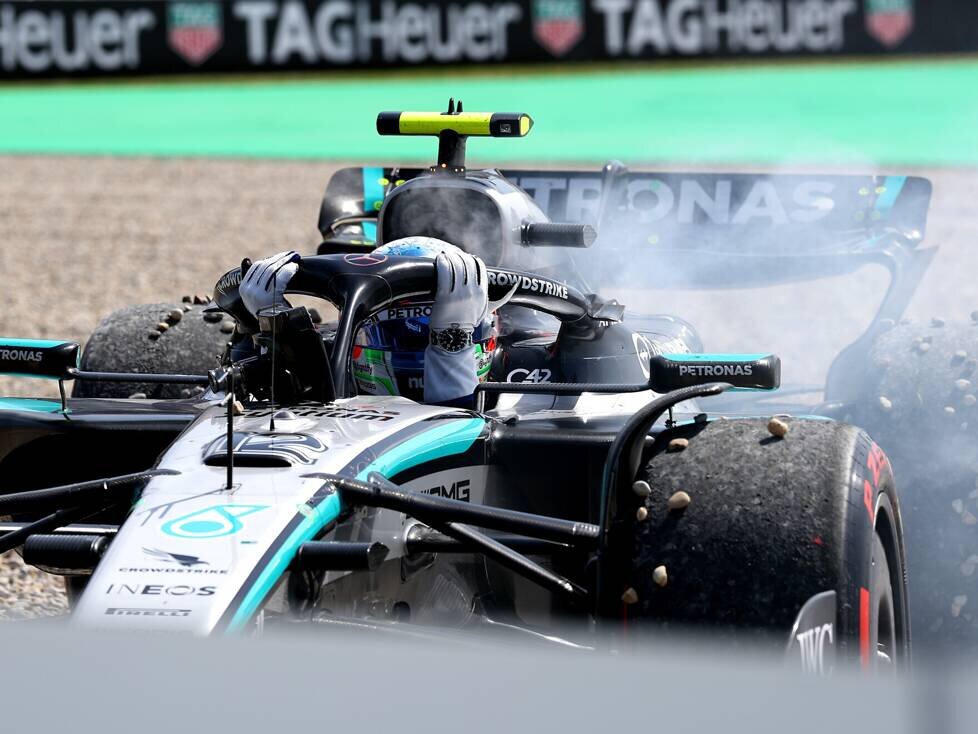
Without gearbox restrictions, the number of penalties for parts changes dropped significantly: However, not a single driver was actually moved back in the grid.
Last year, with the current Formula 1 engines, the teams seemed to have their engines reasonably well under control, as the number of penalty demotions fell significantly compared to the previous year.
During the 2025 Formula 1 season, drivers were penalized 14 times for exceeding the engine quota – in 2024, there were 20 offenses recorded, with the same number of races.
Incidentally, “penalty” is perhaps the wrong word here. Not once did a driver actually have to start a few places further back in the field. All drivers who had new engine parts installed in their cars started from the pit lane.
This is because the teams usually took the opportunity, when they were already far back in qualifying, to use new parts and change the setup. Such a change after qualifying always results in a start from the pit lane.
One reason for the lower number of penalties was the elimination of gearbox restrictions. In previous years, teams had to economize with their gearboxes—first over a certain number of races, then, as with engine components, over a certain quota per season. In 2025, this restriction no longer existed because the reliability of the current designs made a regulation “obsolete,” as the association announced before the season.
In 2024, the gearbox, which was divided into internal and external elements, had still resulted in four penalties – but even without these, there was a slight decline in violations.
Red Bull as the biggest offender
The biggest “offender” among the teams was Red Bull: Max Verstappen had his entire range replaced in Brazil, but still managed to drive from the pits to the podium. His teammate Yuki Tsunoda even had to start from the pits three times due to new engine parts: in Imola, Budapest, and Las Vegas.
This makes the Japanese driver the unluckiest among the drivers—otherwise, only Pierre Gasly (Alpine) had to be taken off the grid more than once with new engine parts: in Montreal and Monza.
Meanwhile, three teams made it through the entire season with their available quota: McLaren kept a clean slate for the third time in a row, and Sauber and Williams also avoided penalties.
The most common cause of exceeding the limit was the internal combustion engine (ICE), which was used beyond the limit twelve times. In most cases, the teams replaced the entire package consisting of the engine, turbocharger, MGU-H, and MGU-K—only in the case of Esteban Ocon (Haas) in Sao Paulo was the engine the sole reason for the penalty. Only one driver (Tsunoda) exceeded the permitted limit of eight for the exhaust.
Changes for 2026
There will be a number of changes for the 2026 season due to the new powertrains: there will be new quotas and some new components will also be introduced. Only the restriction for batteries and control electronics will remain the same as this year – at two.
In the future, only three elements may be used for the engine and turbocharger instead of the previous four, and the quota for the MGU-K will even be reduced from four to two. Instead of the previous eight exhaust systems, only three may be used in 2026. In addition, there will be so-called ancillary components, which are specified as five per season.
However, in 2026, each driver will be allowed to use one additional element per engine part, and in later seasons this will only apply to manufacturers competing in their first Formula 1 season.