


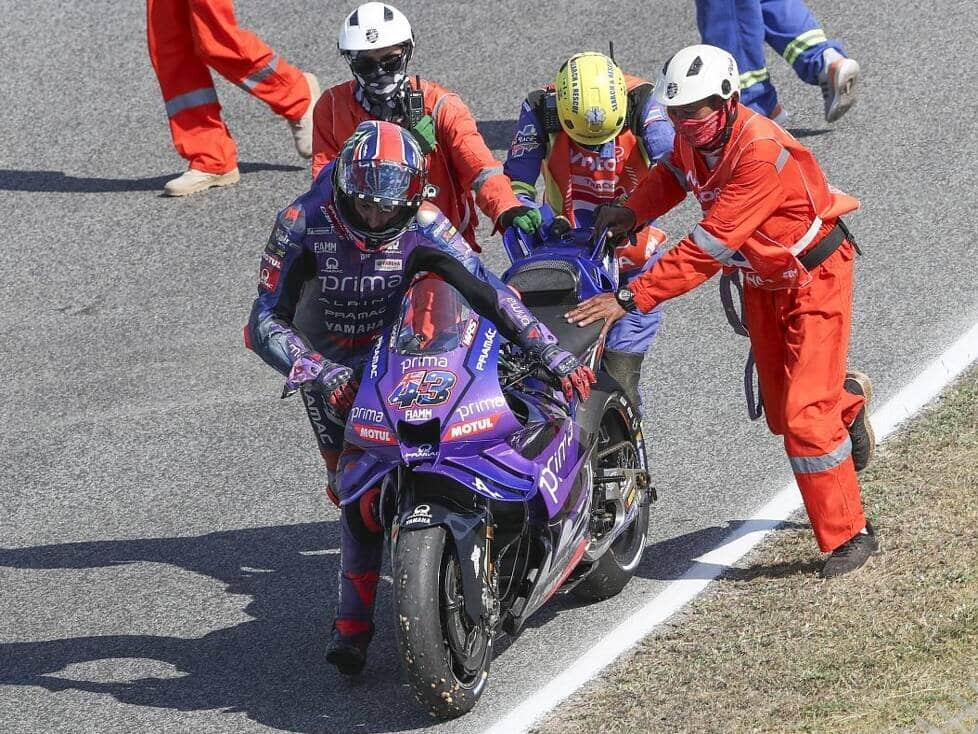
From 2026, the FIM will take decisive action in the event of crashes: Restarts in the run-off area will no longer be permitted in MotoGP or the Superbike World Championship – What this means
The FIM has decided on an important rule change for the 2026 season that affects both MotoGP and the Superbike World Championship (WSBK). In future, riders will no longer be allowed to restart their motorcycles directly at the edge of the track or in the run-off area after a crash.
Until now, riders have been able to try to restart a motorcycle that has stalled after a crash in the gravel trap or run-off area and then continue riding. However, the FIM considers this procedure to be a safety risk, as it requires riders and marshals to remain in the middle of an ongoing session.
From 2026, the following will apply: If the engine stalls after a crash, the motorcycle must be moved by the marshals behind the first protective barrier, usually onto the service road. Only there may the restart take place, with the assistance of the marshals if necessary. Restarts on the track or in the run-off area are prohibited.
Continuing to ride remains permitted in principle
Despite the stricter rules, riders will still be able to rejoin the race after a crash. In MotoGP, they can return to the track after the restart and continue the session or race.
Special rules apply in WSBK: in practice and Superpole sessions, riders may return to the pits after a crash, but may not start a new timed lap.
In the race, however, it is still possible to continue immediately.
If the motorcycle has not stalled after the crash, the rider may continue immediately as before. However, the marshals are entitled to briefly inspect the bike. If they find any safety-related damage, such as loose fairing parts or fluid loss, they can stop the rider or inform the race director.
The goal: greater protection for marshals
The rule change is primarily intended to protect the marshals. The immediate clearing of run-off areas is intended to reduce dangerous situations on the active track. The association acknowledges that the new procedure may initially pose challenges, but safety is the top priority.
The new regulation applies to all FIM-sanctioned circuit championships, including the Endurance World Championship (EWC). National federations are also expressly encouraged to adopt this protocol.