


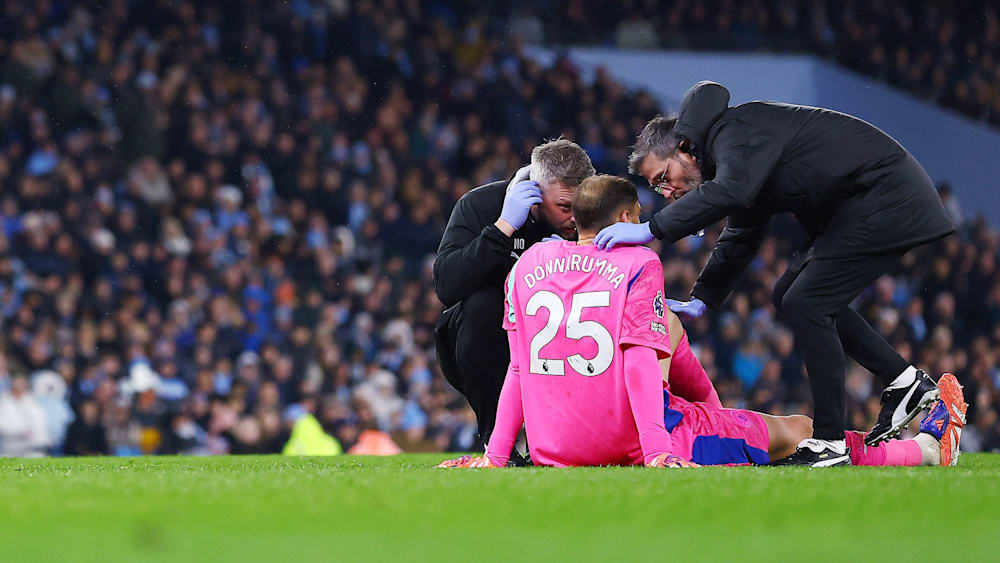
English soccer wants to put an end to “tactical timeouts” caused by goalkeepers feigning injury. Five associations and leagues have agreed on a pilot program, which still needs to be approved by the International Football Association Board (IFAB). The first trial is set to begin as early as Saturday.
In the future, if a goalkeeper in England needs medical attention and the referee signals for medical staff to enter the field, the coach will have ten seconds to name a field player who must leave the field for one minute. If the coach does not designate a player to the fourth official, the captain must leave the field. This is the pilot program agreed upon by the Football Association, the Premier League, the English Football League, the National League, and the Women’s Super League, as reported by the BBC. Approval from the International Football Association Board (IFAB) is still pending.
Pro Ref, the English referees’ organization led by chief referee Howard Webb, developed the rule in consultation with the leagues. The logic behind it follows the existing rules for field players: They, too, must leave the field for one minute when the physio comes to them. This rule was already applied at the last World Cup in the U.S., Canada, and Mexico.
Several exceptions apply
The pilot program provides for several exceptions in which no teammate is required to leave the field: if the goalkeeper does not request a physical therapist and has not interrupted play; if the goalkeeper and a field player have collided; if the goalkeeper has been fouled and requires immediate treatment; if the goalkeeper is bleeding; if there is a serious injury requiring a substitution; or if a concussion is suspected.
At the IFAB’s annual meeting in February, Chief Referee Pierluigi Collina had declared combating the so-called “goalkeeper timeout” a priority. However, the IFAB itself decided against an immediate rule change and instead invited leagues to conduct their own pilot programs. At the 2026 World Cup, Collina had instructed his referees to generally prohibit players from entering the coaching zone during stoppages in play. English soccer deemed this measure alone to be insufficient.
Farke: “Our hands are tied”
The practice that is to be banned in the future has been observed with increasing frequency in recent seasons. November 29, 2025, is particularly memorable: In the 57th minute of the Premier League match between Manchester City and Leeds United, goalkeeper Gianluigi Donnarumma went down, received treatment, and allowed coach Pep Guardiola to regroup his team in front of the bench. Leeds had previously come back from a 0–2 halftime deficit and put City in a tight spot. “Everyone knows why he went down,” said Leeds’ German coach Daniel Farke afterward. “That’s not the elephant in the room—it was obvious.”
Although the move was within the rules and “clever,” as Farke put it at the time, “but is it in the spirit of fair play? I have my doubts. It’s up to those in charge to find a solution. I asked the fourth official at the time if he wanted to do something about it”—to no avail. “Our hands are tied.” Even match-winner Phil Foden, who scored City’s 3–2 winner in stoppage time, didn’t downplay the incident when speaking to the BBC at the time: “That little pause was decisive.”
If the IFAB grants approval in time, the new rule is set to be tested for the first time as early as this coming Saturday during the first-round League Cup match between Tranmere Rovers and AFC Rochdale. According to the BBC, the Australian A-League is also planning a modified version in which the captain must always leave the field—regardless of the coach’s decision. The IFAB is set to evaluate the results of the pilot tests over the course of the season.