


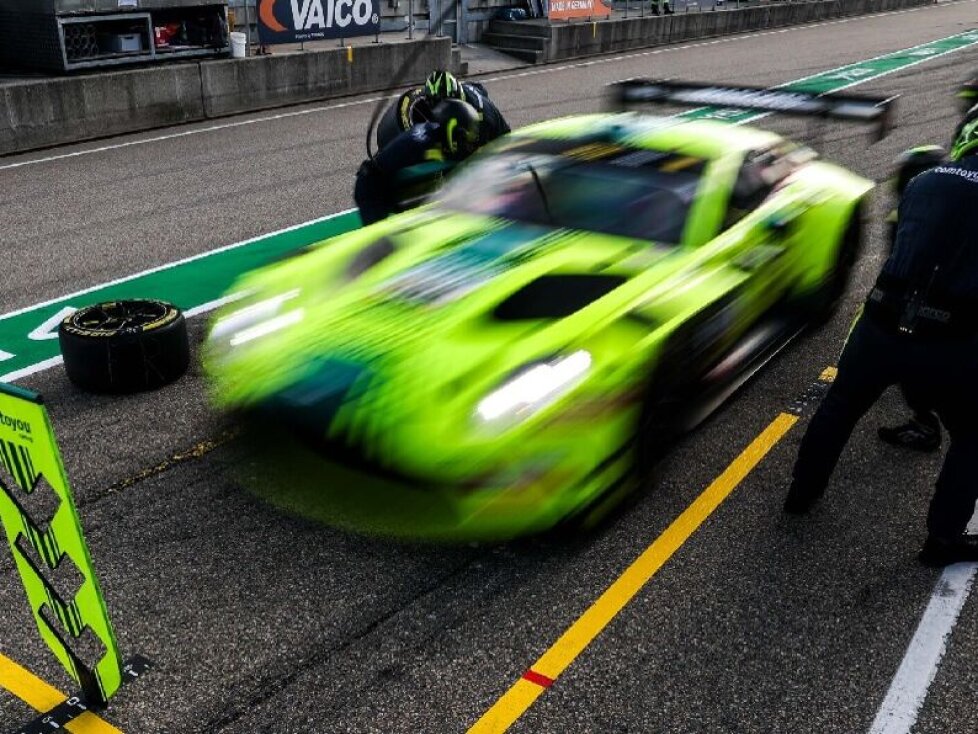
BMW Team Schubert set a new pit stop record at the Sachsenring – but it lasted just four minutes: how the newest DTM team pulled off this sensation
It was a race of pit stop records in the DTM: first, BMW Team Schubert took the lead on Saturday at the Sachsenring, completing Kelvin van der Linde’s pit stop in 5.583 seconds. In doing so, the team from Oschersleben broke the previous Winward record set the year before, when the Mercedes-AMG team changed all four tyres on Jules Gounon’s car in 5.652 seconds.
Four minutes later, the Comtoyou crew went one better – completing the change for Aston Martin driver Nicolas Baert in 5.510 seconds. “We really thought we’d set the absolute fastest time, but then Comtoyou came along – and were marginally quicker,” said team boss Torsten Schubert, referring to the 73 thousandths that ultimately made the difference.
Never before has a pit stop for a GT3 car been that fast – and, since the switch to the GT3 regulations in 2021, no DTM crew has managed it either. And that’s despite the fact that, in the first year, six crew members were allowed to pitch in instead of four. Back then, however, hardly any crew was faster than seven seconds.
How the Aston Martin rookies set the benchmark for pit stops
“These days, a pit stop taking 6.9 seconds puts you in 13th place,” says Comtoyou DTM team principal Mario Schuhbauer, highlighting just how much the standard in the DTM has improved since 2021. In the last eight races, the Aston Martin team – which certainly doesn’t have the biggest budget on the grid – has clocked the fastest pit stop five times.
But how did the Belgians, who have only been competing in the DTM since 2025, manage to make the leap to the top? “We trained intensively over the winter, but after Zandvoort we readjusted our system and positions,” reveals Schuhbauer. “Things have been going even better since then.”
Pit Stop Challenge as motivation: “They want this trophy”
A huge source of motivation for the mechanics is the DTM’s Pit Stop Challenge, introduced in 2023, in which the “underdogs” are now just one point behind the Emil Frey team. “Victory means so much to the lads,” says Schuhbauer. “Then, at the grand awards ceremony – when the DTM champion is also crowned – you’re called onto the stage as the pit crew. They want that trophy.”
To achieve this, they’re working up a sweat even after work – in their spare time. “Today they’re all training together again in the gym,” says Comtoyou’s DTM manager upon returning from the Sachsenring. “Not because someone tells them they have to, but because they want to be fit given the extremely high standard. It’s become a sport – and that really fascinates me, because I don’t think that’s the case for everyone.”
A Frenchman as a key figure: every video is analysed together
A key figure is the Frenchman Pierre Planat, who is himself part of the crew as a tyre changer – the person who removes and fits the tyres – and who sets the direction. He has ensured that every position is double-staffed so that the crew is prepared for any absences. Even on race days, he often spends a long time sitting in front of his laptop, analysing every pit stop using a special programme.
“Every pit stop is recorded,” says Schuhbauer. “When we’re training, everyone sits down afterwards and orders something to eat. And then every video isn’t just watched, but meticulously analysed – with times and reference points. We sometimes superimpose videos on top of one another: what was done differently? What were the walking routes like? That’s one of the biggest factors.”
Group photo with the Schubert crew
It was also Planat who came up with the idea of taking a group photo with the Schubert crew on the day the pit stop records were set. Because he knew: it might not happen again any time soon that two pit stops would be completed in just 5.5 seconds on the same day.
“The lads should just take their time,” says team principal Torsten Schubert, explaining his team’s approach – a team renowned for its strong pit stops for years. “I always say: it doesn’t have to be 5.5 seconds. It works out sometimes when everything goes perfectly.”
It’s much more important, he says, that no mistakes are made and that they always stay under seven seconds. “That’s solid – and thank God, so far this year, not a single pit stop has gone wrong,” says the 63-year-old, not without pride.