


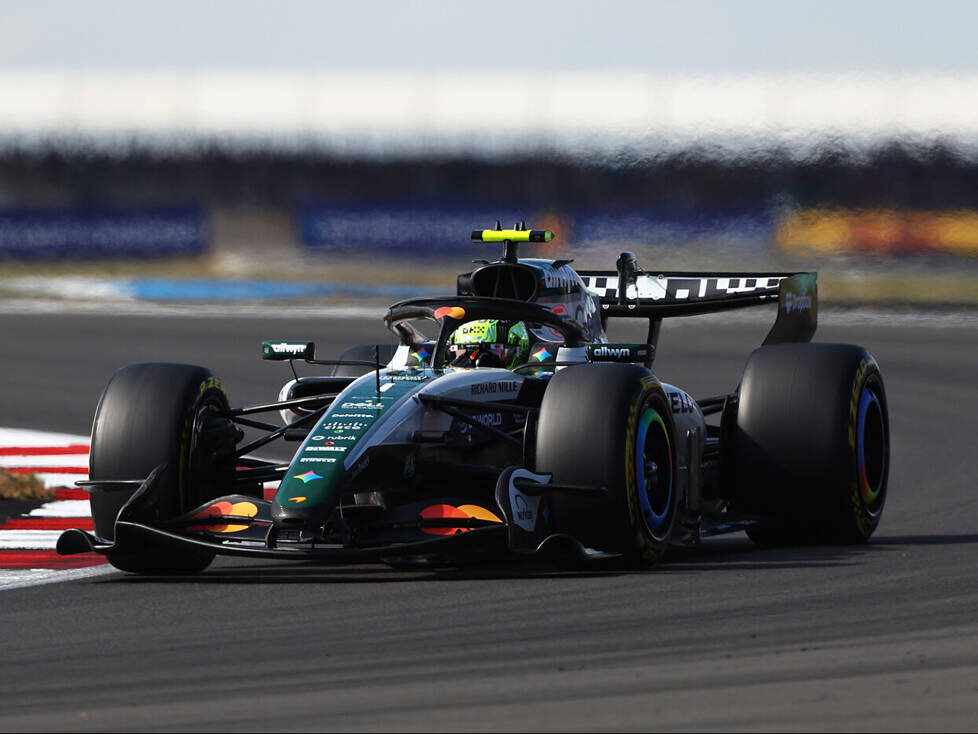
Although Mercedes introduced a new power unit specification in Austria, McLaren is racing at Silverstone without this upgrade
While Audi and Ferrari introduced their first ADUO upgrades of the year in Barcelona and Spielberg, respectively, Mercedes also debuted a new specification of its power unit in Austria.
However, Mercedes’ update was not an ADUO step but rather a reliability upgrade, following numerous technical failures throughout the season. The premature end to the race for championship leader Kimi Antonelli in Barcelona would be the most recent example.
Most Mercedes customer teams have the new power unit in the rear this weekend. Ahead of the first free practice session at Silverstone, Alpine drivers Pierre Gasly and Franco Colapinto switched to new components. These include new parts for the internal combustion engine as well as the turbocharger.
Carlos Sainz will also start the race with a completely new power unit following his problems in Austria. His Williams teammate Alexander Albon, on the other hand, is still using the same engine as in Spielberg.
This means that McLaren is the only Mercedes customer team that will not be starting the British Grand Prix with the new power unit for either of its two drivers. Zak Brown confirmed this at the official FIA press conference.
“Of course we’d like [the upgrade]. That’s always the case when you know there’s more power waiting for you, but you don’t have it in your car yet. You want to get it as soon as possible.”
“But I wouldn’t describe it as frustrating. It is simply the way it is. We’ll just keep going and push. [The upgrade] will be in the rear [of our cars] in the not-too-distant future.”
This inevitability brings back memories of the start of the season. McLaren explained at the time that they would be experiencing the disadvantages of being a customer team for the first time, especially when considering data transfer or the learning curve compared to the Mercedes works team.
This situation, however, is completely different. Brown has made it clear that this is about the remaining life of the existing engines and that McLaren has not yet reached the point where they need to change them.
“You have to rotate your engines, and we still have a little life left in ours, so we’re holding off on a change for now.”
“Williams got [the upgrade] because Carlos had his issue, so he had to change the engine. I don’t remember exactly how it works with Alpine, but I think they’ve gotten it twice as well. So it’s a matter of timing.”
Looking at the mileage so far in the 2026 Formula 1 season, Alpine has logged the most miles of any Mercedes customer team—by a significant margin. This is partly due to how many retirements McLaren has had so far. Williams is further down on that list, which also explains why Albon hasn’t switched to the new specification yet.
If McLaren racks up significant race kilometers at Silverstone, Brown expects Lando Norris and Oscar Piastri to switch to the new specification before the race weekend in Belgium.
“You want to do it as soon as possible, but you have to switch between the different engines. Of course, you can swap out some parts, but we’ll have [the new specification] soon—hopefully for the next race.”
Spa-Francorchamps is one of the most demanding tracks on the calendar when it comes to energy consumption. As a result, switching engines before the Belgian Grand Prix makes perfect sense.
Mercedes team principal Toto Wolff already explained in Austria that installing a new power unit brings a small performance boost. After all, a few PS are always lost over the course of an engine’s life cycle.
Aside from the power unit’s specifications, McLaren team principal Andrea Stella emphasized that 30 percent of the time lost to Mercedes occurs on the straights. McLaren is currently investigating this difference, though Stella openly admits that it is primarily due to the car’s aerodynamic drag.