


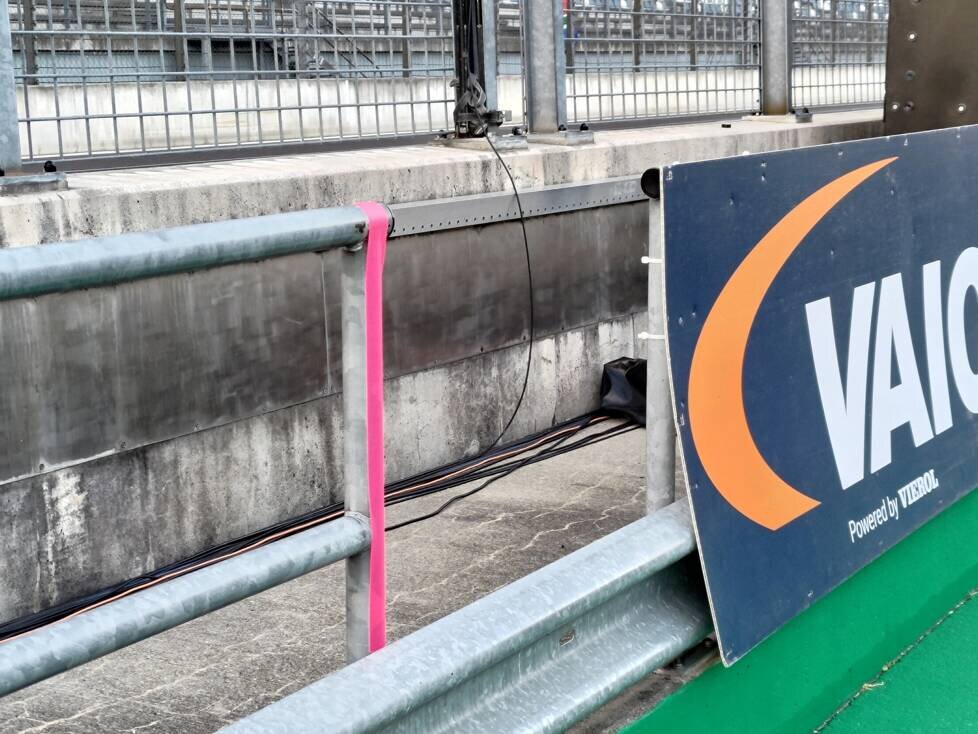
Inconspicuous strips of duct tape on the pit wall help DTM teams avoid unsafe releases: How the ingenious system works
The DTM has mandated a greater distance between pit stop stations at the Norisring to prevent unsafe release incidents and collisions in the pit lane. But the teams themselves have also found ways to guard against unsafe releases—namely, with clever markings.
Already at the Lausitzring, numerous reflective strip stickers caught the eye; they were affixed to the edge of the pit lane where they were clearly visible to the mechanics—in the upper section for the DTM teams, and in the lower section for the ADAC GT Masters teams. But how does the system work in detail?
“The lollipop man sets reference points,” explains Steve Buschmann, team manager for the Mercedes-AMG Team Winward. “These are the stickers—the tapes—attached to the pit wall.”
Team Determines Unsafe Release Corridor
According to Buschmann, the location where the two markings are placed is precisely calculated. “We define a corridor within which the lollipop must be positioned,” the team manager continues. “Within this corridor, a normal release guarantees that we’ll drive into that car as we exit—and that’s the corridor we mark.”
This means: If an approaching competitor’s car is located between the first and second markings in the pit lane, releasing one’s own car would, according to Winward’s calculations, guarantee an unsafe release—in accordance with DTM criteria.
This is because the racing series is the only one in the world where the Fast Lane does not have the right of way if a car is fully ahead when crossing the white line between the Working Lane and the Fast Lane while pulling away after a pit stop.
Why the Lollipop Doesn’t Indicate When the Driver Should Start Moving
And there’s something else that’s important: The so-called Car Controller, with his lollipop, is solely responsible for indicating to the driver when starting to move would constitute an unsafe release. “That’s why we also call him the Traffic Manager,” says Buschmann.
So the lollipop is only down when another vehicle is in the unsafe release corridor. And it’s not intended to signal to the driver when to pull away, because the driver sees his pit crew and, thanks to the car dropping as the pneumatic pistons release it, can feel anyway when the stop is over and he can hit the gas.
“That’s the big advantage of our system”
But how does the Winward team calculate the two points for the corridor? “You can calculate that relatively easily by using the drivers’ average reaction time, since every release is different,” explains Buschmann. However, there are also teams that push the limits in this regard.
“You could take it to the extreme by calculating it down to the exact ‘unsafe release’ point when the car crosses the line. That means you keep the lollipop up at all times, except for that brief moment when the overlap occurs and the car crosses that line. Some teams do that. We, however, prefer to play it safe.”
This also prevents two cars from driving side-by-side in the pit lane. “That’s the big advantage of our system,” says Buschmann, not without pride. However, even the Mercedes-AMG team cannot completely rule out unsafe releases.
“As I said, these are average values,” he says. “If the car stalls and the driver misses the moment—or the clutch doesn’t work, or whatever—then it’s all for nothing.”