


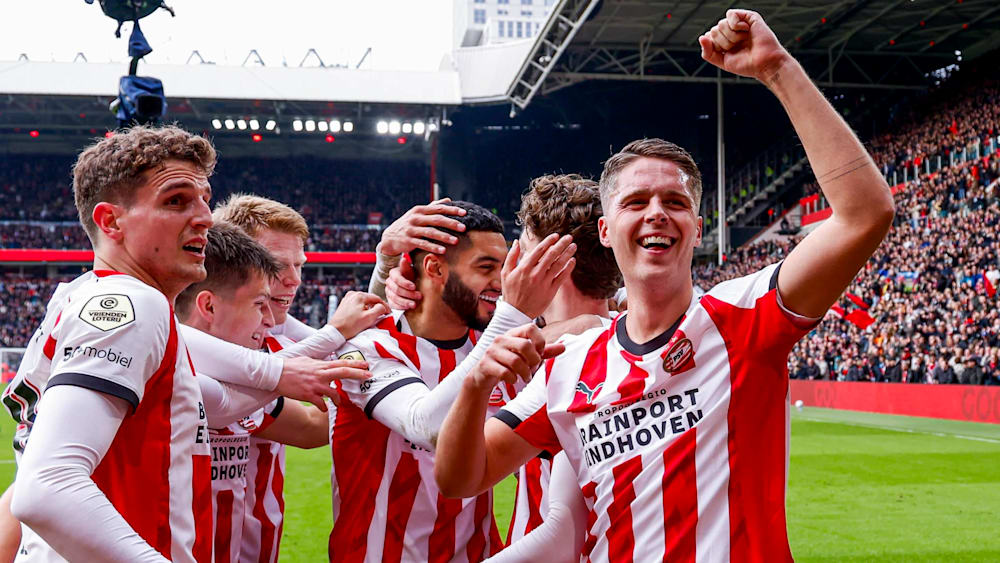
PSV Eindhoven defended their Eredivisie title at the beginning of April. In addition to their dominance, Peter Bosz’s team also benefited from the desolate performances of the other two big clubs, one of which is heading for a historic low.
The designers of PSV Eindhoven’s championship shirts had to start thinking about the design of that top early on this season. By February 1 at the latest – after the 3-0 win in the top match against Feyenoord – it must have been clear to them that the players would be wearing them. The only unanswered question was when they would put it on for the first time. The designers got the answer on Sunday. As rivals Rotterdam were held to a goalless draw in Volendam on matchday 29, the Red & Whites celebrated their third championship title in a row on the couch after beating Utrecht 4-3 at the beginning of April.
No Dutch team had ever clinched the championship so early: PSV beat their own record, which dates back to April 8, 1978. Former Bundesliga coach Peter Bosz’s side may be the earliest winners in terms of time, but not in terms of the remaining games. Due to two consecutive defeats against Nijmegen (2:3) and at promoted Telstar (1:3) before the international break, Alkmaar’s record from 1981 still stands. At the time, AZ had secured the title with seven matchdays to go.
PSV convincing despite a personnel bloodletting last summer
The fact that PSV are now early champions was not necessarily foreseeable before the season. This is because Bosz had to cope with a personnel bloodletting. Captain Luuk de Jong, Malik Tillman, Noa Lang, Johan Bakayoko and defender Olivier Boscagli were among those to leave the club. However, there was little sign of the upheaval on the pitch: together with PSV managing director Marcel Brands, Bosz built a squad that simply fit together well right from the start.
The showpiece was a quartet that had already played a major part in the last two championships. Ten-man Ismael Saibari, conductor Joey Veerman, captain Jerdy Schouten and the tireless Guus Til implemented Bosz’s impressive ball almost to perfection. No wonder Til and Saibari lead the internal scoring charts with 13 and 14 goals respectively.
In February, the duo also scored within four minutes against Feyenoord to make it 3-0 in the 17th minute – a demonstration of power that is emblematic of the season. While PSV delivered consistently, their closest rivals Rotterdam and Ajax were completely disappointing. Feyenoord, who are in 2nd place, are below the points average of the worst runners-up in Eredivisie history. On average, Robin van Persie’s team have scored just 1.86 points per game so far, 0.05 fewer than Willem II in the entire 1998/99 season. Ultimately, the Rotterdam side need eleven points from their remaining five games to avoid undercutting their negative record.
Feyenoord not a team for top games – Ajax share the points too often
Based on the performances on show, however, the fans should be pleased: Feyenoord lacked balance in their first full season under van Persie, which was particularly evident in the top games. The “Club aan de Maas” have collected just three points from their eight encounters with the current top six due to their defensive vulnerability. That is clearly not enough!
Ajax also proved to be very vulnerable in the first phase of the season under the then new coach John Heitinga. The predicted return to the Ajax DNA failed to materialize; instead, things went downhill again under Francesco Farioli after the rebuild in the previous season. The change of coach to Fred Grim and Oscar Garcia did not prevent the regression. Although they stabilized Amsterdam somewhat, they hardly won any matches. As a result, Ajax won just twelve of their first 29 league games (twelve draws) – only in 1964/65 were there fewer. Although the gap to second place is “only” six points, the designers in Amsterdam are currently a long way from developing a championship shirt.